
INTRODUCTION
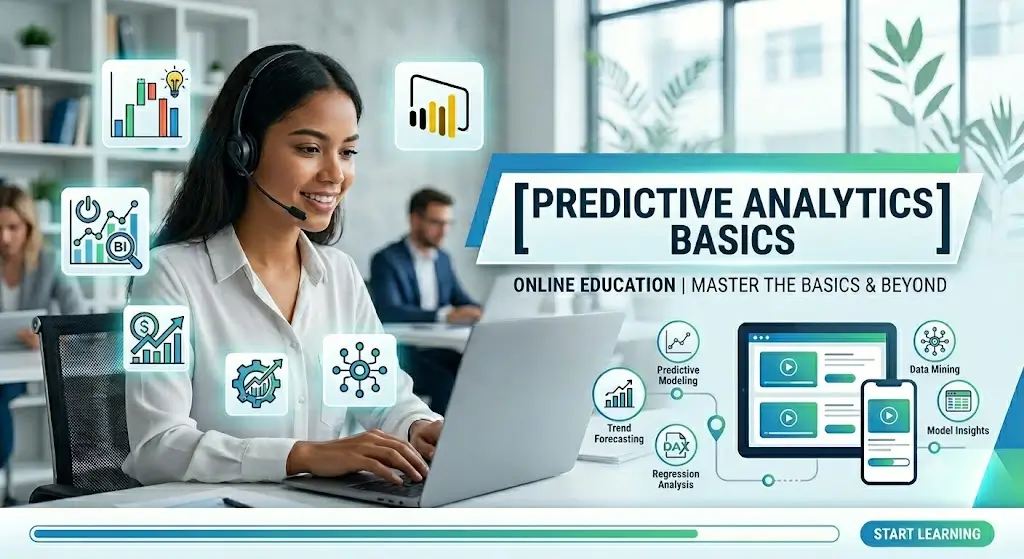
The Predictive Analytics Basics Course is a comprehensive beginner-level program designed to help learners understand how organizations use data to predict future events, trends, and outcomes. In today’s digital economy, data has become one of the most valuable assets for businesses, governments, healthcare institutions, and research organizations. However, collecting data alone is not enough. The real value comes from transforming data into actionable insights that support better decisions.
Predictive analytics combines statistics, data analysis, machine learning, and forecasting techniques to identify patterns in historical data and estimate future possibilities. Consequently, organizations can proactively respond to challenges and opportunities rather than simply reacting after events occur.
Moreover, predictive analytics is widely used in finance, healthcare, retail, marketing, logistics, manufacturing, telecommunications, and many other industries. Therefore, professionals with analytics knowledge are increasingly in demand across the global job market.
This course provides a strong foundation in predictive analytics concepts while remaining beginner-friendly and practical.
WHAT IS PREDICTIVE ANALYTICS?
Predictive analytics is the practice of using historical and current data to forecast future events.
Unlike descriptive analytics, which explains what happened in the past, predictive analytics focuses on what is likely to happen next.
Additionally, predictive analytics helps organizations identify trends, patterns, and opportunities before they occur.
Because of this capability, businesses can make more strategic and informed decisions.
IMPORTANCE OF PREDICTIVE ANALYTICS
Modern organizations generate large amounts of data every day.
However, raw information has limited value without proper analysis.
Predictive analytics helps transform data into actionable insights.
Moreover, it allows companies to reduce uncertainty and improve planning.
As a result, organizations can improve efficiency, increase profitability, and gain a competitive advantage.
EVOLUTION OF DATA ANALYTICS
Data analytics has evolved significantly over the past few decades.
Initially, organizations focused on descriptive reports and historical summaries.
Later, diagnostic analytics helped explain why events occurred.
Today, predictive analytics enables forecasting and future planning.
Furthermore, advances in artificial intelligence have expanded predictive capabilities even further.
DATA AS THE FOUNDATION OF PREDICTION
Every predictive model depends on quality data.
Therefore, data collection and preparation are essential steps.
Organizations gather information from:
- Customer interactions
- Sales records
- Business transactions
- Online behavior
- Social media activity
- Operational systems
- Market research
High-quality data improves prediction accuracy and reliability.
DATA COLLECTION METHODS
Data can be collected from various sources.
Primary data comes directly from surveys, interviews, observations, and experiments.
Secondary data comes from reports, databases, publications, and existing records.
Additionally, organizations often combine multiple sources to improve analytical accuracy.
DATA CLEANING AND PREPARATION
Before analysis begins, data must be prepared properly.
This process includes:
- Removing duplicates
- Correcting errors
- Handling missing values
- Standardizing formats
- Organizing datasets
Consequently, prepared data produces more reliable predictions.
UNDERSTANDING PATTERNS AND TRENDS
Predictive analytics relies on identifying patterns.
These patterns reveal relationships between variables.
Moreover, trends help analysts understand how situations evolve over time.
By recognizing these patterns, organizations can forecast future behavior more effectively.
STATISTICAL FOUNDATIONS OF PREDICTIVE ANALYTICS
Statistics plays a central role in predictive analytics.
Analysts use statistical techniques to evaluate data and measure relationships.
Key concepts include:
- Mean
- Median
- Mode
- Standard deviation
- Correlation
- Probability
These tools provide the foundation for predictive models.
FORECASTING TECHNIQUES
Forecasting estimates future outcomes using historical data.
Organizations use forecasting to predict:
- Sales demand
- Revenue growth
- Inventory needs
- Customer behavior
- Market trends
As a result, forecasting supports strategic planning and resource allocation.
PREDICTIVE MODELING FUNDAMENTALS
Predictive models identify relationships between data variables.
These models generate predictions based on historical patterns.
Common predictive models include:
- Regression models
- Classification models
- Decision trees
- Time-series forecasting models
Each model serves different analytical objectives.
MACHINE LEARNING IN PREDICTIVE ANALYTICS
Machine learning enhances predictive capabilities by enabling systems to learn from data automatically.
Moreover, machine learning models improve as more data becomes available.
Applications include:
- Customer recommendations
- Fraud detection
- Demand forecasting
- Predictive maintenance
- Risk assessment
Because of these benefits, machine learning is becoming increasingly important in analytics.
CUSTOMER BEHAVIOR ANALYTICS
Organizations use predictive analytics to understand customer behavior.
For example, businesses can predict:
- Purchase likelihood
- Product preferences
- Customer retention
- Churn probability
Consequently, marketing campaigns become more targeted and effective.
PREDICTIVE ANALYTICS IN MARKETING
Marketing teams rely heavily on predictive insights.
Additionally, predictive analytics helps identify potential customers and optimize advertising investments.
Benefits include:
- Improved campaign performance
- Better audience targeting
- Increased customer engagement
- Higher conversion rates
PREDICTIVE ANALYTICS IN FINANCE
Financial institutions use predictive models to assess risks and opportunities.
Applications include:
- Credit scoring
- Fraud detection
- Investment forecasting
- Risk management
Therefore, predictive analytics improves financial decision-making.
PREDICTIVE ANALYTICS IN HEALTHCARE
Healthcare organizations use predictive analytics to improve patient outcomes.
For example:
- Disease risk prediction
- Treatment planning
- Resource allocation
- Patient monitoring
As a result, healthcare services become more efficient and proactive.
PREDICTIVE ANALYTICS IN RETAIL
Retail businesses use predictive analytics to understand purchasing patterns.
Moreover, it helps optimize inventory and supply chain operations.
Retail applications include:
- Demand forecasting
- Inventory management
- Customer segmentation
- Product recommendations
PREDICTIVE ANALYTICS IN MANUFACTURING
Manufacturing companies use predictive analytics to improve productivity.
Applications include:
- Predictive maintenance
- Quality control
- Equipment monitoring
- Production planning
Consequently, operational efficiency improves significantly.
BUSINESS DECISION-MAKING
Predictive analytics supports better decision-making.
Rather than relying solely on intuition, organizations use data-driven insights.
As a result:
- Risks decrease
- Opportunities increase
- Strategies improve
- Performance becomes more measurable
CHALLENGES IN PREDICTIVE ANALYTICS
Although predictive analytics is powerful, it also presents challenges.
Common challenges include:
- Poor data quality
- Data privacy concerns
- Model bias
- Limited historical information
- Changing market conditions
Therefore, analysts must continuously monitor and improve predictive models.
FUTURE OF PREDICTIVE ANALYTICS
The future of predictive analytics is closely connected to artificial intelligence and automation.
Moreover, organizations increasingly rely on real-time predictions.
Emerging trends include:
- AI-powered forecasting
- Automated analytics
- Advanced machine learning
- Predictive business intelligence
- Smart decision support systems
Consequently, predictive analytics will continue to play a critical role in digital transformation.
SKILLS YOU WILL GAIN
After completing this course, learners will develop:
- Predictive analytics fundamentals
- Data interpretation skills
- Trend analysis techniques
- Forecasting knowledge
- Statistical thinking
- Business intelligence awareness
- Predictive modeling concepts
- Data-driven decision-making ability
- Analytical problem-solving skills
- Business forecasting understanding
BENEFITS OF THE COURSE
This course helps learners:
- Understand predictive analytics concepts
- Develop analytical thinking
- Improve business decision-making skills
- Build data literacy
- Learn forecasting principles
- Understand machine learning foundations
- Prepare for advanced analytics studies
- Enhance professional development
CAREER OPPORTUNITIES
After completing this course, learners may explore opportunities such as:
- Data Analyst Trainee
- Business Analytics Assistant
- Reporting Analyst
- Market Research Analyst
- Forecasting Assistant
- Business Intelligence Support Executive
- Data Operations Associate
- Analytics Coordinator
- Junior Data Science Trainee
- Research Analytics Assistant
CONCLUSION
The Predictive Analytics Basics Course provides a comprehensive foundation for understanding how data can be transformed into future-focused insights. By combining statistics, forecasting, business intelligence, and predictive modeling concepts, learners gain valuable analytical skills that are highly relevant in today’s data-driven economy.
As organizations increasingly depend on predictive decision-making, professionals with analytics knowledge will continue to play a critical role in business success.
FAQ SECTION
1. What is Predictive Analytics Basics Course?
It is a beginner-level course that teaches forecasting and predictive data analysis concepts.
2. Who should take this course?
Students, business professionals, aspiring analysts, and entrepreneurs.
3. Do I need coding experience?
No, this course is designed for beginners.
4. Will I learn predictive modeling?
Yes, the course introduces predictive modeling concepts and techniques.
5. Is predictive analytics used in business?
Yes, it is widely used in finance, marketing, healthcare, retail, and many other industries.
6. Is this course useful for data science careers?
Yes, it provides a strong foundation for future data science learning.
7. Will I receive a certificate?
Yes, a certificate is awarded upon successful completion.
8. Can beginners understand this course?
Absolutely. The course is designed specifically for beginners.
9. Is predictive analytics in demand?
Yes, predictive analytics is one of the fastest-growing areas in business and technology.
10. What skills will I gain?
You will gain forecasting, analytical thinking, predictive modeling awareness, and data-driven decision-making skills.



Reviews
There are no reviews yet.