
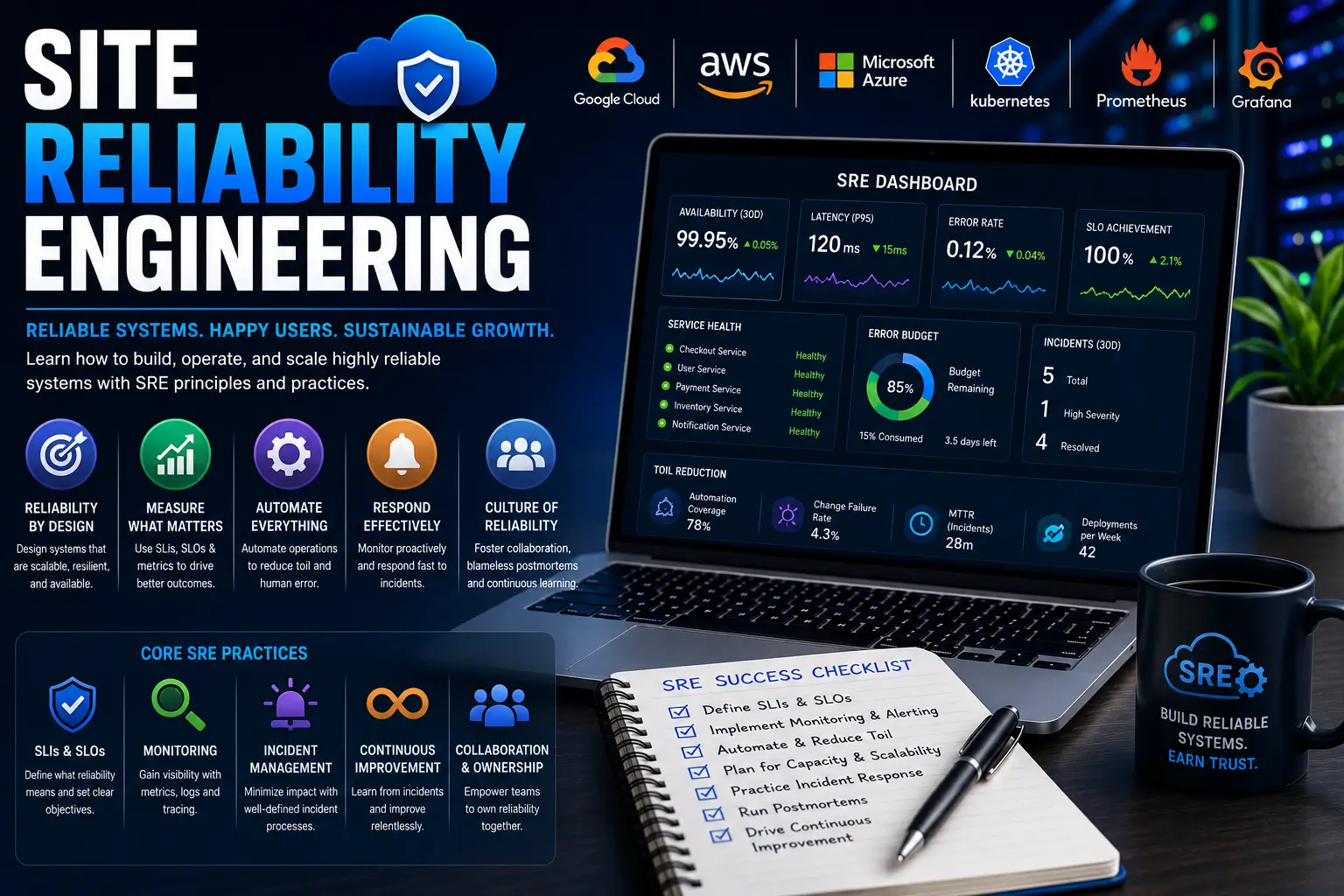
Introduction
The Site Reliability Engineering Course is a comprehensive training program designed to equip learners with the knowledge and practical skills required to build, operate, and maintain highly reliable software systems. Site Reliability Engineering (SRE) combines software engineering principles with IT operations to create scalable, resilient, and efficient technology infrastructure. Originally introduced to improve the reliability of large-scale online services, SRE has become a widely adopted practice across organizations that depend on cloud computing, distributed systems, and digital platforms.
Modern businesses require applications that remain available, secure, and responsive around the clock. System failures, downtime, slow performance, and infrastructure issues can negatively affect customer experience and business operations. Site Reliability Engineering addresses these challenges through automation, monitoring, incident management, capacity planning, observability, and continuous improvement.
Whether you are a student, software developer, DevOps engineer, cloud professional, system administrator, IT operations specialist, or technology enthusiast, this course provides practical knowledge to build expertise in Site Reliability Engineering.
Why Site Reliability Engineering is Important
Site Reliability Engineering helps organizations maintain reliable digital services while supporting rapid software development and continuous delivery.
Key benefits of Site Reliability Engineering include:
- Improves application availability and uptime
- Enhances system performance and scalability
- Reduces operational risks and downtime
- Supports automation of repetitive operational tasks
- Improves incident response and recovery
- Strengthens monitoring and observability
- Enables efficient cloud infrastructure management
- Supports continuous delivery and DevOps practices
- Improves customer experience and service reliability
- Contributes to long-term operational excellence
For example, SRE teams use automation and monitoring to detect issues early, reduce manual intervention, and ensure reliable software performance.
Course Overview
This course provides a structured understanding of Site Reliability Engineering principles and modern operational practices.
Learners will explore:
- Introduction to Site Reliability Engineering (SRE)
- SRE principles and responsibilities
- Service Level Indicators (SLIs)
- Service Level Objectives (SLOs)
- Service Level Agreements (SLAs)
- Monitoring and observability fundamentals
- Logging and distributed tracing basics
- Incident management and response
- Root cause analysis techniques
- Infrastructure automation concepts
- Capacity planning and resource management
- Performance optimization strategies
- DevOps and CI/CD integration
- Cloud reliability and infrastructure management
- Best practices in Site Reliability Engineering
What You Will Learn
By the end of this course, learners will be able to:
- Understand Site Reliability Engineering principles
- Monitor application health and system performance
- Understand SLIs, SLOs, and SLAs
- Support infrastructure reliability initiatives
- Apply automation concepts to operational tasks
- Improve incident response and service recovery processes
- Understand capacity planning and scalability concepts
- Support DevOps collaboration and continuous improvement
- Analyze system performance and operational metrics
- Contribute to reliable, secure, and scalable IT services
Key Components of Site Reliability Engineering
1. Reliability Engineering
Learn how organizations design, operate, and maintain reliable software systems with high availability and minimal downtime.
2. Monitoring and Observability
Understand how monitoring tools, logs, metrics, dashboards, and tracing systems help identify and resolve operational issues.
3. Incident Management
Explore structured approaches to incident detection, response, escalation, communication, recovery, and post-incident analysis.
4. Infrastructure Automation
Learn how automation reduces manual operational tasks, improves consistency, and supports efficient infrastructure management.
5. Performance and Capacity Management
Understand how organizations optimize system performance, manage infrastructure resources, and prepare for future growth.
Skills You Will Gain
After completing this course, learners will develop valuable professional skills, including:
- Site Reliability Engineering (SRE)
- Infrastructure reliability management
- System monitoring
- Incident management
- Performance analysis
- Capacity planning
- Infrastructure automation awareness
- Observability fundamentals
- Root cause analysis
- DevOps collaboration
- Cloud operations awareness
- Problem-solving
- Analytical thinking
- Process improvement
- Operational excellence
Benefits of This Course
Completing this course offers several professional advantages, including:
- Strong understanding of Site Reliability Engineering principles
- Better career opportunities in cloud computing and DevOps
- Improved system reliability and operational management skills
- Practical understanding of monitoring and observability concepts
- Better awareness of infrastructure automation and incident management
- Enhanced troubleshooting and analytical capabilities
- Increased employability across technology organizations
- Competitive advantage in SRE and DevOps careers
- Strong foundation for advanced cloud computing, DevOps, Kubernetes, and infrastructure management certifications
Who Should Enroll?
This course is suitable for:
- Students interested in cloud and DevOps careers
- Software developers
- DevOps engineers
- Cloud engineers
- System administrators
- IT operations professionals
- Infrastructure engineers
- Network administrators
- Technical support engineers
- Anyone interested in Site Reliability Engineering
No previous SRE experience is required, although basic knowledge of Linux, networking, or cloud computing can be beneficial.
Career Opportunities
After completing this course, learners may pursue roles such as:
- Site Reliability Engineer (SRE)
- DevOps Engineer
- Cloud Engineer
- Infrastructure Engineer
- Systems Engineer
- Platform Engineer
- IT Operations Engineer
- Reliability Engineer
- Cloud Operations Associate
- Production Support Engineer
- Technical Operations Engineer
Certification
Upon successful completion of the Site Reliability Engineering Course, learners receive a professional certificate recognizing their knowledge of SRE principles, monitoring, observability, incident management, infrastructure automation, capacity planning, cloud reliability, DevOps collaboration, performance optimization, and operational excellence. This certification enhances career opportunities across cloud service providers, software development companies, technology startups, financial institutions, e-commerce platforms, telecommunications companies, enterprise IT organizations, and multinational technology firms.
Conclusion
The Site Reliability Engineering Course provides learners with practical knowledge and professional skills to build and maintain reliable, scalable, and high-performing software systems. By mastering monitoring, observability, incident response, infrastructure automation, performance optimization, capacity planning, and DevOps collaboration, learners will be well prepared for rewarding careers in cloud computing, DevOps, infrastructure engineering, and IT operations.
Whether your goal is to become a Site Reliability Engineer, strengthen your cloud operations expertise, improve infrastructure reliability skills, or build a successful career in modern IT operations, this course provides a strong foundation for long-term professional success.
FAQ
1. What is the Site Reliability Engineering Course?
It is a course that teaches the principles and practices of Site Reliability Engineering (SRE), including system reliability, monitoring, automation, incident management, and DevOps collaboration.
2. Who should enroll in this course?
Students, software developers, DevOps engineers, cloud professionals, system administrators, IT operations specialists, infrastructure engineers, and anyone interested in SRE.
3. Do I need prior cloud or DevOps experience?
No. The course is beginner-friendly, although basic knowledge of Linux, networking, or cloud computing can be helpful.
4. What topics are covered in this course?
The course covers SRE fundamentals, SLIs, SLOs, SLAs, monitoring, logging, observability, incident management, automation, capacity planning, performance optimization, cloud infrastructure, and DevOps practices.
5. Will I learn monitoring and incident management?
Yes. The course explains monitoring strategies, observability concepts, incident response processes, root cause analysis, and service recovery best practices.
6. Does this course include DevOps and cloud reliability concepts?
Yes. You will learn how Site Reliability Engineering works alongside DevOps practices to improve infrastructure reliability, automation, scalability, and continuous service delivery.
7. Will I receive a certificate after completing the course?
Yes. A professional course completion certificate is awarded upon successful completion.
8. Is Site Reliability Engineering an in-demand skill?
Yes. SRE professionals are highly sought after by cloud providers, software companies, fintech organizations, e-commerce platforms, technology startups, telecommunications companies, and enterprise IT organizations.
9. How does Site Reliability Engineering benefit organizations?
It improves application availability, reduces downtime, enhances monitoring, automates operational tasks, strengthens incident response, optimizes system performance, and supports reliable software delivery.
10. What career opportunities are available after this course?
You can pursue roles such as Site Reliability Engineer, DevOps Engineer, Cloud Engineer, Infrastructure Engineer, Systems Engineer, Platform Engineer, IT Operations Engineer, Reliability Engineer, Production Support Engineer, or Technical Operations Engineer.





Reviews
There are no reviews yet.