
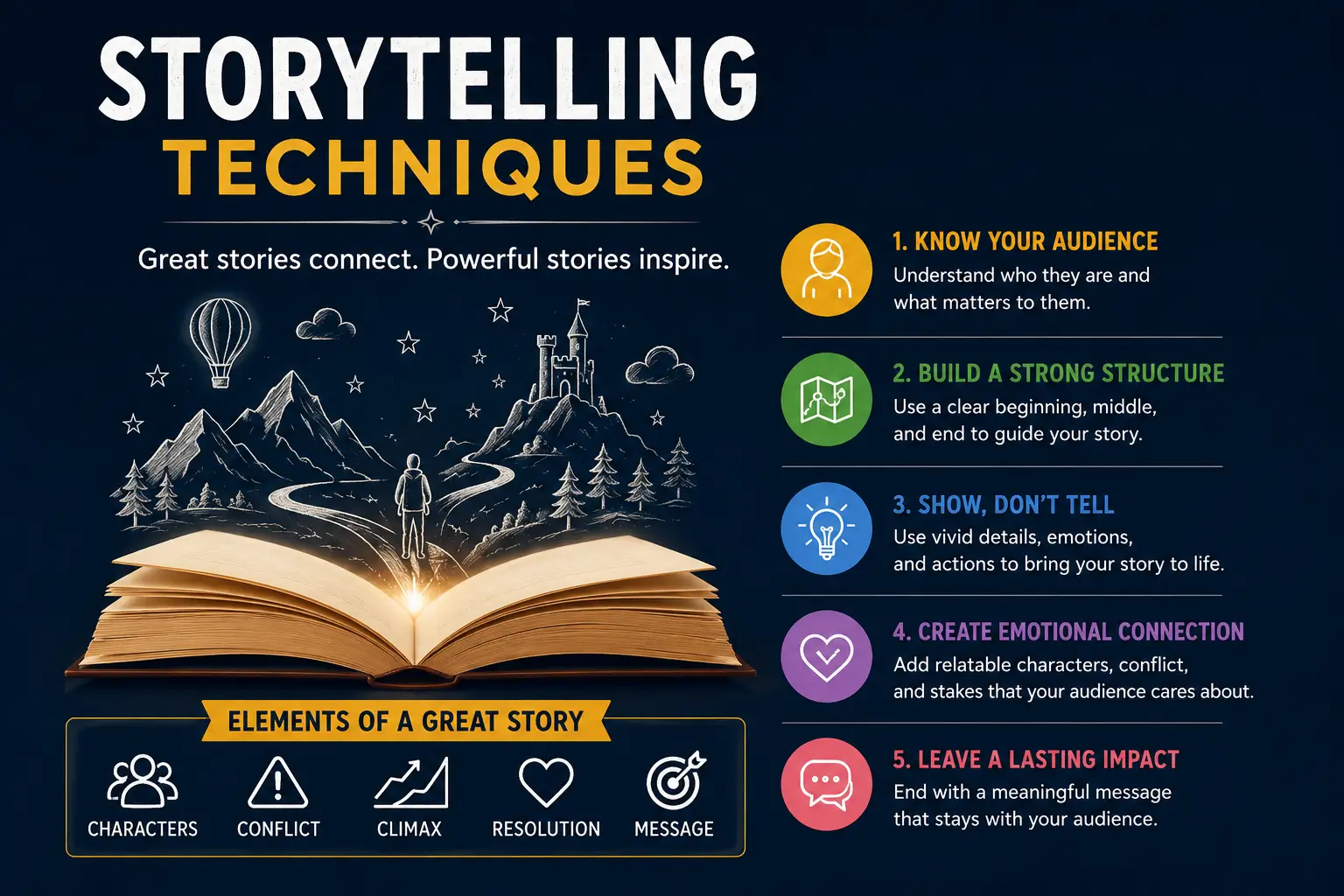
Introduction to Storytelling Techniques
The Storytelling Techniques course provides learners with an introduction to the art and science of storytelling. Storytelling is one of the oldest and most powerful forms of communication, used to share ideas, preserve culture, entertain audiences, and influence decisions.
Effective storytelling goes beyond simply telling events—it involves structuring narratives, building characters, creating emotional connections, and engaging audiences. This course helps learners understand how stories are crafted and why they are so impactful.
Learners are introduced to the basic elements of storytelling and how they are used across different formats such as writing, film, speeches, marketing, and digital media.
Importance of Storytelling Techniques
Storytelling is an essential skill in communication and creative industries.
The Storytelling Techniques course helps learners:
- Understand narrative structure
- Improve communication skills
- Develop creative thinking
- Build emotional expression
- Learn character development
- Enhance writing abilities
- Engage audiences effectively
- Apply storytelling in multiple fields
Good storytelling improves clarity, influence, and engagement.
Understanding Storytelling
Storytelling is the process of sharing ideas through structured narratives.
Learners explore:
What is Storytelling
Understanding how stories communicate meaning.
Types of Stories
Learning about personal, fictional, educational, and professional storytelling.
Purpose of Stories
Understanding why stories are used in communication.
Audience Connection
Learning how stories engage listeners and readers.
These basics form the foundation of storytelling.
Story Structure Fundamentals
A strong structure makes stories effective.
The course covers:
Beginning (Setup)
Introducing characters, setting, and situation.
Middle (Conflict)
Building challenges and events.
End (Resolution)
Concluding the story meaningfully.
Plot Development
Organizing events in a logical sequence.
Structure helps maintain clarity and engagement.
Character Development in Storytelling
Characters bring stories to life.
Learners understand:
Character Creation
Building believable and interesting characters.
Character Motivation
Understanding goals and behavior.
Character Growth
Showing change and development over time.
Emotional Depth
Creating relatable personalities.
Strong characters enhance storytelling impact.
Conflict and Emotion in Stories
Conflict drives storytelling forward.
The course introduces:
Types of Conflict
Understanding internal and external conflicts.
Emotional Engagement
Connecting stories to feelings.
Tension Building
Keeping audiences interested.
Resolution Techniques
Solving conflicts effectively.
Emotion makes stories powerful and memorable.
Narrative Techniques
Different methods are used to tell stories.
Learners explore:
First-Person Narration
Telling stories from personal perspective.
Third-Person Narration
Using an outside narrator.
Linear Storytelling
Events told in order.
Non-Linear Storytelling
Events told out of order for effect.
Narrative style shapes audience experience.
Storytelling Across Media
Storytelling is used in many fields.
The course covers:
- Writing and literature
- Film and scriptwriting
- Marketing and advertising
- Education and training
- Digital content creation
Each medium uses storytelling differently.
Creative Writing and Expression
Storytelling requires creativity.
Learners understand:
Idea Generation
Creating unique story concepts.
Imagination Skills
Building creative scenarios.
Expression Techniques
Communicating ideas clearly.
Writing Style
Developing personal storytelling voice.
Creativity improves storytelling quality.
Audience Engagement Strategies
Engaging audiences is essential.
Learners explore:
Hook Techniques
Grabbing attention early.
Emotional Connection
Building strong audience relationships.
Clarity in Communication
Making stories easy to understand.
Retention Methods
Keeping audiences interested until the end.
Engagement improves storytelling success.
Skills You Will Gain
After completing this course, learners may develop:
- Storytelling skills
- Creative writing ability
- Communication skills
- Narrative development knowledge
- Emotional expression skills
- Audience engagement techniques
- Character building skills
- Creative thinking ability
Benefits of Storytelling Techniques Course
This course provides several benefits:
- Improved communication skills
- Strong creative expression
- Better writing ability
- Enhanced presentation skills
- Useful for multiple career fields
- Increased audience engagement ability
Who Should Join
This course is suitable for:
- Students
- Beginners
- Writers
- Content creators
- Educators
- Marketers
- Creative professionals
No previous experience is required.
Career Opportunities
After completing this course, learners may explore:
- Content Writer Assistant
- Story Writer Assistant
- Script Writing Assistant
- Digital Content Creator
- Marketing Content Assistant
- Creative Writing Assistant
FAQ Section
1. What is Storytelling Techniques?
Storytelling Techniques is a beginner course that teaches how to create structured, engaging, and emotional stories.
2. Who can join this course?
Students, beginners, writers, and content creators can join.
3. Do I need writing experience?
No, this course is designed for beginners.
4. What will I learn in this course?
You will learn story structure, character development, narrative techniques, and emotional storytelling.
5. Why is storytelling important?
It helps communicate ideas effectively and engage audiences.
6. Does this course cover creative writing?
Yes, it includes creative expression and writing techniques.
7. What skills will I gain?
You will gain storytelling, writing, and communication skills.
8. Is this course suitable for beginners?
Yes, it is designed for new learners.
9. Can this course help in professional careers?
Yes, it is useful in media, marketing, education, and content creation.
10. How does this course improve communication?
It teaches clarity, emotional expression, and structured narrative skills.





Reviews
There are no reviews yet.