
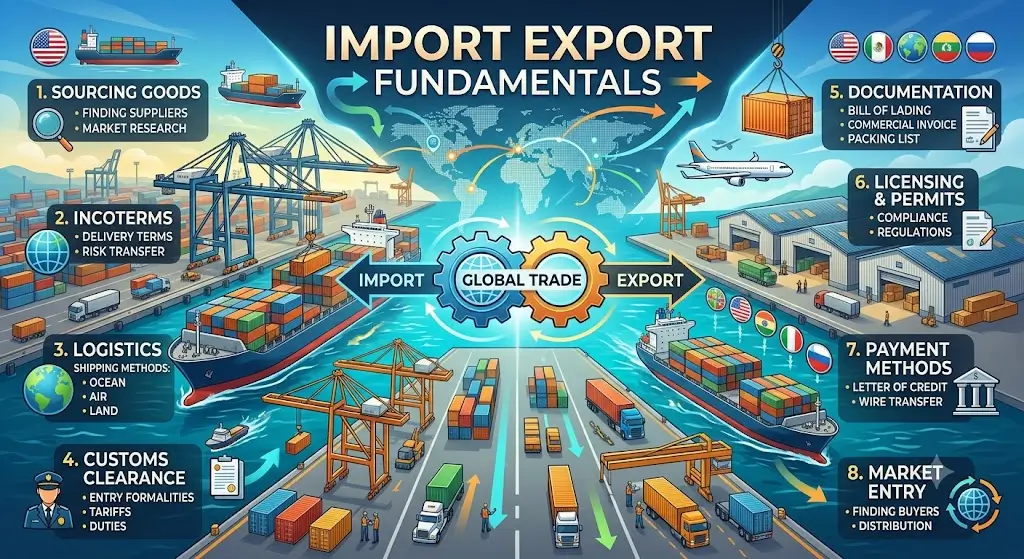
Introduction to Import Export Fundamentals
International trade has become an essential part of the global economy, allowing countries and businesses to exchange goods, services, and resources across borders. The Import Export Fundamentals course provides learners with a comprehensive introduction to the principles, processes, and practices involved in international trade.
Importing involves bringing goods or services into a country from foreign markets, while exporting refers to selling goods or services to international customers. Together, these activities help businesses expand market reach, increase revenue opportunities, and contribute to economic growth.
This course introduces learners to the key concepts of import-export operations and explores the procedures, documentation, logistics, and regulations involved in international trade.
Importance of Import Export Fundamentals
Understanding international trade helps individuals and businesses participate effectively in global markets.
Studying import export fundamentals helps learners:
- Understand international trade processes
- Learn import and export procedures
- Improve logistics awareness
- Develop knowledge of trade documentation
- Understand customs and compliance concepts
- Support business expansion opportunities
- Enhance global business understanding
- Improve supply chain awareness
These benefits make import-export knowledge valuable in business, logistics, and international trade sectors.
Understanding International Trade
International trade connects businesses and consumers across different countries.
Global Commerce
Learners explore how products and services move between nations.
Trade Relationships
The course explains the importance of international business partnerships.
Market Opportunities
Participants gain awareness of global business expansion possibilities.
Economic Contributions
Learners understand how international trade supports economic development.
These concepts form the foundation of global business operations.
Import Procedures
Importing products requires careful planning and compliance.
The course introduces:
Import Process Awareness
Understanding the steps involved in importing goods.
Supplier Coordination
Learning how businesses work with international suppliers.
Documentation Requirements
Exploring documents required for import transactions.
Regulatory Compliance
Understanding the importance of following import regulations.
These concepts help ensure efficient import operations.
Export Procedures in Import Export Fundamentals
Exporting allows businesses to reach international customers.
Learners explore:
Export Planning
Understanding how businesses prepare products for foreign markets.
Customer and Market Research
Learning how to identify export opportunities.
Export Documentation
Exploring documents required for international shipments.
Export Compliance
Understanding legal and regulatory considerations in export activities.
These concepts support successful export operations and market expansion.
Trade Documentation and Compliance
Documentation is a critical part of international trade.
The course covers:
Shipping Documents
Understanding common documents used in international transactions.
Commercial Documentation
Learning the importance of accurate business records.
Customs Requirements
Exploring procedures related to customs clearance.
Compliance Awareness
Understanding regulations that affect import and export activities.
Proper documentation helps reduce delays and improve trade efficiency.
Logistics and Transportation
Transportation is essential for moving goods internationally.
Learners gain awareness of:
- Freight transportation methods
- Shipping processes
- Logistics coordination
- Warehouse operations
- Delivery planning
- Supply chain support
Understanding logistics helps businesses manage international trade effectively.
Trade Finance and Payment Methods
Financial transactions are important in international trade.
The course discusses:
Payment Methods
Understanding common international payment practices.
Trade Finance Basics
Learning how financial systems support trade activities.
Risk Management Awareness
Exploring methods that help reduce transaction risks.
Business Transactions
Understanding the flow of payments between trading partners.
These concepts support smoother and more secure trade operations.
International Market Research
Successful trade requires understanding market conditions.
Learners understand:
Market Analysis
Evaluating international demand and opportunities.
Customer Preferences
Learning how consumer needs vary across markets.
Competitive Awareness
Understanding factors that influence business success.
Business Expansion Planning
Exploring strategies for entering international markets.
These concepts help businesses make informed trade decisions.
Applications of Import Export Fundamentals
Import-export knowledge is useful across many industries.
The course explores applications in:
International Trade Companies
Supporting cross-border business activities.
Logistics and Shipping Organizations
Managing transportation and supply chain operations.
Manufacturing Businesses
Importing materials and exporting finished products.
Global Commerce Operations
Supporting international business growth and development.
These applications demonstrate the importance of import-export expertise.
Skills You Will Gain
Upon completing this course, learners may develop:
- International trade awareness
- Import procedure knowledge
- Export process understanding
- Trade documentation skills
- Logistics awareness
- Supply chain knowledge
- Market research understanding
- Business communication skills
- Trade compliance awareness
- Global business knowledge
These competencies are valuable in international trade, logistics, business operations, and supply chain management.
Benefits of Studying Import Export Fundamentals
This course offers several valuable benefits:
- Improved understanding of international trade
- Better awareness of import and export operations
- Enhanced logistics knowledge
- Increased trade documentation understanding
- Improved business communication skills
- Better awareness of global markets
- Greater understanding of trade compliance
- Preparation for advanced international business studies
The knowledge gained helps learners participate effectively in global trade and business operations.
Who Should Join
This course is suitable for:
- Students
- Entrepreneurs
- Business professionals
- Logistics personnel
- Supply chain learners
- Trade assistants
- Small business owners
- International business enthusiasts
- Commerce students
- Beginners interested in global trade
No prior experience is required.
Career Opportunities
After completing this course, learners may explore opportunities such as:
- Import Export Assistant
- Trade Operations Assistant
- Logistics Coordinator Assistant
- Shipping Documentation Assistant
- Supply Chain Support Executive
- International Trade Assistant
- Export Documentation Assistant
- Business Operations Assistant
- Customs Support Coordinator
- Logistics Support Officer
FAQ Section
1. What is Import Export Fundamentals?
It is a beginner-friendly course that introduces international trade, import procedures, export operations, logistics, and trade documentation concepts.
2. Who can join this course?
Students, entrepreneurs, business professionals, and anyone interested in international trade can join.
3. Do I need prior import-export experience?
No, the course is designed for beginners.
4. What will I learn?
You will learn about import procedures, export operations, logistics, trade documentation, customs awareness, and international business concepts.
5. Why is import-export knowledge important?
It helps businesses participate in global trade, expand markets, and manage international transactions effectively.
6. Does the course cover trade documentation?
Yes, learners gain awareness of shipping documents, commercial records, customs requirements, and compliance procedures.
7. What skills will I gain?
You will gain international trade awareness, logistics knowledge, documentation understanding, market research awareness, and business communication skills.
8. Is this course suitable for beginners?
Yes, it is specifically designed for learners with no prior experience.
9. Can this course support careers in logistics and international trade?
Yes, it provides foundational knowledge useful in trade operations, logistics, shipping, supply chain management, and export-import businesses.
10. Is Import Export Fundamentals useful for entrepreneurs?
Yes, it helps entrepreneurs understand international markets, trade processes, logistics management, and global business opportunities.




Reviews
There are no reviews yet.