
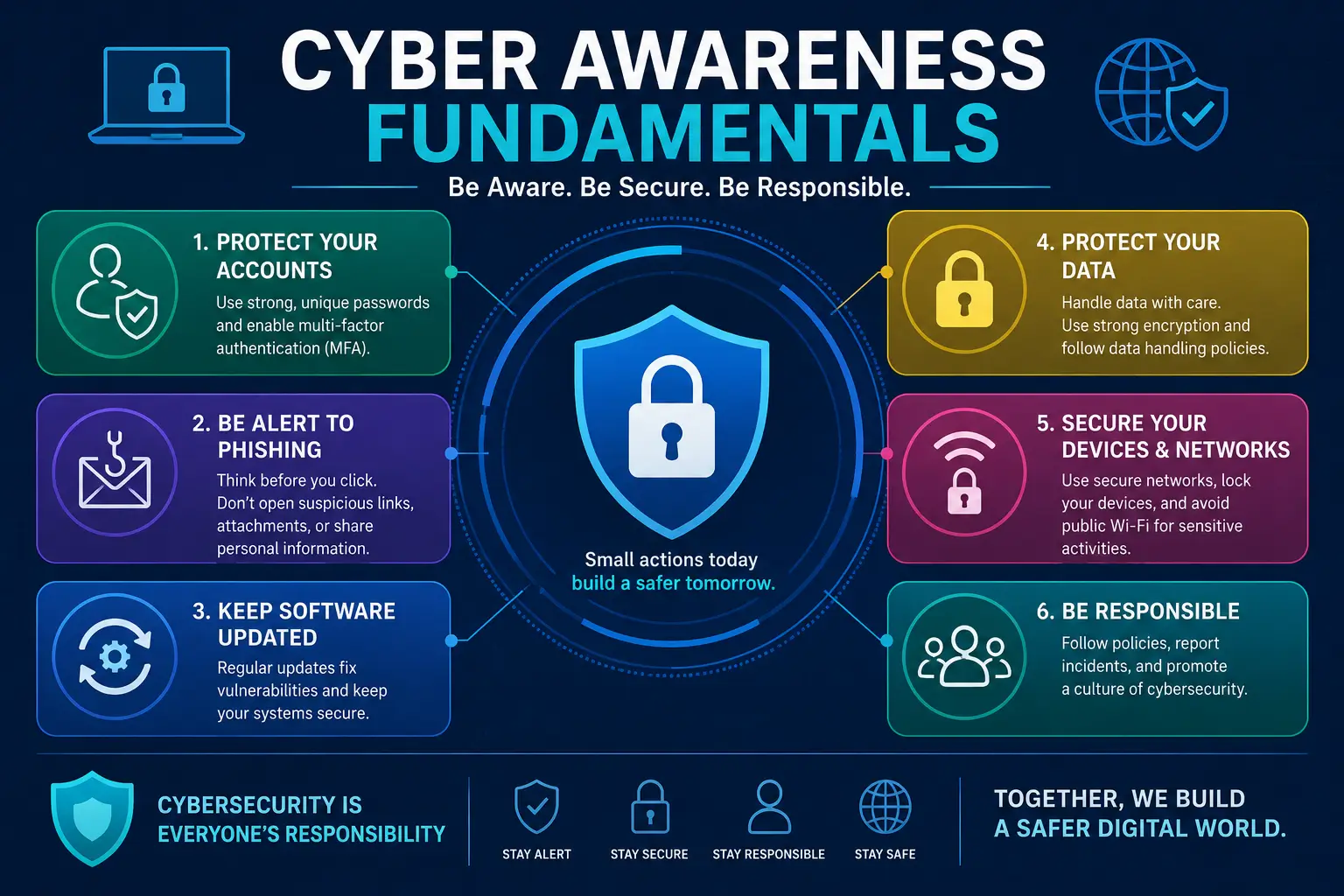
The Cyber Awareness Fundamentals Course is a complete beginner-friendly training program designed to help learners understand the basics of cybersecurity and online safety. In today’s digital world, cyber threats are increasing rapidly, and individuals and organizations must stay alert and informed to protect their data and systems.
This course focuses on building strong cyber awareness by teaching learners how to identify common cyber risks, avoid online scams, protect sensitive information, and follow best security practices. It is suitable for students, professionals, employees, and anyone who uses the internet regularly.
Cyber awareness is not just about technical knowledge—it is about developing the right habits and mindset to stay safe in the digital environment.
INTRODUCTION TO CYBER AWARENESS
Cyber awareness refers to understanding potential online threats and knowing how to protect yourself from them. It is the first step toward cybersecurity and plays a crucial role in preventing cyber attacks.
In this course, learners are introduced to the basics of cyber threats, including phishing, malware, identity theft, data breaches, and social engineering attacks. Understanding these threats helps individuals stay cautious while using digital platforms.
IMPORTANCE OF CYBER AWARENESS
Cyber awareness is essential in today’s interconnected world where most activities happen online, including banking, communication, shopping, and work.
Key importance includes:
- Protecting personal and professional data
- Preventing cyber attacks and scams
- Ensuring safe internet usage
- Avoiding financial fraud
- Securing online accounts
- Building digital trust
Without proper cyber awareness, users become vulnerable to attacks and data theft.
UNDERSTANDING CYBER THREATS
This course explains the most common cyber threats in detail:
1. Phishing Attacks
Fake emails or messages designed to steal sensitive information.
2. Malware
Malicious software that harms devices or steals data.
3. Identity Theft
Unauthorized use of personal information.
4. Social Engineering
Manipulating users to reveal confidential information.
5. Data Breaches
Unauthorized access to sensitive organizational data.
Learners will understand how these threats operate and how to avoid them.
CYBER HYGIENE PRACTICES
Cyber hygiene refers to daily habits that improve digital security.
This section includes:
- Using strong and unique passwords
- Regular software updates
- Avoiding suspicious links
- Using antivirus protection
- Safe Wi-Fi usage
- Regular data backups
Good cyber hygiene reduces the risk of cyber attacks significantly.
PASSWORD AND ACCOUNT SECURITY
Passwords are the first line of defense in cybersecurity.
Learners will study:
- Creating strong passwords
- Password management techniques
- Two-factor authentication (2FA)
- Avoiding password reuse
- Secure login practices
These practices help protect online accounts from unauthorized access.
SAFE INTERNET AND BROWSING PRACTICES
Safe browsing is essential for avoiding online threats.
This course covers:
- Identifying secure websites (HTTPS)
- Avoiding unsafe downloads
- Recognizing fake websites
- Safe use of public Wi-Fi
- Browser security settings
Learners will gain practical skills for safe internet usage.
DATA PROTECTION AND PRIVACY
Data protection is a critical part of cyber awareness.
Learners will explore:
- Importance of personal data security
- Protecting sensitive information
- Privacy settings on apps and platforms
- Avoiding oversharing online
- Understanding data tracking
This helps users maintain control over their digital identity.
CYBER SAFETY IN WORKPLACES
Organizations face serious cyber risks due to employee errors and weak security practices.
This section includes:
- Workplace cybersecurity policies
- Safe email practices
- Handling confidential data
- Device security at work
- Reporting suspicious activity
- Corporate cyber awareness training
Employees play a key role in maintaining cybersecurity in organizations.
SOCIAL MEDIA SECURITY
Social media platforms are common targets for cyber attacks.
Learners will understand:
- Safe social media usage
- Privacy settings management
- Avoiding fake profiles
- Responsible content sharing
- Preventing account hacking
This ensures safe and responsible social media behavior.
SKILLS YOU WILL GAIN
After completing this course, learners will develop:
- Cyber awareness skills
- Online safety understanding
- Cyber hygiene habits
- Data protection knowledge
- Password security skills
- Risk identification ability
- Safe browsing practices
- Digital responsibility awareness
These skills are essential in both personal and professional life.
BENEFITS OF THIS COURSE
- Improved online safety
- Reduced risk of cyber attacks
- Better digital habits
- Stronger data protection awareness
- Increased professional security knowledge
- Safer internet usage
Cyber awareness is a lifelong skill in the digital age.
WHO SHOULD ENROLL?
- Students
- Professionals
- Employees
- Business owners
- HR teams
- IT beginners
- Internet users
- Corporate staff
No technical background is required.
CAREER IMPACT
Cyber awareness skills are useful in roles such as:
- IT Support Executive
- Cybersecurity Assistant
- HR Compliance Officer
- Data Entry Operator
- Office Administrator
- Digital Operations Staff
- Security Awareness Trainer
These skills are valuable across all industries.
CONCLUSION
The Cyber Awareness Fundamentals Course is essential for anyone who uses the internet in daily life. It helps individuals understand cyber threats, build safe habits, and protect personal and professional information.
In a world where cyber risks are increasing, awareness is the first and most powerful defense. This course ensures learners are prepared to stay safe, secure, and responsible in the digital environment.
FAQ SECTION
1. What is Cyber Awareness?
Cyber awareness is understanding online threats and knowing how to stay safe from them.
2. What will I learn in this course?
You will learn cyber threats, safe browsing, password security, and data protection.
3. Is this course beginner-friendly?
Yes, it is designed for beginners with no technical background.
4. Why is cyber awareness important?
It helps protect personal data and prevents cyber attacks.
5. What are cyber threats?
Cyber threats include phishing, malware, identity theft, and hacking attempts.
6. Who should take this course?
Anyone using the internet should take this course.
7. Does this course include practical safety tips?
Yes, it includes real-world cyber safety practices.
8. Can this help in jobs?
Yes, cyber awareness is useful in all professional roles.
9. What is cyber hygiene?
It refers to safe daily digital habits that improve security.
10. How can I stay safe online?
By using strong passwords, avoiding scams, and following safe browsing practices.





Reviews
There are no reviews yet.