
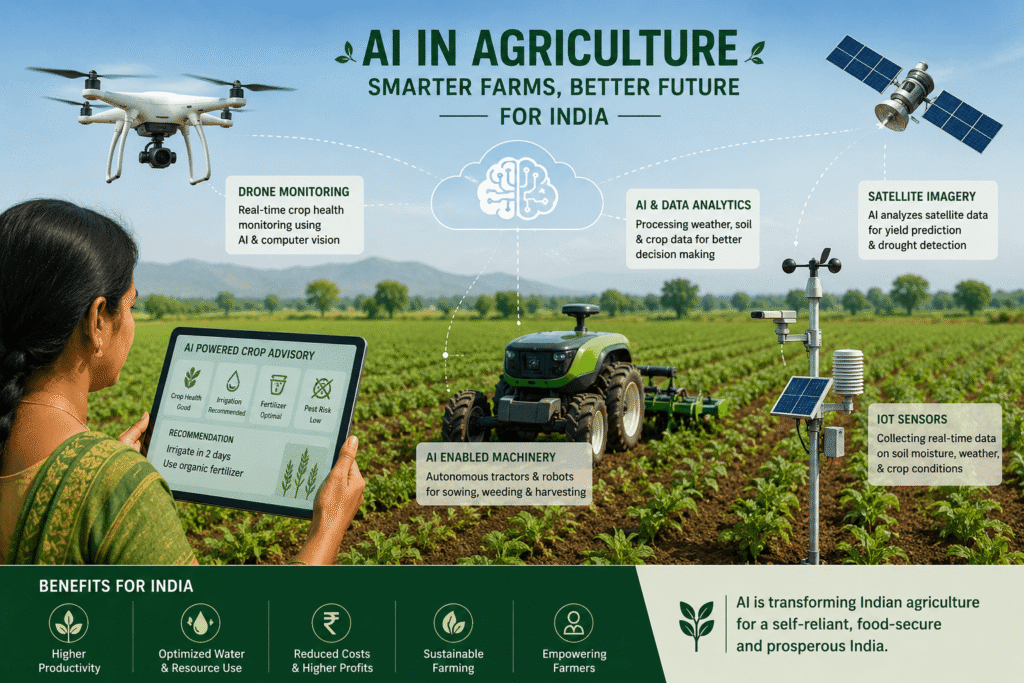
Introduction
Agriculture has always been the backbone of India’s economy, employing millions and feeding a nation of over a billion people. With the rise of Artificial Intelligence (AI), the sector is undergoing a technological revolution. From predicting weather patterns to automating irrigation, AI is transforming how farmers cultivate, harvest, and manage resources. At Eduvish.com, we explore how AI is reshaping Indian agriculture, improving productivity, sustainability, and profitability.
What Is AI in Agriculture?
Artificial Intelligence in agriculture refers to the use of smart technologies like machine learning, computer vision, and data analytics to optimize farming processes. AI helps farmers make data‑driven decisions, reduce waste, and increase crop yields — all while conserving natural resources.
Importance of AI in Indian Agriculture
- Precision farming: AI enables accurate monitoring of soil, weather, and crop health.
- Resource optimization: Smart sensors help manage water and fertilizers efficiently.
- Predictive analytics: AI forecasts crop diseases, pest attacks, and market trends.
- Automation: Robots and drones simplify planting, irrigation, and harvesting.
- Sustainability: Reduces environmental impact through efficient resource use.
AI Technologies Used in Agriculture
| Technology | Application |
|---|---|
| Machine Learning | Predicts crop yield and disease outbreaks. |
| Computer Vision | Detects pests and monitors plant growth. |
| IoT Sensors | Tracks soil moisture, temperature, and humidity. |
| Drones | Aerial mapping and precision spraying. |
| Robotics | Automates repetitive tasks like weeding and harvesting. |
| Data Analytics | Helps farmers make informed decisions. |
AI Applications in Indian Agriculture
1. Crop Monitoring
AI‑powered drones and sensors provide real‑time data on crop health, helping farmers detect issues early.
2. Soil Analysis
Smart sensors analyze soil composition, moisture, and nutrients to guide fertilizer use.
3. Weather Prediction
AI models forecast rainfall and temperature, enabling better planning for sowing and harvesting.
4. Pest and Disease Detection
Computer vision identifies pest infestations and diseases before they spread.
5. Smart Irrigation
AI systems automate water distribution based on soil and weather data.
6. Market Forecasting
Predictive analytics help farmers decide when and where to sell crops for maximum profit.
Benefits of AI in Agriculture
- Increased productivity through data‑driven decisions.
- Reduced costs by optimizing resources.
- Improved crop quality with precision monitoring.
- Enhanced sustainability through eco‑friendly practices.
- Empowered farmers with real‑time insights and automation.
Challenges of Implementing AI in India
- High initial cost: Technology adoption can be expensive for small farmers.
- Lack of awareness: Many farmers are unaware of AI benefits.
- Infrastructure gaps: Limited internet access in rural areas.
- Data privacy: Concerns about misuse of farm data.
- Skill shortage: Need for training and technical support.
Government Initiatives Supporting AI in Agriculture
India’s government is promoting AI adoption through:
- Digital India and Smart Agriculture programs.
- ICAR (Indian Council of Agricultural Research) projects using AI for crop management.
- Agri‑tech startups supported under Startup India.
- AI‑based soil health cards and precision farming schemes. These initiatives aim to make farming smarter, sustainable, and profitable.
Role of Agri‑Tech Startups
Startups are driving innovation in AI‑based agriculture:
- CropIn – Provides farm management solutions.
- Fasal – Uses AI for precision irrigation.
- DeHaat – Offers AI‑driven advisory and supply chain support.
- AgNext – Focuses on AI‑based quality analysis of produce.
These companies are bridging the gap between technology and traditional farming.
Future of AI in Indian Agriculture
AI will continue to revolutionize farming by:
- Integrating satellite data for precision mapping.
- Expanding AI‑driven marketplaces for farmers.
- Promoting climate‑smart agriculture.
- Enhancing agricultural education and training. The future is bright — AI will make Indian agriculture more efficient, resilient, and sustainable.

