
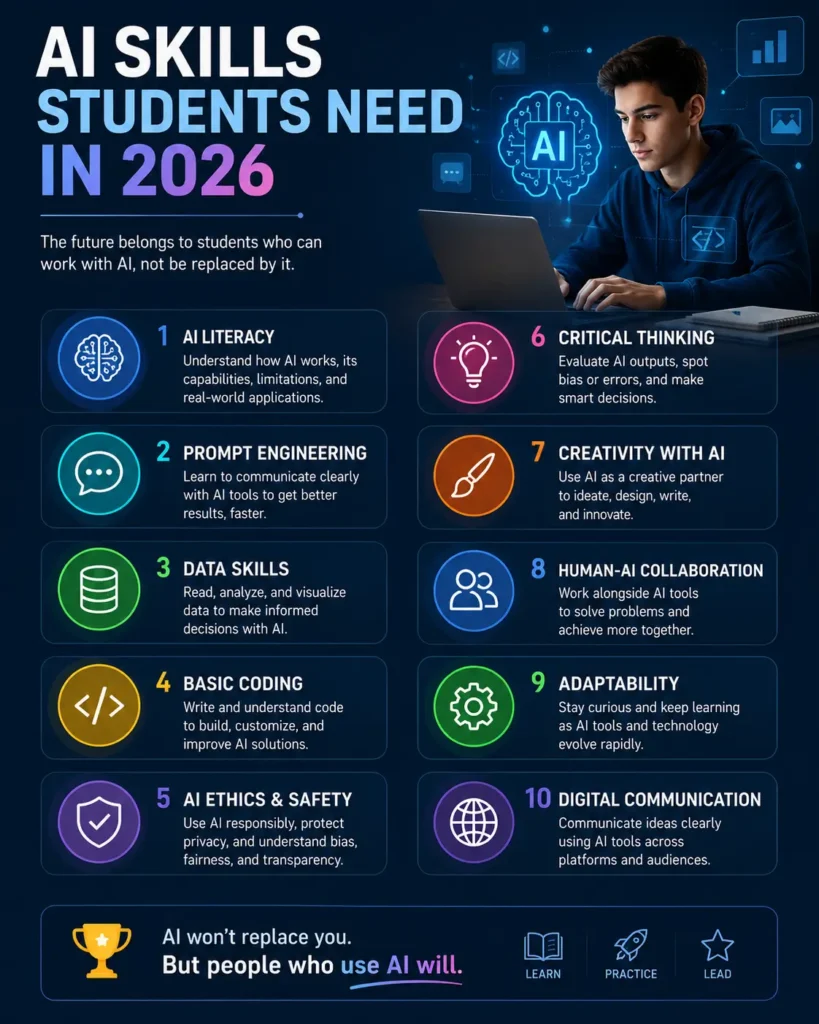
Why AI Skills Matter
- AI is everywhere: From healthcare and finance to marketing and education.
- Universities and employers now assess digital readiness.
- Future-proof careers depend on mastering AI fundamentals and applied skills.
Core AI Skills for Students
| Skill | What It Means | Why It Matters in 2026 |
|---|---|---|
| Prompt Engineering | Crafting effective inputs for AI tools | Better outputs from generative AI, essential for content, coding, and automation. |
| AI Automation & Workflow Orchestration | Connecting apps and automating tasks | Saves time, reduces manual work, creates AI-powered processes. |
| Machine Learning Fundamentals | Understanding supervised/unsupervised learning, model evaluation | Core knowledge for 90% of AI-related jobs. |
| Deep Learning | Neural networks, CNNs, RNNs, Transformers | Powers image recognition, autonomous systems, and speech-to-text. |
| Computer Vision | Image classification, object detection, OCR | Growing in eCommerce, healthcare, automotive, and security. |
| Natural Language Processing | Text classification, sentiment analysis, chatbot development | Essential for language-based AI systems. |
| LLM Fine-Tuning | Training large language models on custom datasets | High demand in SaaS, fintech, EdTech, and IT. |
| AI Agents & Autonomous Systems | AI that plans, acts, and automates workflows | Next big wave in automation and productivity. |
| Data Literacy | Collecting, cleaning, analyzing, and interpreting data | Foundation for all AI applications. |
| Ethical AI | Understanding bias, privacy, and transparency | Ensures responsible AI use in society. |
Supporting Skills
- Mathematics & Statistics: Linear algebra, probability, optimization.
- Programming (Python, R, Java): Core languages for AI development.
- Critical Thinking: Evaluating AI outputs and identifying biases.
- Communication Skills: Explaining AI concepts to non-technical audiences.
Risks & Challenges
- Over-reliance on AI: Students must still build human judgment.
- Bias in AI systems: Requires ethical awareness.
- Rapid tech changes: Continuous learning is essential.
How Students Can Prepare
- Start with Python and ML basics on platforms like Kaggle.
- Practice prompt engineering with tools like ChatGPT.
- Build projects in computer vision and NLP.
- Stay updated on AI ethics and policy developments.
Conclusion
By 2026, students who master prompt engineering, ML fundamentals, data literacy, workflow automation, and ethical AI will be best positioned for success. These skills are not just for tech careers — they are becoming essential across industries.

