
Introduction
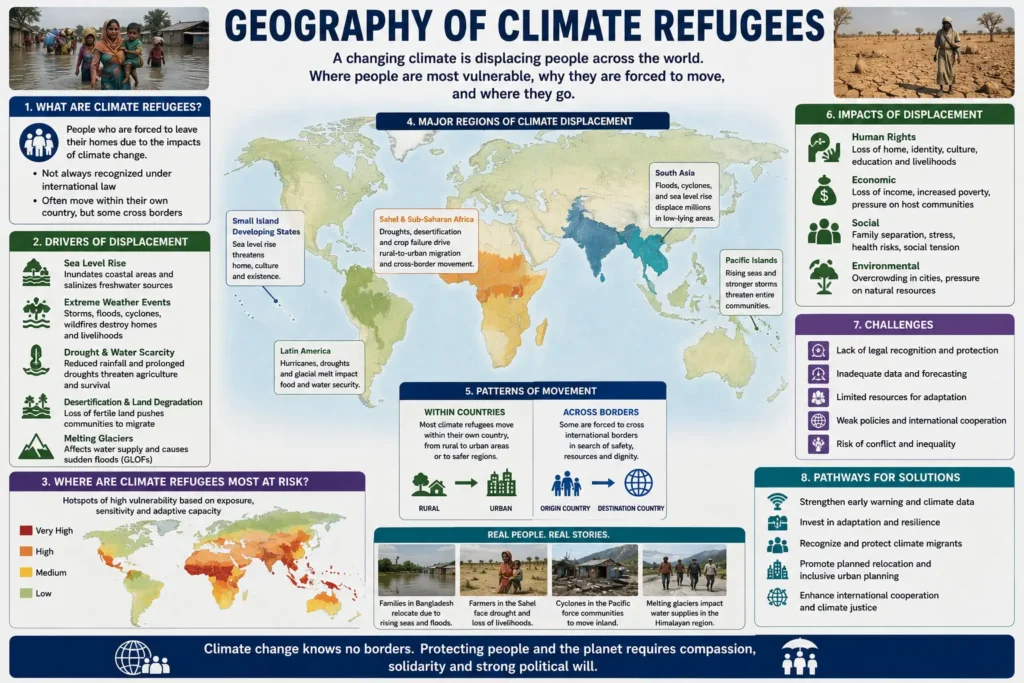
The geography of climate refugees examines how climate change influences migration patterns and forces communities to relocate due to rising sea levels, droughts, floods, and extreme weather events. Understanding the geography of climate refugees helps policymakers, researchers, and communities address the growing challenges of climate-induced displacement.
What Are Climate Refugees?
Climate refugees are people displaced due to climate‑related hazards such as:
- Floods and rising sea levels (e.g., Sundarbans, Bangladesh).
- Droughts and desertification (e.g., Odisha, India).
- Extreme heatwaves (Middle East, Africa).
- Cyclones and hurricanes (Caribbean, South Asia).
Global Statistics
- 122 million people displaced worldwide due to conflict and climate hazards.
- 220 million internal displacements in the past decade from weather disasters.
- 60,000 displacements per day linked to floods, droughts, and storms.
- 90 million displaced people live in countries with high climate hazard exposure.
Geography of Climate Refugees
1. South Asia
- Bangladesh and India face sea level rise and river flooding.
- Sundarbans islands are disappearing, forcing migration to cities like Kolkata and Dhaka.
2. Middle East & Africa
- Syria, Yemen, and DRC host millions exposed to heatwaves and droughts.
- Sub‑Saharan Africa faces desertification and water scarcity.
3. Latin America
- Amazon deforestation and hurricanes in Central America push rural populations into urban centers.
4. Pacific Islands
- Nations like Tuvalu and Kiribati risk complete submersion, leading to cross‑border migration.
Political & Economic Implications
- Urban pressure: Cities like Mumbai, Delhi, and Lagos face infrastructure strain.
- Cross‑border migration: Bangladesh to India, Central America to the US.
- Security risks: Climate migration overlaps with conflict zones.
- Economic impact: Loss of livelihoods in agriculture and fisheries.
Solutions & Adaptation
- Climate‑resilient infrastructure in vulnerable regions.
- International cooperation for relocation and aid.
- Sustainable agriculture to reduce rural migration.
- Legal recognition of climate refugees under international law.
Conclusion
The geography of climate refugees highlights the urgent need for global action. Climate change is reshaping migration patterns, threatening stability, and demanding sustainable solutions. Recognizing climate refugees as part of international law and investing in adaptation strategies is essential for a secure future.
FAQ SECTION
Who are climate refugees?
Climate refugees are people who are forced to leave their homes because of environmental changes and climate-related disasters such as floods, droughts, and rising sea levels.
What causes climate migration?
Climate migration is caused by environmental factors including extreme weather events, water scarcity, land degradation, and rising sea levels.
Why is the geography of climate refugees important?
It helps researchers and policymakers understand migration patterns, identify vulnerable regions, and develop strategies for adaptation and support.
Which regions are most affected by climate displacement?
Coastal areas, low-lying islands, drought-prone regions, and flood-prone communities are among the most vulnerable.
How does climate change affect human migration?
Climate change can reduce access to food, water, housing, and livelihoods, forcing people to relocate to safer areas.

