
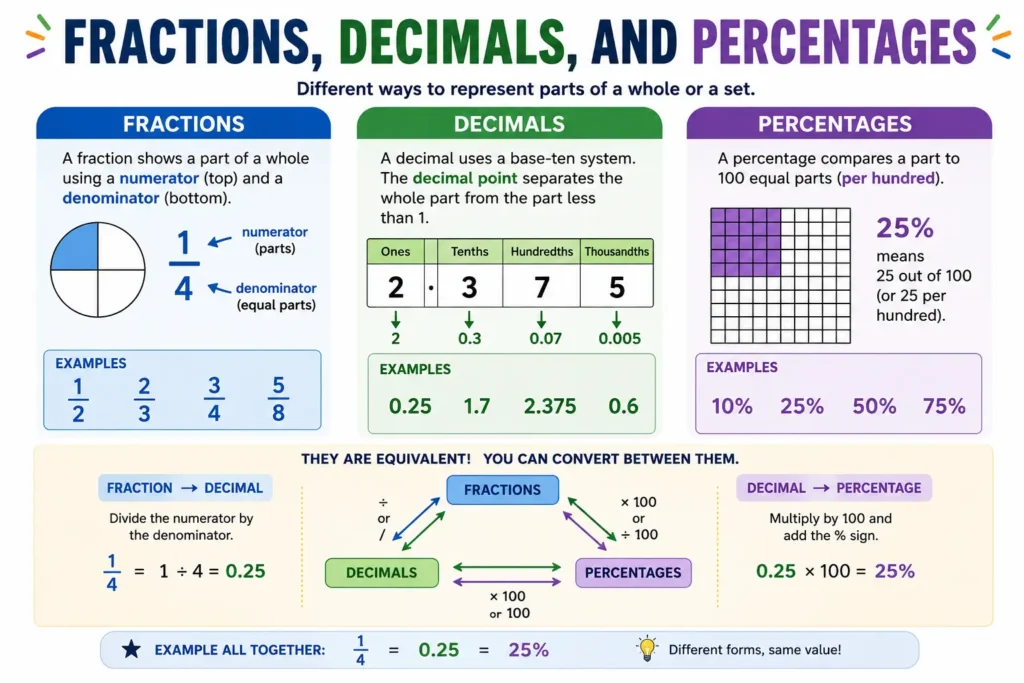
What Are They?
- Fractions: Express parts of a whole using numerator/denominator (e.g., ).
- Decimals: Use base-10 place value to represent fractions (e.g., 0.75).
- Percentages: Show values per hundred (e.g., 75%).
Conversions
| Conversion | Rule | Example |
|---|---|---|
| Fraction → Decimal | Divide numerator by denominator | |
| Decimal → Percentage | Multiply by 100 and add % | |
| Percentage → Fraction | Write over 100 and simplify | |
| Decimal → Fraction | Write decimal over 1, multiply top/bottom by 10/100, then simplify |
Real-Life Applications
- Shopping Discounts: A 25% discount on ₹200 = ₹50 off, final price ₹150.
- Budgeting: Spending 0.3 of income = 30%.
- Cooking: 0.5 cup milk = cup = 50%.
- Exams: Scoring 45/50 = 0.9 = 90%.
Common Mistakes
- Forgetting to simplify fractions.
- Misplacing decimal points (0.5 ≠ 0.05).
- Confusing 5% with 0.5 (actually 50%).
- Adding fractions without common denominators.
Practice Examples
- Convert → Decimal = 0.625 → Percentage = 62.5%.
- Convert 0.32 → Percentage = 32%.
- Convert 80% → Fraction = .
Conclusion
Fractions, decimals, and percentages are different forms of the same value. By learning how to convert between them, students can solve math problems faster and apply these skills in everyday life.

