
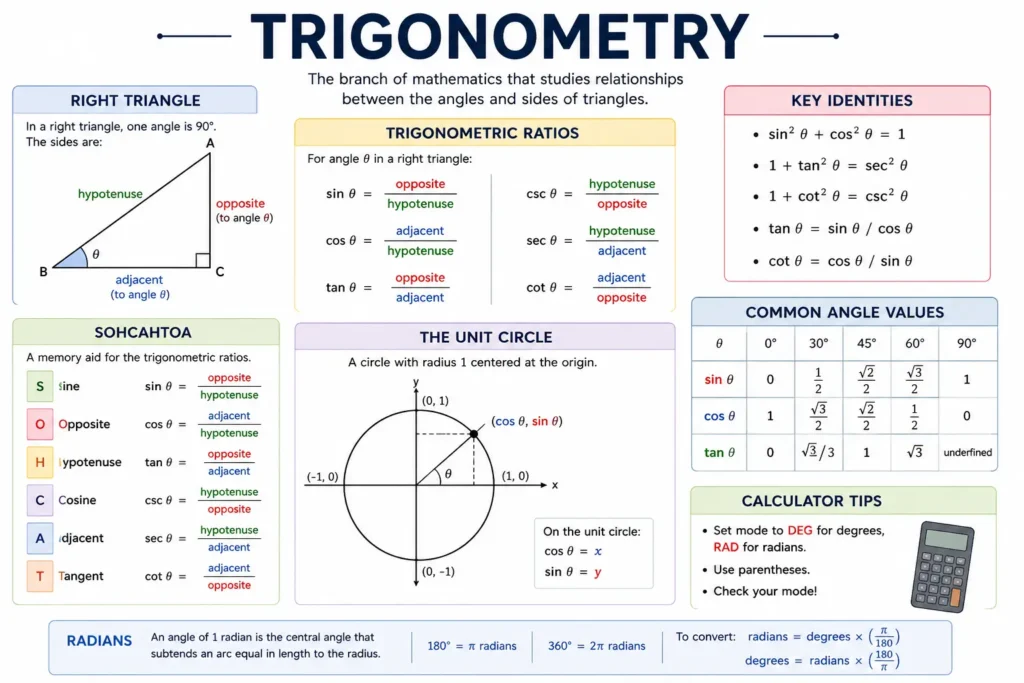
Trigonometry: Complete Guide
What is Trigonometry?
- Derived from Greek words: “trigono” (triangle) + “metry” (measurement).
- Focuses on angles and side lengths of triangles.
- Used in geometry, physics, engineering, astronomy, and navigation.
Basic Trigonometric Ratios
For a right-angled triangle with angle θ:
| Ratio | Formula | Example |
|---|---|---|
| Sine (sin) | Opposite / Hypotenuse | |
| Cosine (cos) | Adjacent / Hypotenuse | |
| Tangent (tan) | Opposite / Adjacent | |
| Cotangent (cot) | Adjacent / Opposite | |
| Secant (sec) | Hypotenuse / Adjacent | |
| Cosecant (csc) | Hypotenuse / Opposite |
Trigonometric Ratios of Standard Angles
| Angle | sin | cos | tan |
|---|---|---|---|
| 0° | 0 | 1 | 0 |
| 30° | 1/2 | √3/2 | 1/√3 |
| 45° | 1/√2 | 1/√2 | 1 |
| 60° | √3/2 | 1/2 | √3 |
| 90° | 1 | 0 | ∞ |
Trigonometric Identities
These identities are essential for solving equations and proofs.
Applications of Trigonometry
- Engineering: Designing bridges, buildings, and machines.
- Astronomy: Calculating distances between stars and planets.
- Navigation: Determining ship and aircraft positions.
- Physics: Wave motion, optics, and mechanics.
- Daily Life: Measuring heights of trees, towers, and buildings.
Common Mistakes
- Confusing sine and cosine ratios.
- Forgetting to convert degrees to radians.
- Misapplying trigonometric identities.
Conclusion
Trigonometry is a powerful mathematical tool that connects geometry with real-world applications. By mastering ratios, identities, and formulas, students can excel in academics and apply these concepts in science, engineering, and everyday problem-solving.

