
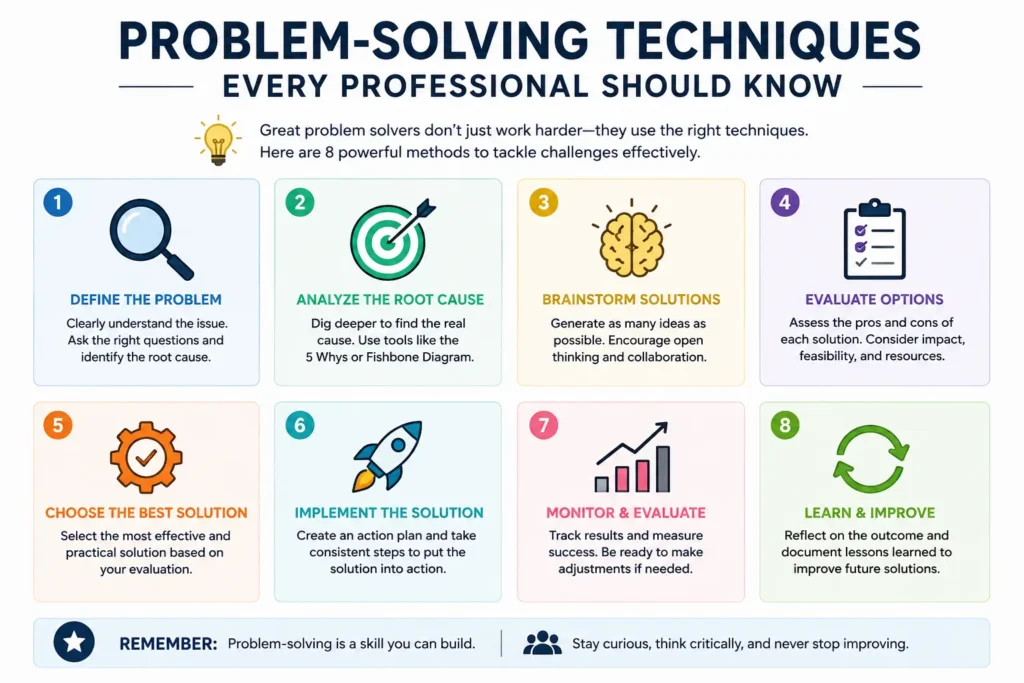
Why Problem-Solving Skills Matter
- Organizations with strong problem-solving cultures grow 3.5x faster than others.
- Professionals who excel at solving problems advance quicker in their careers and make better decisions.
- These skills reduce waste, improve customer satisfaction, and foster innovation.
Core Problem-Solving Techniques
| Technique | How It Works | Best Use Case |
|---|---|---|
| 5 Whys Analysis | Ask “Why?” repeatedly until you uncover the root cause. | Identifying underlying issues in recurring problems. |
| Root Cause Analysis | Systematically trace problems back to their origin. | Quality issues, operational inefficiencies. |
| Brainstorming | Generate multiple ideas without judgment. | Creative solutions, team collaboration. |
| Mind Mapping | Visualize problems and solutions in a diagram. | Complex issues requiring clarity and structure. |
| SMART Framework | Define Specific, Measurable, Achievable, Relevant, Time-bound goals. | Strategic planning and solution implementation. |
Modern Approaches
- Systems Thinking: View problems as part of a larger system.
- Cross-Functional Collaboration: Involve diverse teams for holistic solutions.
- Rapid Prototyping: Test solutions quickly and iterate.
- Data-Driven Decision Making: Use analytics to validate solutions.
Common Mistakes to Avoid
- Treating symptoms instead of root causes.
- Ignoring stakeholder input.
- Relying only on intuition without data.
- Failing to review and adjust after implementation.
Best Practices for Professionals
- Combine creative techniques (brainstorming, mind mapping) with analytical methods (root cause analysis, 5 Whys).
- Document solutions and outcomes for future reference.
- Encourage open communication and feedback.
- Continuously refine processes to prevent recurrence.
Conclusion
Problem-solving is not just about fixing issues — it’s about turning challenges into opportunities. By mastering techniques like the 5 Whys, Root Cause Analysis, Brainstorming, Mind Mapping, and SMART goals, professionals can drive innovation, efficiency, and career success.