
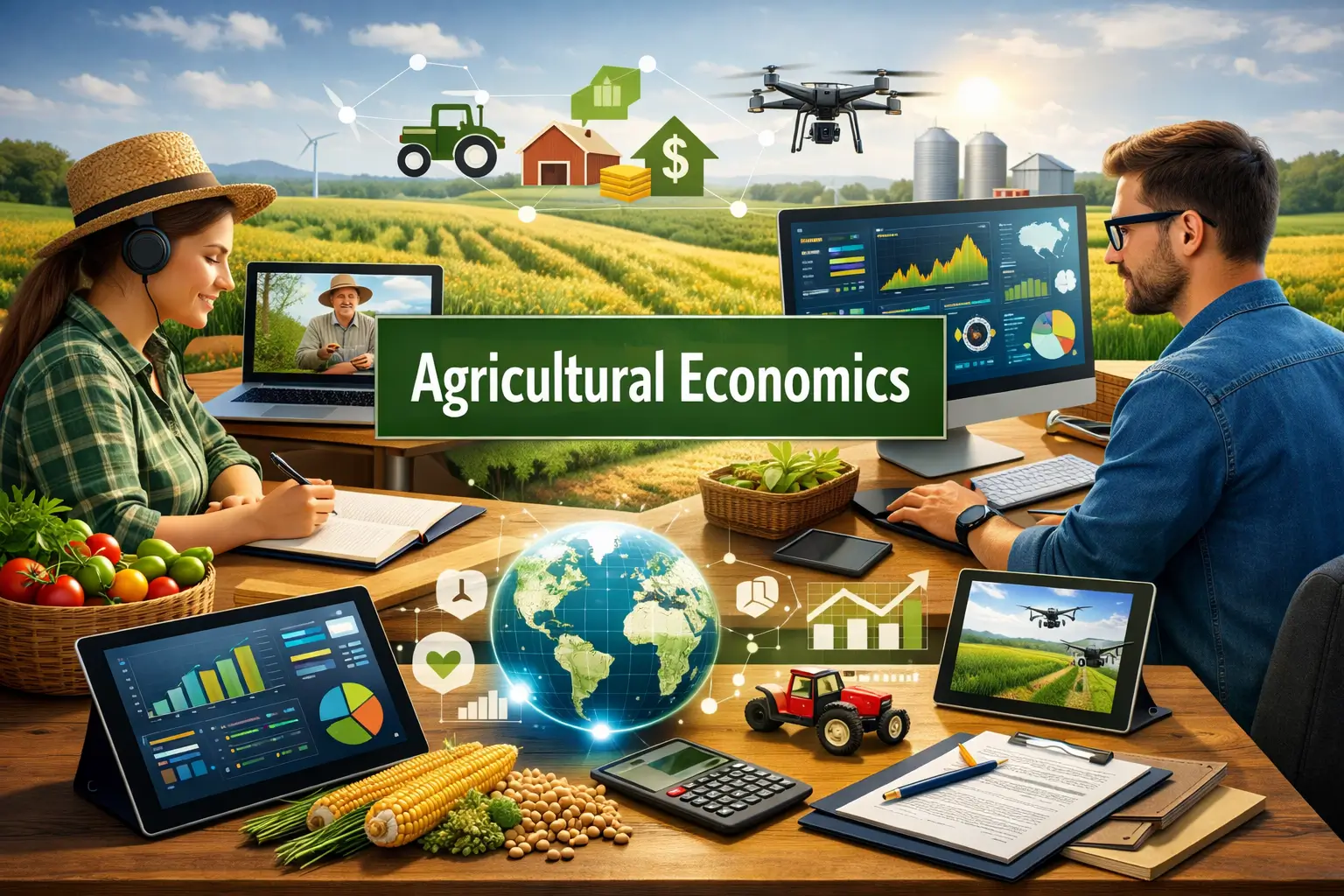
The Agricultural Economics Course is a comprehensive, beginner-friendly program designed to introduce learners to the economic principles and business practices that influence agriculture and the global food industry. Agricultural economics focuses on the production, distribution, and consumption of agricultural products while helping farmers, agribusinesses, and policymakers make informed decisions that improve productivity, sustainability, and profitability. This course provides a strong foundation for individuals interested in agriculture, economics, agribusiness, and rural development.
Throughout this course, you will learn the fundamentals of agricultural economics, including agricultural production systems, market structures, pricing mechanisms, and resource management. You will gain knowledge of how supply and demand affect agricultural commodities, how farming businesses operate, and how economic factors influence food production and distribution. The course also covers topics such as farm management, agricultural marketing, trade policies, and rural economic development.
The Agricultural Economics Course focuses on practical and analytical skills that help learners understand the financial and economic challenges faced by the agricultural sector. You will learn about cost analysis, budgeting, risk management, agricultural finance, and sustainable farming practices that support long-term growth. The course also introduces government policies, food security concepts, and the impact of climate change and technological advancements on agricultural economies.
This course is ideal for students, farmers, agribusiness professionals, entrepreneurs, and individuals interested in agriculture, economics, and food systems. It is also suitable for those who want to build careers in agricultural management, policy development, and rural development initiatives.
After completing the Agricultural Economics Course, learners can explore career opportunities such as Agricultural Economist, Agribusiness Manager, Farm Manager, Agricultural Analyst, Rural Development Officer, Market Research Analyst, and Agricultural Policy Consultant. The course also serves as a strong foundation for advanced studies in agricultural sciences, economics, agribusiness management, and sustainable development.
FAQ SECTION
What is an Agricultural Economics Course?
An Agricultural Economics Course teaches economic principles related to agriculture, farm management, agribusiness, agricultural finance, and rural development.
Who can enroll in this course?
Students, farmers, agribusiness professionals, entrepreneurs, researchers, and anyone interested in agriculture can enroll.
Do I need an economics background?
No, prior economics knowledge is not required.
Is the course available online?
Yes, many institutions offer online, offline, and hybrid learning options.
How long does the course take?
Most Agricultural Economics Courses range from 3 months to 12 months.
Will I receive a certificate after completing the course?
Yes, students receive a professional certificate upon successful completion.
What subjects are covered in this course?
Subjects include farm management, agricultural finance, agricultural marketing, rural development, and agribusiness management.
What career opportunities are available after completing this course?
You can work as an Agricultural Economist, Farm Manager, Agribusiness Manager, Agricultural Consultant, or Policy Analyst.
Is Agricultural Economics a good career in India?
Yes, India has a growing demand for professionals who can improve agricultural productivity and rural economic development.
Can farmers benefit from this course?
Yes, farmers can learn financial planning, market analysis, and resource management strategies to improve profitability.





Reviews
There are no reviews yet.