
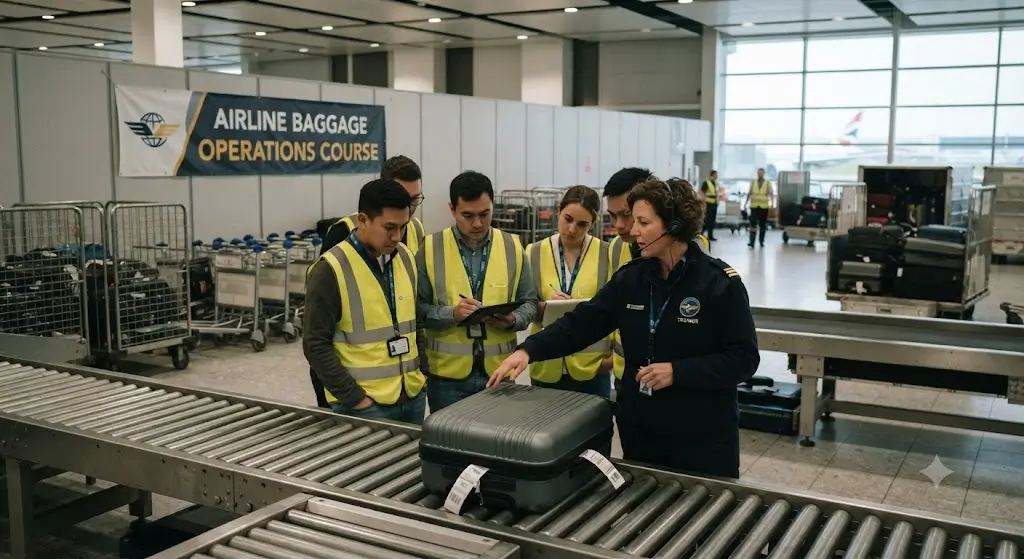
Introduction to Airline Baggage Operations
The Airline Baggage Operations Course is a comprehensive professional training program designed to prepare learners for managing one of the most critical functions in airport ground handling—baggage movement and coordination. Every passenger journey involves baggage handling, from check-in to final delivery at the destination, making this an essential part of airline operations.
Baggage operations involve multiple interconnected processes including baggage acceptance, screening, sorting, transfer handling, loading into aircraft, unloading upon arrival, and delivery at baggage claim. These operations require precision, coordination, safety compliance, and effective communication among airport teams.
This course combines aviation operations, ground handling procedures, airport systems, safety management, and customer service principles to provide learners with practical knowledge applicable across airlines, airports, and ground handling organizations.
Why Airline Baggage Operations Matter
Efficient baggage operations are essential for ensuring smooth airport experiences and maintaining airline reliability. Delays, lost baggage, or mishandling can significantly impact passenger satisfaction and airline reputation.
Well-managed baggage operations improve turnaround times, reduce operational errors, enhance safety, and increase passenger trust. They also ensure compliance with international aviation regulations and optimize airport efficiency.
The Airline Baggage Operations Course helps learners understand how precise coordination and modern technology contribute to seamless baggage movement throughout the airport system.
Course Overview
The Airline Baggage Operations Course introduces learners to the systems, procedures, and technologies used in airline baggage handling and airport operations.
Participants begin by studying baggage handling fundamentals, airport operations, and airline procedures. The course explores baggage check-in processes, baggage handling systems (BHS), tagging and tracking, sorting systems, transfer baggage operations, loading and unloading procedures, mishandled baggage handling, and customer service.
Learners also study aviation safety regulations, airport communication systems, digital tracking technologies, ground handling coordination, leadership, teamwork, and operational performance improvement.
Practical case studies demonstrate how baggage operations teams manage high-volume passenger traffic while ensuring accuracy, safety, and efficiency.
Topics Covered
Throughout the Airline Baggage Operations Course, learners will study:
Baggage Handling Fundamentals
Understand baggage types, handling processes, airport baggage flow, airline procedures, and operational workflows.
Check-in and Baggage Acceptance
Learn baggage tagging, weight limits, security screening coordination, passenger documentation, and airline policies.
Baggage Handling Systems (BHS)
Study automated sorting systems, conveyor systems, scanning technologies, baggage routing, and system monitoring.
Baggage Tracking and Technology
Explore RFID tracking, barcode systems, real-time baggage tracking, digital platforms, and data management systems.
Loading and Unloading Operations
Understand aircraft loading procedures, cargo-baggage balance coordination, unloading processes, and turnaround efficiency.
Transfer and Transit Baggage
Learn connecting flight baggage handling, transfer coordination, airport hub operations, and timing management.
Mishandled Baggage Management
Study lost, delayed, or damaged baggage procedures, passenger communication, reporting systems, and recovery processes.
Ramp and Ground Handling Coordination
Explore coordination with ramp teams, aircraft turnaround activities, baggage carts, and ground support equipment (GSE).
Aviation Safety and Compliance
Understand safety protocols, hazard prevention, baggage screening regulations, and international aviation standards.
Customer Service in Baggage Operations
Learn passenger communication, complaint handling, service recovery, and improving passenger satisfaction.
Skills You Will Gain
After completing the Airline Baggage Operations Course, learners will develop valuable professional skills including:
- Airline baggage handling
- Baggage tracking systems
- Airport operations coordination
- Ground handling procedures
- Baggage sorting and loading
- Mishandled baggage management
- Aviation safety compliance
- Customer service
- Airport communication
- Operational efficiency
- Team coordination
- Problem-solving
- Quality control
- Time management
- Leadership
These competencies are valuable across airlines, airports, ground handling companies, cargo operations, aviation service providers, and airport logistics organizations.
Benefits of the Course
The Airline Baggage Operations Course provides practical knowledge for managing baggage systems efficiently while ensuring safety, accuracy, and customer satisfaction.
Participants gain confidence in handling baggage operations, using tracking technologies, managing passenger concerns, improving operational efficiency, and coordinating with airport teams. The course also strengthens communication, teamwork, and problem-solving skills.
As global air travel continues to grow, skilled baggage operations professionals are increasingly in demand across the aviation industry.
Who Should Enroll?
This course is suitable for:
- Aviation students
- Airport ground staff
- Airline baggage handlers
- Ground handling personnel
- Cargo and logistics staff
- Passenger service agents
- Airport operations staff
- Aviation management students
- Ramp coordination teams
- Individuals interested in aviation careers
No previous experience is required.
Career Opportunities
After completing the Airline Baggage Operations Course, learners may pursue careers such as:
- Baggage Operations Officer
- Airport Baggage Handler
- Ground Handling Executive
- Baggage Control Supervisor
- Airport Operations Assistant
- Mishandled Baggage Officer
- Airline Ground Services Agent
- Baggage Tracking Coordinator
- Ramp Baggage Coordinator
- Cargo and Baggage Associate
- Airport Customer Service Agent
- Aviation Operations Assistant
- Ground Support Staff
- Airport Duty Officer
- Airline Operations Coordinator
Certification
Upon successful completion of the Airline Baggage Operations Course, learners receive a professional certificate recognizing their expertise in baggage handling systems, baggage tracking, airport operations, ground handling coordination, aviation safety, customer service, and operational management. This certification supports career advancement across airlines, airports, ground handling companies, logistics firms, and aviation service organizations.
Frequently Asked Questions (FAQs)
1. What is the Airline Baggage Operations Course?
The course teaches how to manage airline baggage handling processes, including check-in, sorting, tracking, loading, and delivery.
2. Who should enroll in this course?
Aviation students, airport staff, baggage handlers, ground handling personnel, cargo staff, and airline employees can benefit from this course.
3. Do I need previous experience?
No. The course is suitable for beginners as well as professionals seeking to improve their baggage operations knowledge.
4. What topics are covered?
Topics include baggage handling systems, tracking technologies, check-in procedures, loading operations, mishandled baggage, safety, and customer service.
5. Will I receive a certificate after completion?
Yes. Participants receive a professional certificate upon successful completion.
6. What skills will I develop?
You will develop skills in baggage handling, airport operations, tracking systems, customer service, safety compliance, teamwork, and problem-solving.
7. Is this course suitable for airline and airport staff?
Yes. It is highly relevant for airline ground staff, airport operations teams, baggage handlers, and aviation service professionals.
8. Can this course improve my aviation career?
Yes. It prepares learners for careers in baggage operations, airport ground handling, airline services, logistics, and aviation operations.
9. Does the course include technology training?
Yes. The course covers baggage handling systems (BHS), RFID tracking, barcode systems, and digital baggage management platforms.
10. Why are baggage operations important?
Baggage operations ensure smooth passenger travel, reduce delays, improve airline efficiency, enhance safety, and increase customer satisfaction across airports and airlines.




Reviews
There are no reviews yet.