
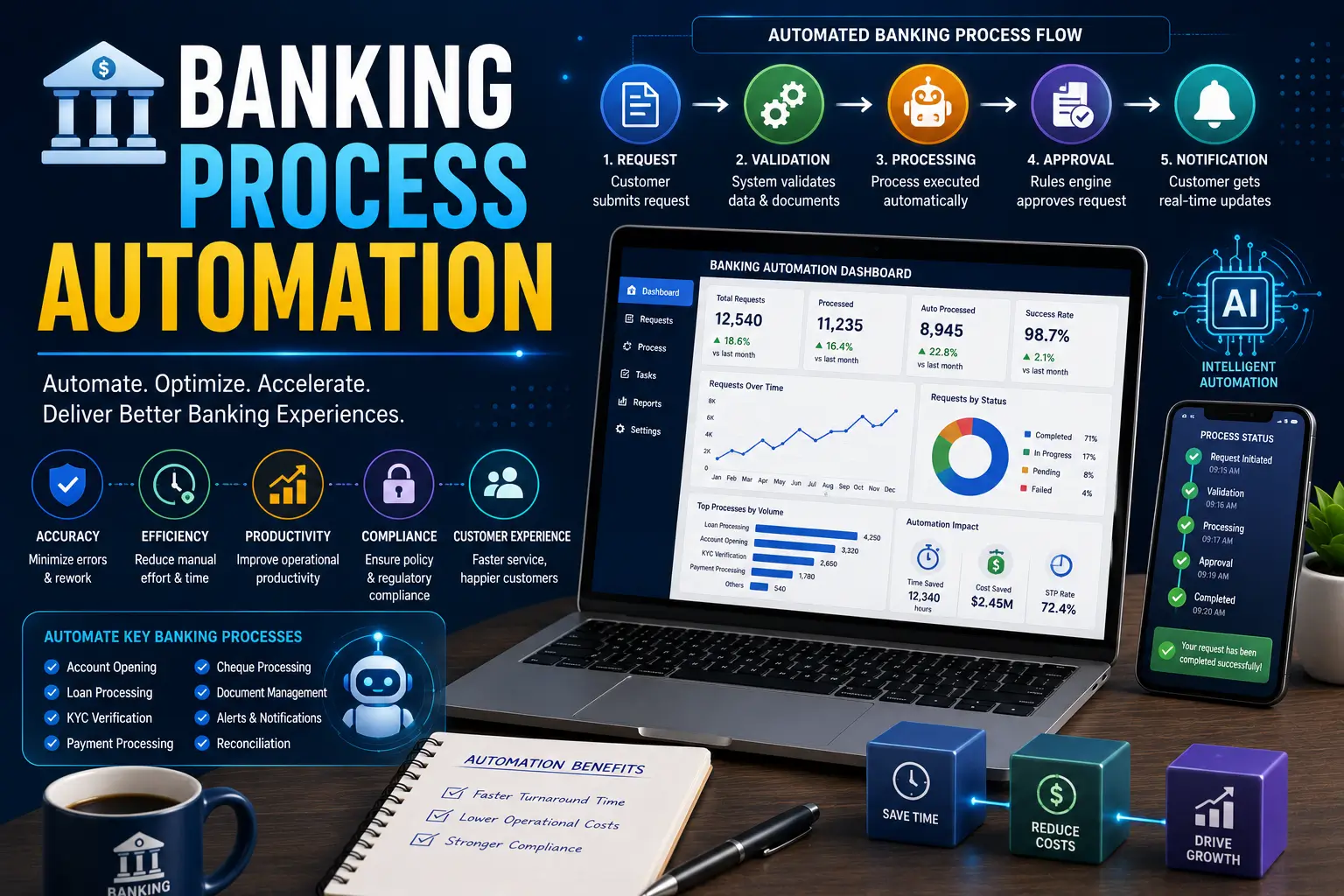
Introduction to Banking Process Automation
The Banking Process Automation Course is designed to help learners understand how modern financial institutions use automation technologies to improve operational efficiency, reduce manual efforts, and deliver faster banking services. As the banking industry continues to adopt digital transformation, automation has become an essential part of improving customer experience, managing financial processes, and increasing accuracy.
Banks handle thousands of daily activities, including account processing, transaction management, customer verification, compliance checks, reporting, and documentation. Traditionally, many of these tasks required manual involvement, which increased processing time and the possibility of errors. Banking process automation helps organizations streamline these activities by using advanced technologies, digital workflows, and automated systems.
This course provides a detailed understanding of how automation works within banking environments. Learners will explore automation concepts, banking workflows, digital transformation strategies, robotic process automation (RPA), and technology-driven financial operations. The program is suitable for beginners, banking professionals, finance students, and technology enthusiasts who want to develop practical knowledge of automation in the banking sector.
Importance of Banking Process Automation
The financial industry is experiencing rapid technological growth. Customers now expect faster transactions, instant services, secure digital platforms, and personalized banking experiences. To meet these expectations, banks are implementing automation solutions that improve speed, accuracy, and operational performance.
Banking process automation helps financial institutions reduce repetitive manual tasks and focus more on strategic activities. Automated systems can handle routine operations such as data entry, document verification, transaction processing, customer onboarding, and reporting.
Some major benefits of banking process automation include:
- Faster processing of banking transactions
- Reduced operational errors
- Improved customer service quality
- Better compliance management
- Increased employee productivity
- Enhanced data accuracy
- Lower operational costs
- Improved decision-making capabilities
By understanding automation principles, professionals can contribute to building efficient and technology-driven banking systems.
Understanding Banking Workflows
A banking workflow represents the sequence of activities involved in completing a financial service or operation. Every banking process includes multiple steps, approvals, data exchanges, and verification activities.
Examples of common banking workflows include:
- Opening customer accounts
- Loan application processing
- Payment verification
- Customer identity verification
- Transaction monitoring
- Compliance reporting
- Customer support operations
Banking process automation focuses on improving these workflows by identifying repetitive tasks and replacing manual activities with automated solutions.
Learners in this course will understand how workflow analysis helps organizations identify improvement opportunities. They will explore how automated workflows increase efficiency while maintaining security and regulatory requirements.
Introduction to Digital Banking Transformation
Digital transformation has changed the way banks operate and interact with customers. Traditional banking models are now supported by digital platforms, mobile applications, online services, and automated technologies.
Banking process automation is a key component of digital transformation because it connects people, processes, and technology. Automation allows banks to provide faster services while maintaining accuracy and security.
Modern digital banking solutions include:
- Online banking platforms
- Mobile banking applications
- Automated payment systems
- Digital customer onboarding
- Automated customer support
- Electronic documentation systems
Understanding these technologies helps learners recognize how automation supports the future of financial services.
Role of Robotic Process Automation (RPA) in Banking
Robotic Process Automation (RPA) is one of the most important technologies used in banking automation. RPA uses software-based bots to perform repetitive digital tasks that were previously completed manually.
In banking environments, RPA can be used for:
- Data entry automation
- Customer information updates
- Report generation
- Transaction verification
- Document processing
- Compliance monitoring
RPA improves productivity by allowing employees to focus on more complex tasks that require decision-making and customer interaction.
This course introduces learners to the fundamentals of RPA and explains how automation bots support banking operations. Learners will understand the advantages, applications, and limitations of RPA technology in financial institutions.
Banking Process Optimization Techniques
Process optimization focuses on improving existing banking operations by removing unnecessary steps, reducing delays, and improving resource utilization.
Effective process optimization involves:
- Identifying workflow challenges
- Analyzing operational activities
- Redesigning inefficient processes
- Implementing automation solutions
- Monitoring performance improvements
Banks use optimization techniques to create smoother customer experiences and improve internal operations.
Through this course, learners develop an understanding of how automation and optimization work together to create efficient banking systems.
Automated Customer Service Systems
Customer service is an important area where banking automation provides significant benefits. Modern banks use automated solutions such as chatbots, virtual assistants, and digital service platforms to support customers.
Automated customer service helps banks:
- Provide 24/7 assistance
- Reduce response times
- Manage common customer requests
- Improve service consistency
- Enhance customer satisfaction
Learners will explore how automation technologies improve customer communication and support banking service delivery.
Banking Data Management and Automation
Banks process large amounts of customer and transaction data every day. Managing this information efficiently requires advanced systems and automated processes.
Automation supports banking data management through:
- Automatic data collection
- Data validation
- Information processing
- Report creation
- Data monitoring
Proper data management helps banks make better decisions and maintain accurate financial records.
This course explains how automation improves data handling while supporting security and operational efficiency.
FAQ SECTION
1. What is a Banking Process Automation Course?
A Banking Process Automation Course teaches learners how modern banks use automation technologies to improve workflows, reduce manual tasks, and increase operational efficiency. The course covers banking automation concepts, digital processes, workflow optimization, and technology-based financial solutions.
2. Who should enroll in this Banking Process Automation Course?
This course is suitable for banking students, finance professionals, business management learners, technology enthusiasts, FinTech beginners, and anyone interested in understanding how automation is transforming the banking industry.
3. Do I need prior technical knowledge to join this course?
No, prior technical experience is not required. The course is designed for beginners and explains banking automation concepts, digital workflows, and automation technologies in a simple and practical way.
4. What skills will I learn from this course?
After completing the course, learners will gain knowledge of banking workflows, robotic process automation (RPA), digital banking operations, process improvement techniques, automation strategies, and financial technology applications.
5. Why is banking process automation important?
Banking process automation helps financial institutions improve speed, accuracy, security, and customer service. It reduces repetitive manual work, minimizes errors, and enables banks to deliver faster and more efficient services.
6. What topics are covered in the Banking Process Automation Course?
The course covers banking automation fundamentals, digital transformation, workflow automation, RPA concepts, automated banking systems, transaction processing, customer service automation, and future trends in financial technology.
7. Is this course suitable for banking professionals?
Yes, banking professionals can use this course to understand modern automation practices and improve their knowledge of digital banking operations and technology-driven financial services.
8. What career opportunities are available after completing this course?
After completing this course, learners can explore career opportunities such as Banking Automation Analyst, Digital Banking Specialist, RPA Banking Associate, Banking Operations Executive, FinTech Analyst, Process Automation Specialist, and Digital Transformation Executive.
9. How does automation improve banking operations?
Automation improves banking operations by reducing processing time, increasing accuracy, simplifying workflows, improving compliance management, and allowing employees to focus on higher-value activities.
10. What is the role of RPA in banking?
Robotic Process Automation (RPA) helps banks automate repetitive tasks such as data entry, document processing, transaction verification, reporting, and customer information management.




Reviews
There are no reviews yet.