
INTRODUCTION
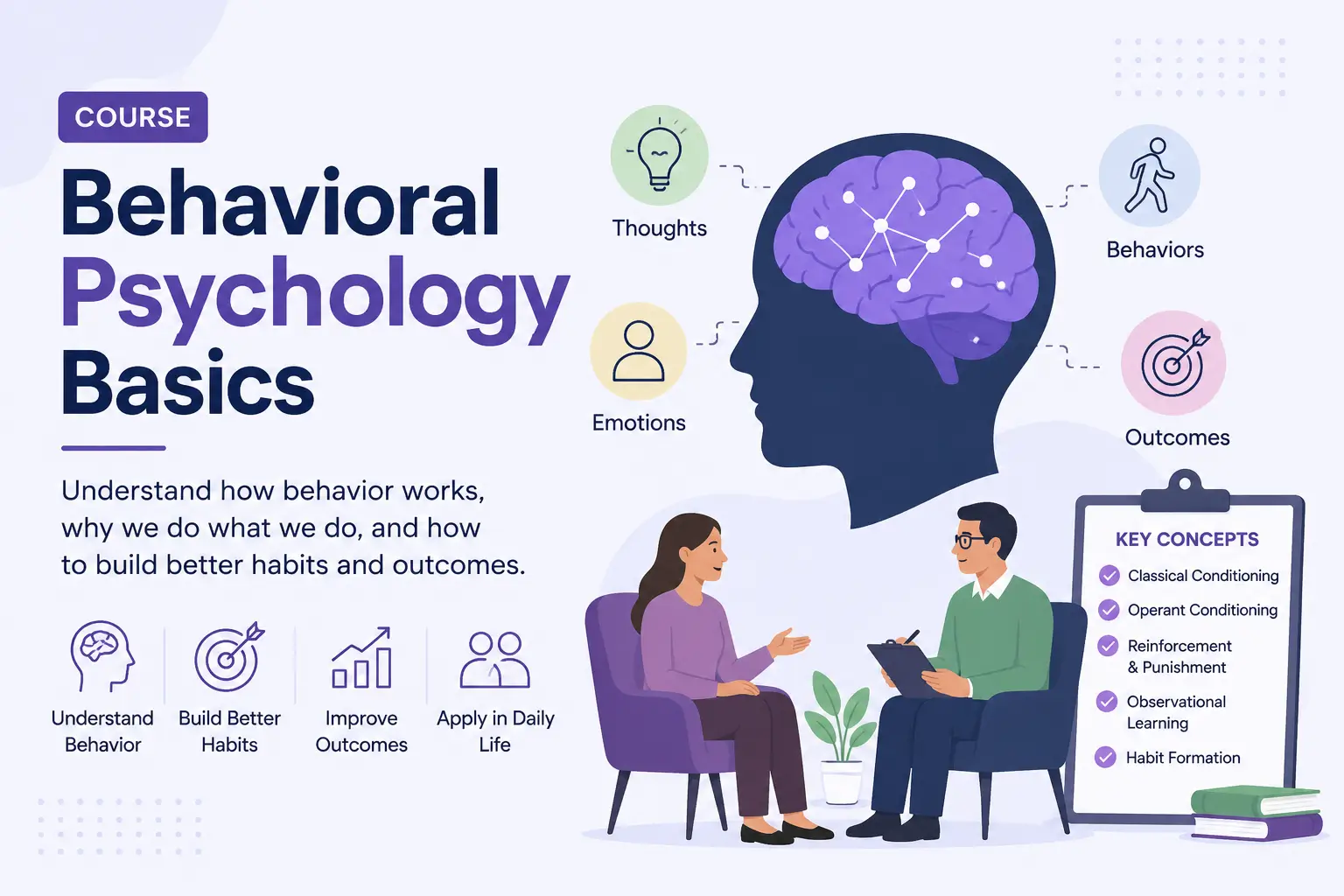
The Behavioral Psychology Basics Course is a beginner-level training program designed to help learners clearly understand how human behavior develops and changes over time. In everyday life, people often wonder why individuals act in certain ways, and this course provides scientific answers to those questions.
Moreover, behavioral psychology focuses on observable actions rather than hidden thoughts, which makes it highly practical and easy to apply. Because of this approach, learners can directly connect theory with real-life situations.
In addition, the course builds a strong foundation for understanding habits, decision-making, emotional responses, and learning patterns. As a result, students gain valuable insight into how behavior is shaped by environment and experience.
WHAT IS BEHAVIORAL PSYCHOLOGY?
Behavioral psychology is a branch of psychology that studies how people behave in different situations. Unlike other approaches, it focuses mainly on actions that can be observed and measured.
Furthermore, it explains how individuals learn from their environment, experiences, and consequences. For example, people often repeat actions that bring rewards while avoiding actions that lead to negative outcomes.
Therefore, this field plays an important role in education, business, therapy, and everyday communication.
IMPORTANCE OF BEHAVIORAL PSYCHOLOGY
Understanding behavior is extremely important in both personal and professional life. Not only does it help improve communication, but it also enhances decision-making skills.
Additionally, behavioral psychology is widely used in schools, workplaces, and marketing strategies. Because of this, learners can apply its principles in multiple industries.
Moreover, when individuals understand how behavior works, they can improve relationships and manage conflicts more effectively. Consequently, this knowledge leads to better emotional intelligence and stronger social skills.
HOW HUMAN BEHAVIOR IS LEARNED
Human behavior is not random; instead, it is learned through experience. People adapt based on their environment and past outcomes.
For instance, when someone receives appreciation for good behavior, they are more likely to repeat it. Similarly, negative experiences often reduce the chances of repeating certain actions.
In addition to this, observation also plays a key role. Many behaviors are learned by watching others and copying their actions in daily life.
CLASSICAL CONDITIONING
Classical conditioning explains how learning happens through association. It shows that two different stimuli can become linked over time.
For example, if a sound is repeatedly paired with food, a person or animal may start reacting to the sound alone.
On the other hand, this type of learning also explains emotional reactions, habits, and automatic responses in daily life.
OPERANT CONDITIONING
Operant conditioning focuses on behavior that is influenced by rewards and punishments. When a behavior is rewarded, it becomes stronger, whereas punishment reduces unwanted actions.
Additionally, this concept is widely used in training systems, education, and workplace behavior management.
Because of its effectiveness, operant conditioning is considered one of the most practical tools in behavioral psychology.
OBSERVATIONAL LEARNING
People often learn by observing others rather than direct experience. This is known as observational learning.
For instance, children learn behaviors by watching parents, teachers, and friends. Similarly, adults also adopt habits by observing colleagues or role models.
Therefore, social environment plays a powerful role in shaping personality and behavior.
HABIT FORMATION
Habits are repeated behaviors that become automatic over time. Initially, they require effort, but gradually they become part of daily routine.
Moreover, habits can be positive or negative depending on reinforcement patterns. Good habits improve productivity, while bad habits can reduce performance and well-being.
As a result, understanding habit formation helps individuals improve lifestyle and discipline.
MOTIVATION AND BEHAVIOR
Motivation is a key factor behind every human action. Without motivation, behavior becomes inconsistent and unfocused.
Furthermore, motivation can be internal (intrinsic) or external (extrinsic). Both types influence how people behave in different situations.
In addition, strong motivation improves performance, learning ability, and long-term success.
EMOTIONS AND BEHAVIOR
Emotions strongly affect how people react in daily life. When emotions are positive, behavior becomes more constructive and cooperative.
However, negative emotions such as anger or stress can lead to impulsive actions. Therefore, emotional control is an important part of behavioral psychology.
By understanding emotional triggers, individuals can improve their responses and decision-making ability.
DECISION-MAKING PROCESS
Decision-making is not always logical; instead, it is influenced by emotions, habits, and past experiences.
Additionally, psychological biases often affect how people choose between options. These biases can sometimes lead to incorrect decisions.
Therefore, learning about behavioral patterns helps improve clarity and accuracy in decision-making.
BEHAVIOR MODIFICATION
Behavior can be changed using structured psychological techniques. These techniques include reinforcement, conditioning, and habit restructuring.
For example, rewarding positive behavior encourages repetition, while reducing negative reinforcement helps eliminate unwanted actions.
In this way, behavior modification is widely used in therapy, education, and personal development.
REAL-LIFE APPLICATIONS
Behavioral psychology is used in many fields such as education, marketing, healthcare, and workplace management.
In education, it helps teachers manage classroom behavior effectively. Meanwhile, in business, it is used to understand customer decisions and improve marketing strategies.
Therefore, its applications are both wide and highly practical.
SKILLS YOU WILL GAIN
After completing this course, learners will develop:
- Strong understanding of human behavior
- Better communication skills
- Improved decision-making ability
- Habit-building techniques
- Emotional awareness
- Behavior analysis skills
- Psychological thinking ability
- Observation skills
- Motivation understanding
- Personal development mindset
BENEFITS OF THIS COURSE
This course helps learners understand why people behave the way they do. Additionally, it improves personal and professional life skills.
Moreover, it enhances emotional intelligence and strengthens social interactions. Because of this, learners become more confident in handling real-life situations.
As a result, it supports growth in multiple career fields such as education, marketing, HR, and psychology support roles.
WHO SHOULD ENROLL
This course is ideal for:
- Students
- Psychology beginners
- Teachers
- HR professionals
- Marketers
- Managers
- Coaches
- Counselors (entry level)
- Business learners
- Anyone interested in human behavior
CAREER OPPORTUNITIES
After completing this course, learners can explore roles such as:
- Behavioral Support Assistant
- HR Assistant
- Marketing Support Executive
- Customer Behavior Analyst (Basic Level)
- Training Assistant
- Research Support Assistant
- Psychology Content Writer
- Sales Behavior Assistant
- Education Support Staff
- Counseling Assistant (Entry Level)
CERTIFICATION
Upon completion, learners receive a certificate that recognizes their understanding of behavioral psychology fundamentals and human behavior analysis.
CONCLUSION
The Behavioral Psychology Basics Course provides a clear and practical understanding of how human behavior works. It not only explains psychological principles but also shows how they can be applied in real life.
Therefore, this course is highly valuable for anyone who wants to improve personal skills, professional performance, and understanding of human behavior.
FAQ SECTION
1. What is Behavioral Psychology Basics Course?
It is a beginner-level course that teaches human behavior and psychology basics.
2. Who should take this course?
Anyone interested in psychology and human behavior.
3. Do I need experience?
No, it is beginner-friendly.
4. What will I learn in this course?
You will learn behavior analysis, habits, and psychology principles.
5. Is this useful in daily life?
Yes, it improves understanding of people.
6. Will I learn about habits?
Yes, habit formation is included.
7. Is this useful for business?
Yes, it helps in marketing and HR roles.
8. Will I get a certificate?
Yes, a completion certificate is provided.
9. Is this useful for psychology careers?
Yes, it supports psychology-related roles.
10. Is this useful for personal growth?
Yes, it improves behavior and decision-making.



Reviews
There are no reviews yet.