
Build Sustainable Growth Strategies with a Circular Business Models Course
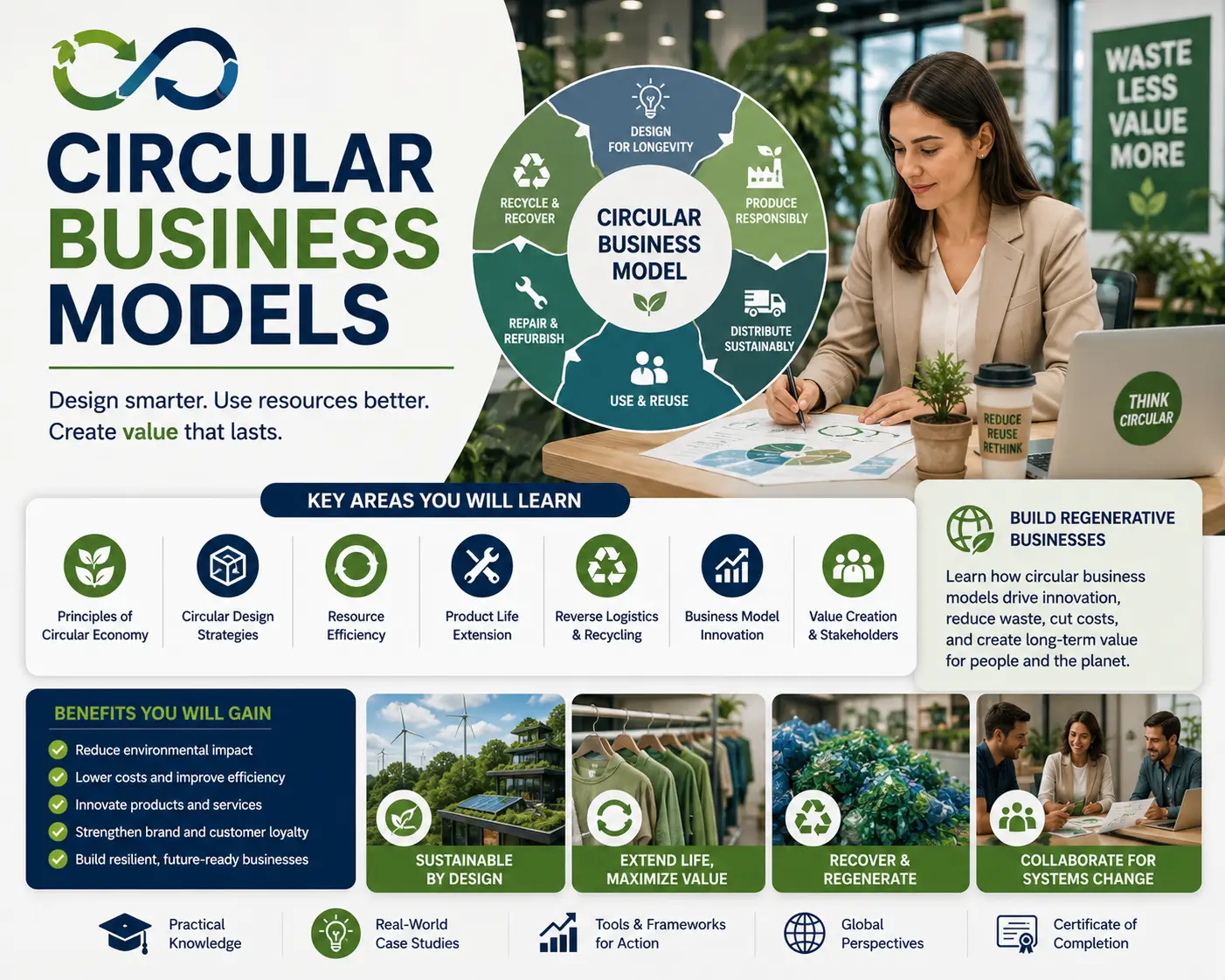
The Circular Business Models Course is designed to help learners understand how organizations can create sustainable economic value while reducing environmental impact. Circular business models are transforming industries by promoting resource efficiency, waste reduction, product life extension, recycling, and responsible consumption practices.
As governments, businesses, and consumers increasingly focus on sustainability, organizations are adopting circular economy principles to improve profitability, reduce operational risks, and meet environmental goals. This course provides a comprehensive introduction to circular business strategies, sustainable innovation, ESG principles, and long-term value creation.
Whether you are a business professional, entrepreneur, sustainability manager, consultant, student, or policymaker, this course offers valuable insights into the future of sustainable business development.
Circular Business Models Course Overview
Traditional business models often follow a linear approach of producing, using, and disposing of products. Circular business models focus on maximizing resource utilization by designing products and services that can be reused, repaired, refurbished, recycled, or regenerated.
The Circular Business Models Course explores how organizations can create competitive advantages while reducing waste and improving sustainability performance.
Why Learn Circular Business Models?
The transition to a circular economy is becoming a strategic priority across industries.
Benefits of learning Circular Business Models include:
- Understanding circular economy principles
- Learning sustainable business strategies
- Improving resource efficiency knowledge
- Supporting environmental sustainability goals
- Understanding ESG frameworks
- Building innovation capabilities
- Enhancing business competitiveness
- Increasing career opportunities in sustainability
What You Will Learn in This Circular Business Models Course
Throughout the course, learners will explore:
- Circular economy fundamentals
- Sustainable business models
- Resource optimization techniques
- Waste reduction strategies
- Product lifecycle management
- Circular supply chain concepts
- ESG and sustainability reporting
- Sustainable innovation methods
- Green business transformation
- Circular value creation strategies
Circular Economy Fundamentals
Learn the principles that support sustainable production and consumption systems.
Sustainable Business Innovation
Understand how organizations develop innovative solutions that reduce environmental impact while generating business value.
Resource Efficiency Strategies
Explore methods for maximizing resource productivity and minimizing waste.
Waste Reduction and Recycling Models
Learn practical approaches to product reuse, recycling, remanufacturing, and recovery.
ESG and Sustainability Frameworks
Understand environmental, social, and governance (ESG) principles that guide responsible business practices.
Skills You Will Gain from the Circular Business Models Course
After completing this course, learners will be able to:
- Understand circular economy concepts
- Analyze sustainable business models
- Evaluate resource efficiency opportunities
- Develop waste reduction strategies
- Apply sustainability frameworks
- Support ESG initiatives
- Identify circular innovation opportunities
- Improve sustainable business planning
Career Benefits
Sustainability expertise is increasingly valuable across industries.
Potential career opportunities include:
- Sustainability Manager
- ESG Consultant
- Circular Economy Specialist
- Business Strategy Consultant
- Sustainability Analyst
- Environmental Program Manager
- Corporate Social Responsibility (CSR) Manager
- Sustainable Supply Chain Specialist
- Green Business Advisor
- Sustainability Project Coordinator
Who Should Enroll?
This course is ideal for:
- Business professionals
- Entrepreneurs
- Sustainability managers
- ESG specialists
- Consultants
- Corporate leaders
- Business students
- Anyone interested in sustainable development
No prior sustainability experience is required.
Certification Benefits
Upon successful completion of the Circular Business Models Course, learners receive a certificate validating their understanding of circular economy principles and sustainable business strategies.
Benefits include:
- Enhanced professional credibility
- Improved sustainability knowledge
- Better strategic planning skills
- Increased employability
- Preparation for advanced sustainability and ESG programs
Conclusion
The Circular Business Models Course provides a strong foundation in sustainable business innovation, circular economy principles, resource efficiency, and ESG strategies. Learners gain practical knowledge that helps organizations create long-term value while reducing environmental impact. Whether you are pursuing a sustainability career or integrating circular practices into your business, this course offers future-focused, industry-relevant skills.
FAQ SECTION
1. What are circular business models?
Circular business models focus on reducing waste and maximizing resource use through reuse, recycling, repair, and regeneration.
2. Is this course suitable for beginners?
Yes, the course is designed for beginners and professionals interested in sustainability and business innovation.
3. What skills will I learn?
You will learn circular economy principles, sustainability strategies, ESG frameworks, resource efficiency, and waste reduction methods.
4. Why are circular business models important?
They help organizations improve sustainability, reduce costs, and create long-term business value.
5. What is the circular economy?
The circular economy is an economic system focused on minimizing waste and maximizing resource utilization.
6. Does the course cover ESG concepts?
Yes, ESG principles and sustainability frameworks are included.
7. Will I receive a certificate?
Yes, learners receive a course completion certificate.
8. Which industries use circular business models?
Manufacturing, retail, fashion, technology, construction, energy, and logistics sectors increasingly adopt circular approaches.
9. Is sustainability knowledge required?
No, prior sustainability experience is not necessary.
10. What should I learn after this course?
Advanced ESG management, sustainable supply chain management, environmental management, and corporate sustainability courses are recommended.



Reviews
There are no reviews yet.