
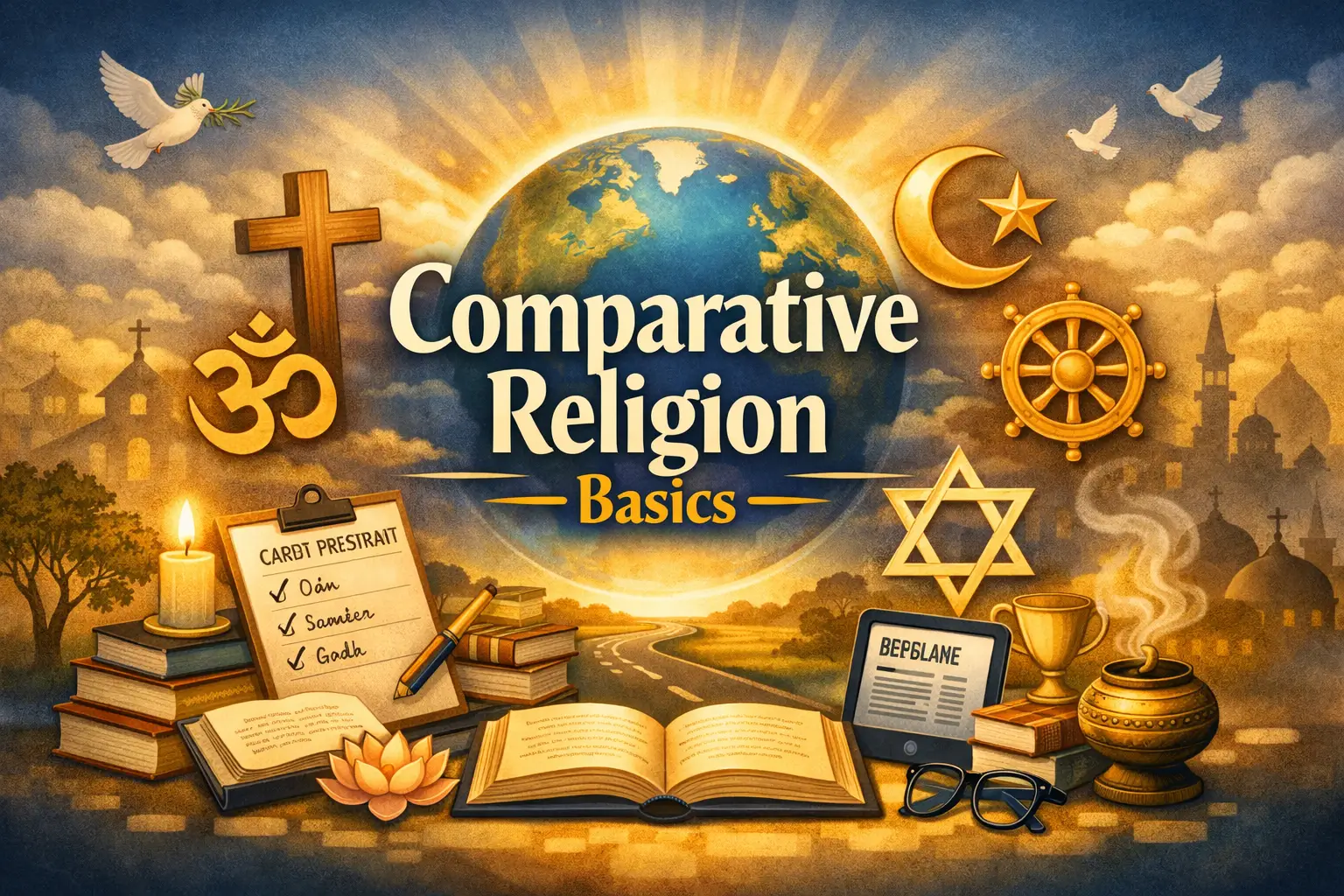
Introduction
The Comparative Religion Basics Course is designed to introduce learners to the study of major world religions and belief systems. In today’s global society, people from different cultural and religious backgrounds interact frequently. Therefore, understanding religious diversity is essential for promoting peace and respect.
Comparative religion is the academic study of similarities and differences between religions. As a result, it helps individuals develop a deeper understanding of human beliefs and traditions.
Course Overview
This course provides a structured introduction to world religions and their core principles. First of all, learners will explore the meaning of comparative religion. Next, they will study major belief systems and their historical backgrounds.
Moreover, the course explains how religions influence culture, ethics, and society. In addition, learners will understand how different faiths approach spirituality and moral values.
Consequently, participants gain a balanced and respectful understanding of global religions.
Importance of Comparative Religion
Comparative religion is important because it promotes understanding and tolerance. Specifically, it helps reduce misunderstandings between different religious communities.
Furthermore, it encourages respect for diversity and cultural awareness. In the same way, it supports peaceful coexistence in multicultural societies.
As a result, individuals develop a broader and more open-minded worldview.
What You Will Learn
In this course, learners will first understand the basics of comparative religion. Then, they will explore major world religions and their core teachings.
Additionally, learners will study similarities and differences between belief systems. Moreover, the course introduces ethical and philosophical perspectives of religions.
Finally, learners will gain awareness of interfaith dialogue and cultural understanding.
Skills You Will Gain
By completing this course, learners will develop important skills such as:
- Understanding world religions
- Cultural awareness and sensitivity
- Comparative analysis of belief systems
- Interfaith communication skills
- Ethical and philosophical thinking
- Critical thinking and open-mindedness
- Global perspective development
In addition, these skills are valuable in education, research, and social development fields.
Benefits of the Course
The Comparative Religion Basics Course provides several important benefits. Firstly, it increases awareness of global religious diversity. Secondly, it promotes tolerance and respect among different communities.
Moreover, it helps learners understand cultural and spiritual perspectives. As a result, individuals become more open-minded and socially aware.
In addition, it supports personal growth and intellectual development through broader understanding.
Who Should Enroll?
This course is suitable for a wide range of learners. For example, students interested in culture, history, and philosophy can benefit greatly.
Furthermore, educators, researchers, and curious individuals can also enroll. Importantly, no prior knowledge of religion is required.
Career Opportunities
After completing this course, learners may explore fields such as:
- Education and teaching support
- Cultural studies and research
- Social work and community development
- Journalism and content writing
- NGO and interfaith organizations
- Academic research in religious studies
Ultimately, this course builds a strong foundation for humanities and social science careers.
Certification
Upon completion, learners receive a certificate recognizing their understanding of comparative religion basics and global belief systems. This certification supports academic and personal development profiles.
Why Choose This Course?
This course simplifies complex religious concepts into an easy-to-understand format. Moreover, it focuses on respectful and balanced learning.
Therefore, learners gain knowledge, tolerance, and global awareness. In conclusion, it is ideal for anyone who wants to understand different religions and promote harmony in society.
FAQ SECTION
1. What is the Comparative Religion Basics Course?
It is a beginner-level course that introduces world religions and belief systems.
2. Is this course suitable for beginners?
Yes, it is designed for beginners with no prior knowledge.
3. What topics are covered in this course?
It includes major world religions, beliefs, and interfaith understanding.
4. Do I need religious studies background?
No, it is a foundation-level course.
5. Will I receive a certificate?
Yes, a certificate is provided after completion.
6. Why is comparative religion important?
It helps build understanding, tolerance, and respect for diversity.
7. Can students from all backgrounds join?
Yes, learners from all backgrounds can enroll.
8. Is this course theoretical or practical?
It is conceptual with real-world cultural examples.
9. What skills will I gain?
You will gain cultural awareness, critical thinking, and interfaith understanding.
10. What careers can this course support?
It supports careers in education, research, social work, and cultural studies.





Reviews
There are no reviews yet.