
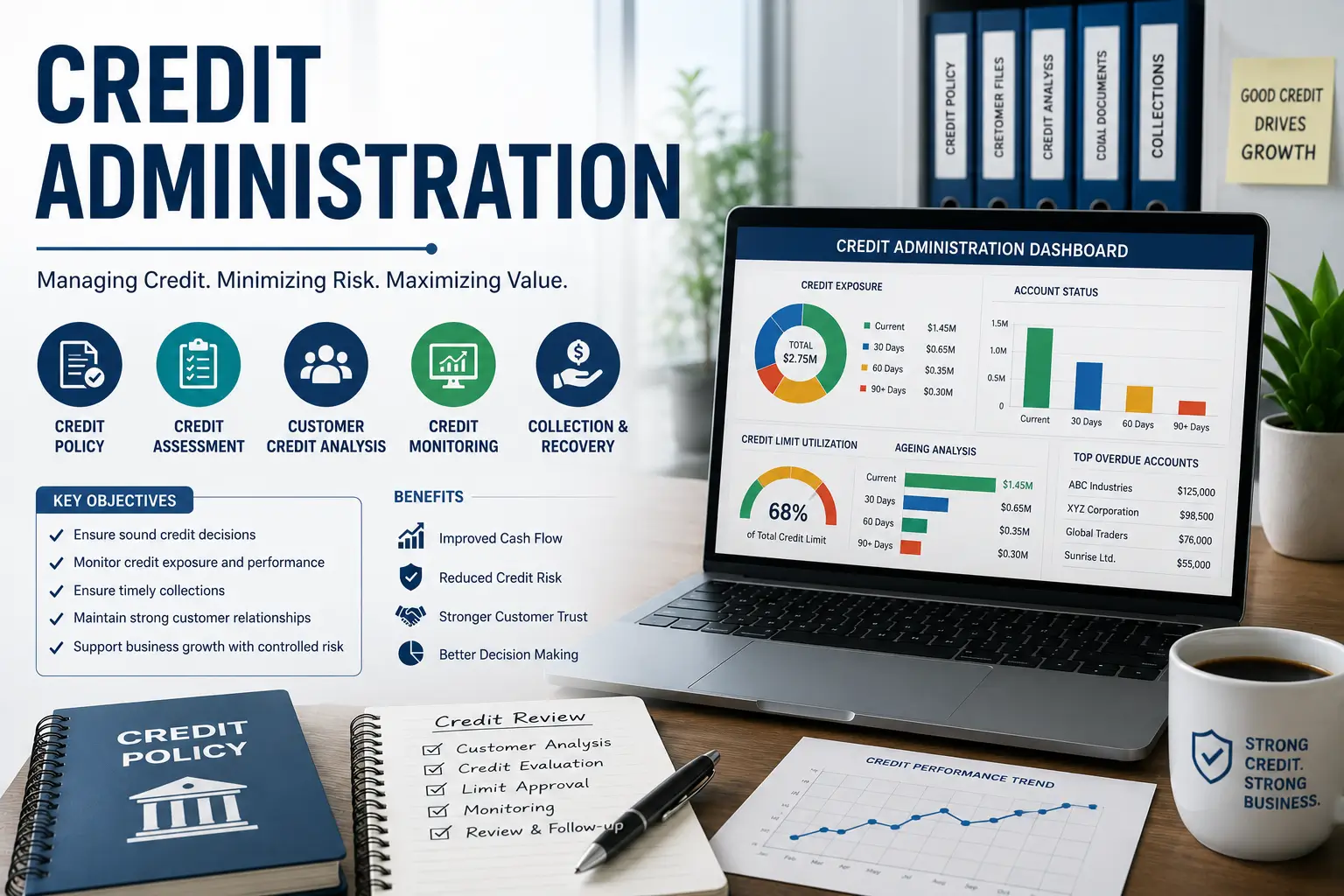
Introduction to Credit Administration
Credit administration plays a vital role in maintaining the financial health of banks, financial institutions, and corporate organizations. Effective credit management ensures that loans and credit facilities are properly evaluated, documented, monitored, and managed throughout their lifecycle. Organizations rely on structured credit administration processes to reduce financial risk while supporting responsible lending practices.
The Credit Administration Course provides a practical introduction to the complete credit administration process, helping learners understand how financial institutions manage credit portfolios while complying with industry regulations and internal policies.
Credit Administration Course Overview
This course explains the complete lifecycle of credit administration, beginning with credit application review and ending with ongoing monitoring and reporting.
Learners explore how lending decisions are supported through financial analysis, documentation, compliance procedures, collateral management, and portfolio supervision. The curriculum also introduces modern credit risk assessment techniques and the importance of maintaining accurate customer records.
Real-world business examples help learners understand how professional credit administration improves operational efficiency and financial performance.
What You Will Learn
Throughout this course, learners will understand:
- Fundamentals of credit administration
- Credit evaluation procedures
- Customer credit assessment
- Financial statement analysis
- Loan documentation processes
- Credit approval workflows
- Credit policy implementation
- Risk assessment methods
- Collateral management
- Credit portfolio monitoring
- Regulatory compliance
- Loan servicing procedures
- Credit reporting techniques
- Recovery and collection basics
- Internal control systems
Key Skills You Will Develop
After completing this course, learners will develop:
- Credit analysis skills
- Financial evaluation techniques
- Risk management knowledge
- Loan documentation abilities
- Credit monitoring practices
- Regulatory compliance awareness
- Decision-making skills
- Financial reporting understanding
- Portfolio management knowledge
- Problem-solving abilities
- Analytical thinking
- Attention to detail
- Communication skills
- Professional documentation
- Banking operations knowledge
Benefits of Learning Credit Administration
Understanding credit administration offers numerous professional advantages.
It helps financial professionals make informed lending decisions while minimizing organizational risk. Strong credit administration also improves customer service, supports regulatory compliance, enhances operational efficiency, and contributes to sustainable financial growth.
Professionals with credit administration knowledge are valuable in commercial banking, corporate finance, microfinance, insurance, fintech companies, and lending institutions.
Who Should Enroll?
This course is suitable for:
- Banking professionals
- Finance students
- Credit officers
- Loan processing executives
- Financial analysts
- Risk management professionals
- Account managers
- Business owners
- Finance graduates
- Corporate finance employees
- Microfinance professionals
- Fintech professionals
- Investment support staff
- Compliance officers
- Anyone interested in banking operations
No previous experience is required.
Career Opportunities
After completing this course, learners can pursue roles including:
- Credit Administrator
- Credit Analyst
- Loan Officer
- Banking Executive
- Credit Operations Associate
- Risk Analyst
- Finance Executive
- Relationship Officer
- Commercial Banking Associate
- Loan Processing Officer
- Portfolio Management Associate
- Financial Services Executive
- Credit Control Officer
- Collections Executive
- Banking Operations Specialist
Why Choose This Course?
The Credit Administration Course combines theoretical knowledge with practical banking concepts that reflect current industry practices.
Learners gain a structured understanding of credit operations, financial documentation, lending procedures, and risk management. The curriculum is designed for beginners while also providing valuable insights for working professionals seeking to strengthen their banking and finance expertise.
Certification
Upon successful completion, learners will receive a Course Completion Certificate demonstrating their knowledge of credit administration principles, lending operations, credit risk management, and financial documentation. This certification can strengthen your professional profile and support career growth within banking, finance, and financial services.
Conclusion
Effective credit administration is essential for maintaining healthy lending operations and reducing financial risk. This course provides the knowledge needed to understand modern credit management practices while building practical skills applicable across banking and financial institutions.
Whether you are planning a career in finance, expanding your banking knowledge, or preparing for new professional opportunities, this course offers a strong foundation for long-term success.
FAQ Section
1. What is Credit Administration?
Credit administration is the process of managing credit applications, loan documentation, monitoring repayments, and controlling lending risks within financial institutions.
2. Is this course suitable for beginners?
Yes. The course is designed for beginners as well as professionals looking to strengthen their credit management knowledge.
3. What topics are covered?
Topics include credit analysis, loan documentation, financial statement evaluation, collateral management, risk assessment, compliance, and portfolio monitoring.
4. Will I receive a certificate?
Yes. Learners receive a certificate after successfully completing the course.
5. Do I need prior banking experience?
No. Prior banking or finance experience is not required.
6. Is the course completely online?
Yes. The course is designed for flexible online learning.
7. What skills will I develop?
You will develop credit analysis, financial evaluation, loan documentation, compliance, and risk management skills.
8. What career opportunities are available?
You can pursue roles in banking, lending institutions, fintech companies, corporate finance, and financial services.
9. Why is credit administration important?
It helps organizations make informed lending decisions, reduce financial risk, maintain compliance, and improve operational efficiency.
10. Who should enroll in this course?
Students, banking professionals, finance graduates, loan officers, credit analysts, entrepreneurs, and anyone interested in financial services can benefit from this course.




Reviews
There are no reviews yet.