
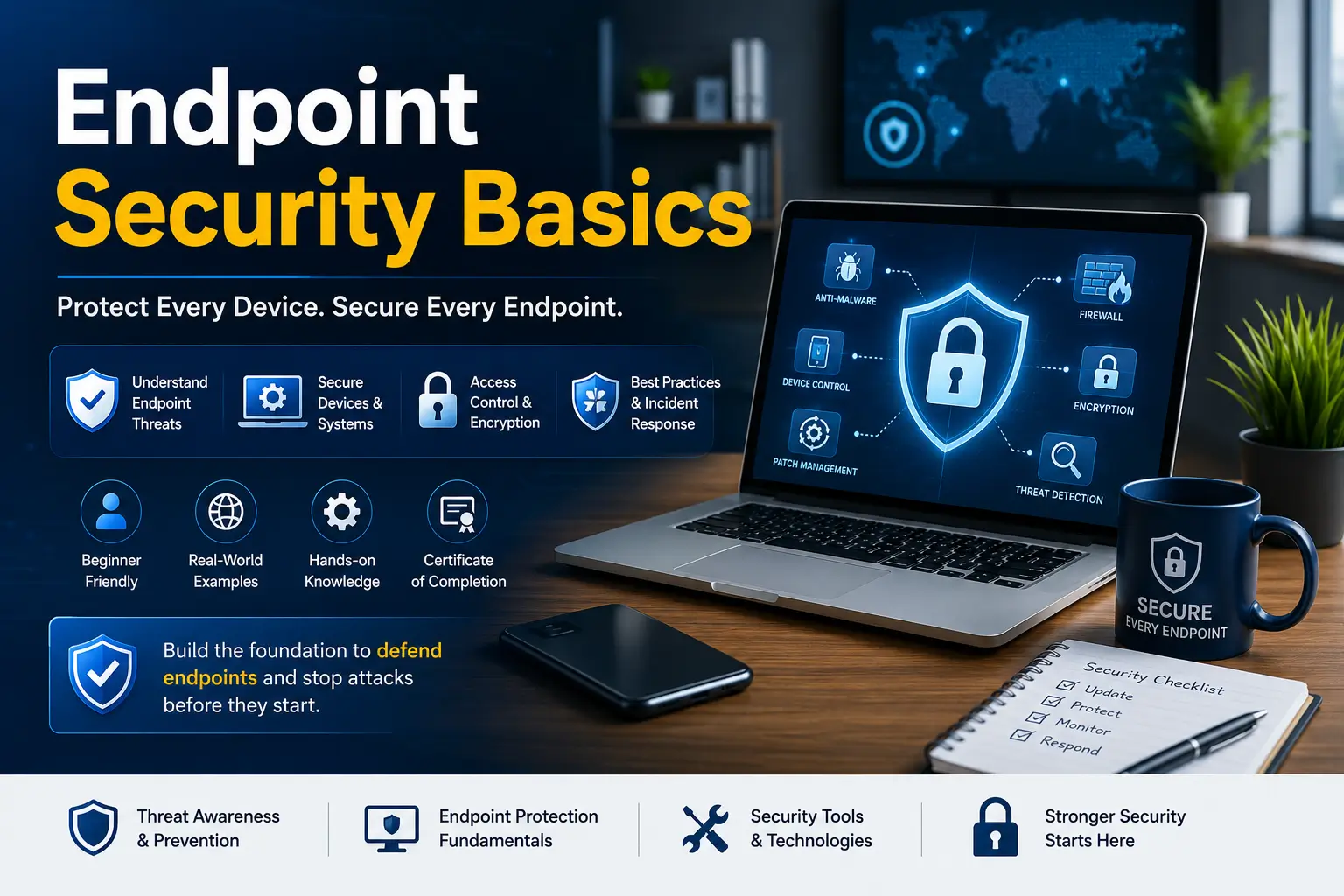
Endpoint Security Basics Course
The Endpoint Security Basics Course provides a comprehensive introduction to protecting endpoint devices such as desktops, laptops, servers, smartphones, and tablets from cyber threats. As organizations increasingly rely on connected devices and remote work environments, endpoint security has become a critical component of modern cybersecurity strategies.
This course introduces the fundamentals of endpoint security, including malware protection, ransomware defense, endpoint protection platforms (EPP), Endpoint Detection and Response (EDR), device hardening, access control, security monitoring, incident response, and cybersecurity best practices. Learners will understand how endpoint security solutions help organizations prevent, detect, and respond to cyber attacks while maintaining business continuity.
Whether you are an IT professional, cybersecurity beginner, system administrator, network administrator, student, or technology enthusiast, this course provides a strong foundation in endpoint protection and cyber defense.
Course Overview
The course explores how endpoint devices become targets for cybercriminals and how organizations implement security controls to protect sensitive data and systems. Learners will discover how endpoint protection technologies work together with security policies and user awareness to reduce cybersecurity risks.
The curriculum combines theoretical knowledge with practical examples, helping learners understand real-world endpoint security challenges and solutions.
What You Will Learn
By completing this course, you will be able to:
- Understand endpoint security fundamentals.
- Identify different types of endpoint devices.
- Recognize common endpoint cyber threats.
- Protect systems from malware and ransomware.
- Understand endpoint protection platforms (EPP).
- Learn Endpoint Detection and Response (EDR) basics.
- Apply device hardening techniques.
- Configure basic endpoint security controls.
- Understand authentication and access management.
- Monitor endpoint security events.
- Support incident response activities.
- Follow endpoint security best practices.
- Improve organizational cyber resilience.
- Understand endpoint compliance requirements.
- Build a strong cybersecurity foundation.
Course Curriculum
The curriculum begins with cybersecurity fundamentals before progressing through endpoint devices, malware protection, EPP, EDR, device hardening, authentication, security monitoring, incident response, mobile device security, compliance, and practical cybersecurity case studies.
Learners will gain practical insights into protecting endpoint devices across enterprise environments.
Skills You Will Gain
After completing the course, you will develop skills in:
- Endpoint Security
- Endpoint Protection
- Cybersecurity Fundamentals
- Malware Prevention
- Ransomware Protection
- Endpoint Detection and Response (EDR)
- Endpoint Protection Platforms (EPP)
- Device Hardening
- Security Monitoring
- Incident Response
- Access Control
- Authentication
- Risk Management
- Security Best Practices
- IT Security Awareness
Benefits of the Course
This course helps learners understand how to protect endpoint devices against modern cyber threats while improving organizational security. Strong endpoint security reduces the risk of malware infections, unauthorized access, data breaches, and operational disruptions.
Professionals with endpoint security knowledge are increasingly valuable as organizations expand remote work environments and adopt advanced cybersecurity technologies.
Who Should Enroll
This course is ideal for:
- Cybersecurity Beginners
- IT Support Professionals
- System Administrators
- Network Administrators
- Security Analysts
- Help Desk Professionals
- Computer Science Students
- Information Security Students
- Technology Professionals
- Business Owners
- Compliance Professionals
- Cloud Administrators
- SOC Team Members
- Technical Support Engineers
- Anyone interested in cybersecurity
Career Opportunities
After completing the Endpoint Security Basics Course, learners may pursue roles such as:
- IT Support Specialist
- Cybersecurity Analyst
- Security Operations Center (SOC) Analyst
- Endpoint Security Administrator
- System Administrator
- Network Administrator
- Information Security Analyst
- Security Consultant
- Technical Support Engineer
- Junior Cybersecurity Professional
These roles are in demand across government organizations, financial institutions, healthcare providers, educational institutions, technology companies, telecommunications firms, and enterprise IT departments.
Certification Details
Upon successful completion, learners receive a Certificate of Completion recognizing their knowledge of Endpoint Security Basics and modern endpoint protection practices. This certification strengthens your professional profile and supports career advancement in cybersecurity, IT administration, information security, and technical support.
If you want to build a strong foundation in protecting computers, mobile devices, and enterprise systems from cyber threats, the Endpoint Security Basics Course provides practical, industry-relevant knowledge for today’s cybersecurity landscape.
9. FAQ SECTION
1. What is the Endpoint Security Basics Course?
It teaches the fundamental concepts of protecting endpoint devices from cyber threats using modern endpoint security technologies.
2. Is this course suitable for beginners?
Yes. The course is designed for beginners and introduces endpoint security concepts step by step.
3. What topics are covered?
Endpoint protection, malware prevention, ransomware defense, EPP, EDR, device hardening, authentication, security monitoring, and incident response.
4. Do I need prior cybersecurity experience?
No. Basic computer knowledge is sufficient to begin the course.
5. Is the course online?
Yes. It is fully online and self-paced.
6. Will I receive a certificate?
Yes. A certificate is awarded after successfully completing the course.
7. Who should enroll?
IT professionals, cybersecurity beginners, students, system administrators, network administrators, and anyone interested in endpoint protection.
8. What skills will I gain?
Endpoint security, malware protection, endpoint monitoring, device hardening, incident response, authentication, and cybersecurity best practices.
9. Can this course help my career?
Yes. Endpoint security skills are highly valued in IT support, cybersecurity, system administration, network administration, and information security roles.
10. Why is endpoint security important?
Endpoint security helps organizations protect computers, mobile devices, and servers from malware, ransomware, unauthorized access, and other cyber threats while ensuring business continuity.




Reviews
There are no reviews yet.