
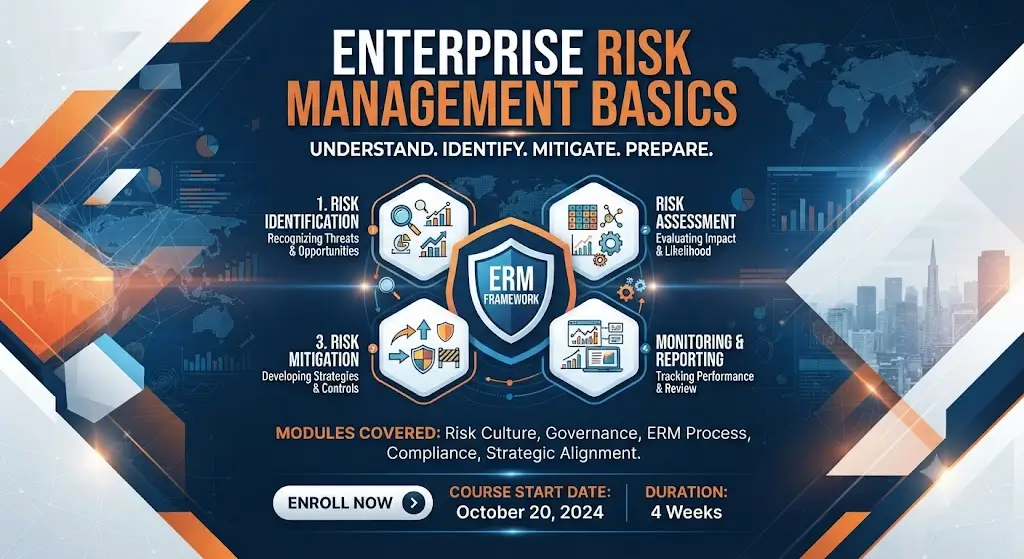
Enterprise Risk Management Basics Course
The Enterprise Risk Management Basics Course introduces learners to the core principles of identifying, evaluating, monitoring, and controlling business risks across an organization. Every business faces uncertainty, whether financial, operational, technological, legal, or strategic. Understanding these risks enables organizations to make informed decisions, protect valuable assets, and achieve long-term objectives.
This course provides practical knowledge of enterprise-wide risk management frameworks, governance practices, internal controls, compliance requirements, and business continuity planning. Instead of focusing on a single department, it explains how organizations manage risk across all business functions to improve performance and resilience.
Understanding Enterprise Risk Management Basics
Enterprise Risk Management Basics provides a structured approach to recognizing risks before they affect business operations. Organizations use this approach to improve decision-making, strengthen governance, and maintain operational stability.
During this section, learners will understand:
- Enterprise-wide risk concepts
- Corporate governance principles
- Internal control systems
- Risk ownership and accountability
- Risk reporting practices
- Compliance management
Why Risk Management Matters
Modern organizations operate in rapidly changing business environments. Effective risk management helps businesses prepare for uncertainty while protecting financial performance and operational efficiency.
Key benefits include:
- Better strategic planning
- Improved business resilience
- Stronger internal controls
- Increased stakeholder confidence
- Better regulatory compliance
- Improved organizational performance
- More effective decision-making
- Sustainable business growth
Types of Business Risks
Every organization faces multiple categories of risks that require continuous monitoring and evaluation.
The course explains:
- Strategic risks
- Operational risks
- Financial risks
- Compliance risks
- Legal risks
- Cybersecurity risks
- Technology risks
- Reputational risks
- Environmental risks
- Market risks
Understanding these risk categories helps organizations prioritize resources and implement suitable control measures.
Risk Identification Techniques
Successful organizations identify risks before they become significant business problems. Various analytical techniques help managers recognize potential threats and opportunities.
Topics covered include:
- Risk registers
- Brainstorming methods
- SWOT analysis
- Process mapping
- Root cause analysis
- Stakeholder interviews
- Business process reviews
- Risk documentation
These techniques enable organizations to create a structured foundation for managing uncertainty.
Risk Assessment and Evaluation
After risks have been identified, they must be evaluated according to their likelihood and potential business impact. This process allows organizations to prioritize actions and allocate resources effectively.
Learners will explore:
- Qualitative assessment
- Quantitative assessment
- Risk probability
- Business impact analysis
- Risk scoring
- Risk prioritization
- Risk heat maps
- Decision-making frameworks
Applying these assessment methods helps organizations understand which risks require immediate attention and which can be monitored over time.
Building a Risk-Aware Culture
A successful organization encourages employees at every level to participate in identifying and managing risks. Leadership support, communication, and accountability are essential for creating a culture where risk awareness becomes part of daily business operations.
By promoting collaboration and continuous monitoring, organizations can strengthen governance, improve compliance, and respond more effectively to changing business conditions.
Frequently Asked Questions (FAQs)
1. What is Enterprise Risk Management Basics?
Enterprise Risk Management Basics is an introductory course that explains how organizations identify, assess, monitor, and manage risks that may affect business objectives, operations, compliance, and long-term growth.
2. Who should enroll in the Enterprise Risk Management Basics Course?
This course is suitable for business professionals, risk managers, compliance officers, internal auditors, finance professionals, project managers, entrepreneurs, students, and anyone interested in learning enterprise risk management.
3. Is this course suitable for beginners?
Yes. The Enterprise Risk Management Basics Course is designed for beginners and starts with fundamental concepts before introducing practical risk management techniques and frameworks.
4. What topics are covered in this course?
The course covers risk identification, risk assessment, risk analysis, risk mitigation strategies, enterprise governance, compliance, internal controls, business continuity planning, and organizational resilience.
5. Why is Enterprise Risk Management important?
Enterprise Risk Management helps organizations identify potential threats early, improve decision-making, strengthen governance, reduce operational disruptions, maintain regulatory compliance, and support sustainable business growth.
6. Will I learn different types of business risks?
Yes. The course explains strategic risks, operational risks, financial risks, compliance risks, legal risks, cybersecurity risks, reputational risks, and environmental risks.
7. What skills will I gain after completing the Enterprise Risk Management Basics Course?
You will learn how to identify business risks, conduct risk assessments, evaluate risk impact, develop mitigation strategies, improve internal controls, support compliance, and contribute to business continuity planning.
8. Are practical risk assessment techniques included?
Yes. The course introduces practical methods such as risk registers, SWOT analysis, risk scoring, risk heat maps, business impact analysis, root cause analysis, and risk prioritization techniques.
9. What career opportunities are available after completing this course?
After completing the course, learners can pursue roles such as Enterprise Risk Analyst, Compliance Officer, Internal Auditor, Risk Management Executive, Business Risk Consultant, Operational Risk Analyst, Corporate Governance Executive, and Internal Control Specialist.
10. How does the Enterprise Risk Management Basics Course support professional growth?
The Enterprise Risk Management Basics Course develops practical risk management knowledge, strengthens analytical and decision-making skills, improves governance understanding, and prepares professionals to manage enterprise risks effectively in a wide range of industries.



Reviews
There are no reviews yet.