
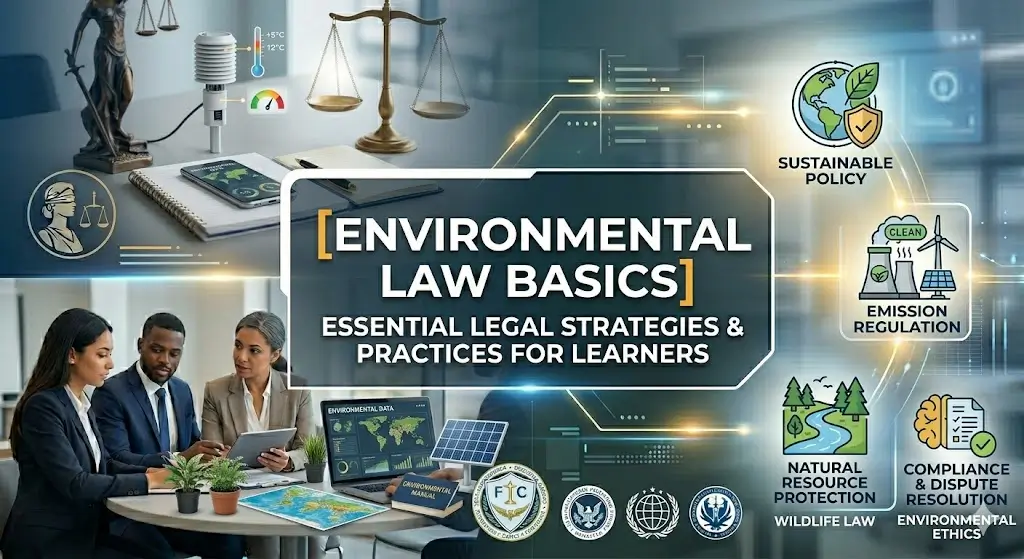
The Environmental Law Basics Course is a beginner-friendly program designed to introduce learners to the fundamental principles of environmental law and the legal frameworks that govern the protection of the environment. Environmental law focuses on regulations, policies, and legal mechanisms aimed at controlling pollution, conserving natural resources, protecting wildlife, and ensuring sustainable development for present and future generations.
Throughout this course, you will learn the core concepts of environmental protection laws, including the role of governments, regulatory bodies, and international organizations in managing environmental issues. The course covers key topics such as pollution control laws, climate change regulations, environmental impact assessments, waste management rules, and conservation of natural resources. You will also gain an understanding of how environmental disputes are resolved and how legal systems enforce compliance with environmental standards.
The Environmental Law Basics Course explains important legal principles such as the precautionary principle, the polluter pays principle, and sustainable development. It also introduces learners to major environmental legislation, enforcement mechanisms, and the role of courts in protecting environmental rights. Real-world case studies are included to help learners understand how environmental laws are applied in practice to address issues such as deforestation, air and water pollution, and industrial waste management.
This course is ideal for law students, environmental science students, policymakers, activists, and anyone interested in understanding how legal systems contribute to environmental protection. It is also valuable for professionals working in sustainability, corporate compliance, public administration, and environmental consultancy roles.
After completing the Environmental Law Basics Course, learners can explore career opportunities in environmental consultancy, legal advisory services, sustainability management, government regulatory bodies, and non-governmental organizations focused on environmental protection. The course also serves as a strong foundation for advanced studies in environmental law, climate policy, and sustainable development.






Reviews
There are no reviews yet.