
Introduction
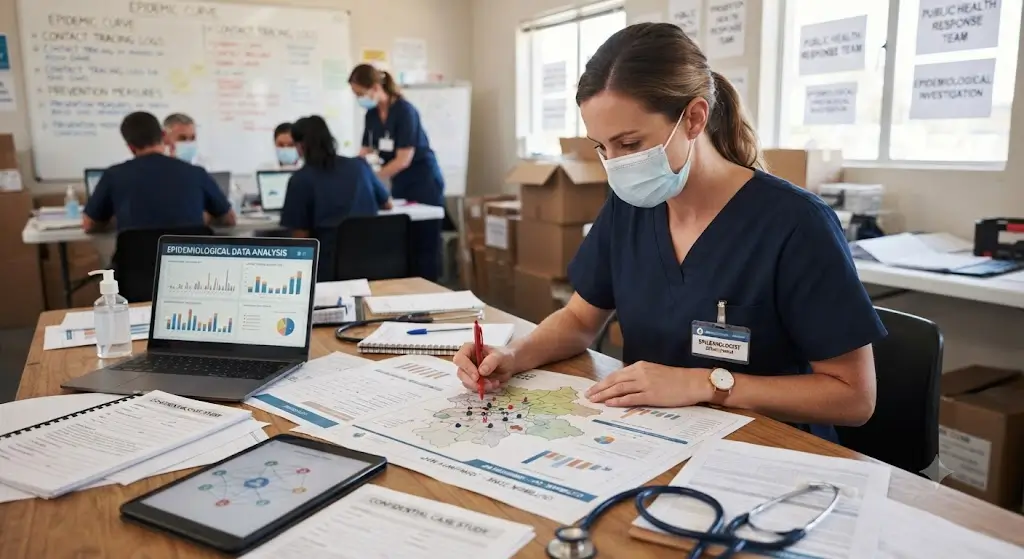
Understanding how diseases spread and identifying their causes are essential for protecting public health. The Epidemiological Investigation Course introduces learners to the principles, methods, and techniques used by epidemiologists to investigate diseases, analyze health patterns, and develop prevention strategies. As global health challenges continue to increase, skilled professionals with epidemiological investigation knowledge play a vital role in disease control and public health protection.
Epidemiological investigation focuses on studying the distribution, causes, and effects of diseases within populations. Therefore, epidemiologists collect health data, identify risk factors, investigate outbreaks, and provide evidence-based recommendations to control and prevent diseases.
Moreover, this course explains how disease surveillance, outbreak investigation, statistical analysis, field studies, laboratory coordination, and public health communication contribute to effective epidemiological responses. Learners also become familiar with infectious disease investigations, non-communicable disease analysis, environmental health risks, and emergency preparedness.
In addition, participants develop practical skills in case investigation, contact tracing, data collection, research methods, risk assessment, and epidemiological reporting. These competencies prepare learners for careers in public health departments, hospitals, research institutions, healthcare organizations, government agencies, and international health programs.
By completing this course, learners establish a strong foundation in epidemiological investigation while contributing to disease prevention, outbreak control, and improved population health outcomes.
Course Overview
The Epidemiological Investigation Course provides comprehensive training in disease investigation, outbreak analysis, surveillance methods, research techniques, and public health response strategies. Furthermore, the course explains how epidemiological investigations support healthcare decision-making and disease prevention.
Fundamentals of Epidemiology
The course begins by introducing the basic principles of epidemiology and its role in public health. Learners understand disease patterns, health indicators, population studies, risk factors, and epidemiological concepts. Consequently, they develop a strong foundation in disease investigation.
Disease Transmission and Risk Factors
Understanding disease spread is essential for controlling outbreaks. Therefore, learners study modes of transmission, infectious disease pathways, environmental factors, behavioral risks, and population-level health threats.
Outbreak Investigation Methods
The course explains outbreak detection, case definition development, field investigations, hypothesis generation, data collection, and response planning. Moreover, learners understand the systematic approach used to investigate disease outbreaks.
Epidemiological Study Designs
Learners explore observational studies, experimental studies, cohort studies, case-control studies, cross-sectional studies, and clinical research methods. Consequently, they understand how different research approaches support health investigations.
Disease Surveillance Systems
The course introduces surveillance methods, health monitoring systems, reporting mechanisms, laboratory coordination, and digital surveillance tools that support early disease detection.
Data Collection and Analysis
Participants study epidemiological data collection, statistical methods, data interpretation, health indicators, disease mapping, and reporting techniques. Therefore, learners develop skills for evidence-based decision-making.
Contact Tracing and Field Investigation
Learners understand contact identification, exposure assessment, field interviews, investigation protocols, and strategies for reducing disease transmission.
Public Health Response
The course explains outbreak management, emergency preparedness, risk communication, intervention planning, and collaboration with healthcare authorities during public health emergencies.
Emerging Trends in Epidemiological Investigation
Finally, participants explore artificial intelligence, digital epidemiology, geographic information systems (GIS), predictive analytics, and modern technologies transforming disease investigation.
Overall, this course combines epidemiological theory with practical investigation methods, enabling learners to understand every aspect of disease investigation while preparing them for careers in public health, research, healthcare, and disease control programs.
What You Will Learn
The Epidemiological Investigation Course equips learners with practical knowledge and analytical skills required to investigate diseases and support public health interventions.
Understanding Epidemiology Principles
First, learners understand epidemiological concepts, disease patterns, population health, risk factors, and the role of epidemiology in healthcare.
Conducting Disease Investigations
Participants learn how to investigate disease cases, identify causes, analyze transmission patterns, and support outbreak control activities.
Outbreak Investigation Techniques
The course teaches learners case identification, outbreak confirmation, field investigation methods, contact tracing, and response planning.
Epidemiological Research Methods
Learners explore study designs, research approaches, data collection methods, sampling techniques, and evidence-based investigation practices.
Health Data Analysis
Participants study statistical analysis, disease trends, health indicators, data interpretation, and epidemiological reporting.
Disease Surveillance
The course explains surveillance systems, monitoring techniques, reporting procedures, laboratory coordination, and digital health technologies.
Risk Assessment and Management
Learners understand how to identify health risks, evaluate disease threats, develop intervention strategies, and support public health decisions.
Public Health Communication
Participants learn risk communication, report preparation, stakeholder coordination, and effective information sharing during health investigations.
Skills You Will Gain
After completing the Epidemiological Investigation Course, learners will develop valuable research, analytical, and public health skills required for disease investigation.
Epidemiological Analysis Skills
Develop the ability to analyze disease patterns, identify causes, evaluate risks, and interpret population health data.
Outbreak Investigation Skills
Learn practical techniques for outbreak detection, case investigation, contact tracing, and disease control planning.
Research Skills
Gain knowledge of epidemiological study designs, research methods, data collection, and scientific reporting.
Data Analysis Skills
Develop skills in statistical interpretation, disease trend analysis, health indicators, and evidence-based decision-making.
Surveillance Management Skills
Understand disease monitoring systems, reporting procedures, health information systems, and surveillance strategies.
Risk Assessment Skills
Learn how to identify public health threats, evaluate risks, and recommend effective prevention strategies.
Communication Skills
Strengthen professional communication skills required for reporting findings, collaborating with healthcare teams, and sharing public health information.
Problem-Solving Skills
Analyze complex health challenges and develop practical solutions through investigation and evidence-based approaches.
Professional Competence
Build confidence to work effectively in public health agencies, research institutions, hospitals, disease control programs, and healthcare organizations.
Benefits of the Course
The Epidemiological Investigation Course provides learners with advanced knowledge and practical skills required to investigate diseases, analyze health threats, and support effective public health interventions. Moreover, the course combines epidemiological concepts with investigation techniques, data analysis, and modern healthcare practices to prepare learners for real-world public health challenges.
Develop Strong Epidemiological Knowledge
First, learners gain a comprehensive understanding of epidemiology principles, disease patterns, risk factors, and investigation methods. As a result, they develop the confidence to analyze health problems and contribute to disease prevention strategies.
Improve Disease Investigation Skills
Accurate investigation helps control disease outbreaks. Therefore, this course teaches learners how to identify cases, investigate disease causes, analyze transmission patterns, and support outbreak response activities.
Learn Outbreak Response Techniques
Public health emergencies require quick and effective action. Consequently, learners study outbreak detection, case definitions, contact tracing, field investigations, and emergency response planning.
Strengthen Data Analysis Skills
Health data plays an important role in epidemiological decisions. Furthermore, participants learn data collection, statistical analysis, disease trend evaluation, health indicators, and evidence-based reporting methods.
Understand Disease Surveillance Systems
Effective surveillance helps detect health threats early. Accordingly, learners explore surveillance methods, reporting systems, laboratory coordination, digital health tools, and disease monitoring strategies.
Develop Research Skills
Epidemiological research supports healthcare improvement. Therefore, learners gain knowledge of research methods, study designs, sampling techniques, data interpretation, and scientific reporting.
Improve Public Health Decision-Making
Epidemiological investigations provide evidence for healthcare planning. Moreover, learners understand how investigation findings support policies, prevention programs, and community health interventions.
Expand Career Opportunities
The demand for skilled epidemiology professionals continues to grow due to increasing focus on disease prevention and healthcare preparedness. As a result, completing this course improves career opportunities in public health, research, healthcare, and disease control sectors.
Prepare for Advanced Learning
The course provides a strong foundation for advanced studies in epidemiology, public health, biostatistics, healthcare management, infectious disease control, and medical research.
Support Global Health Protection
Epidemiological investigations help protect communities from emerging diseases and health threats. Ultimately, this course prepares learners to contribute to stronger healthcare systems and improved global health outcomes.
Who Should Enroll
The Epidemiological Investigation Course is designed for individuals who want to develop expertise in disease investigation, public health research, and healthcare data analysis.
Public Health Students
Students pursuing public health, epidemiology, healthcare management, medicine, nursing, life sciences, or related fields can strengthen their academic knowledge and prepare for professional careers.
Healthcare Professionals
Doctors, nurses, laboratory professionals, and healthcare workers who want to improve their understanding of disease investigation and outbreak response can benefit from this course.
Epidemiology Professionals
Individuals working in disease surveillance, healthcare research, and public health programs can enhance their investigation and analytical skills.
Medical Researchers
Researchers involved in healthcare studies, clinical research, and population health projects can improve their knowledge of epidemiological methods.
Public Health Officers
Professionals working in government health departments, disease control programs, and healthcare agencies can strengthen their expertise in investigation techniques.
Laboratory Professionals
Laboratory technicians and healthcare scientists can understand how laboratory findings support epidemiological investigations and disease monitoring.
NGO and Health Program Workers
Professionals working in community health programs, disease prevention projects, and humanitarian health initiatives can improve their public health investigation skills.
Anyone Interested in Epidemiology
Anyone interested in disease patterns, healthcare research, outbreak investigation, and public health improvement can enroll in this course.
Career Opportunities
The increasing need for disease prevention, outbreak control, and healthcare research has created excellent career opportunities for professionals with expertise in epidemiological investigation. Therefore, completing the Epidemiological Investigation Course can help learners build rewarding careers across healthcare, research, and public health sectors.
Potential career roles include:
- Epidemiologist
- Epidemiological Investigation Officer
- Public Health Analyst
- Disease Surveillance Specialist
- Outbreak Investigation Officer
- Public Health Research Associate
- Clinical Research Coordinator
- Infection Control Officer
- Health Data Analyst
- Epidemiology Program Coordinator
- Public Health Officer
- Disease Control Specialist
- Research Assistant
- Global Health Program Officer
- Healthcare Consultant
Graduates may find employment opportunities in:
- Government health departments
- Public health agencies
- Hospitals
- Research institutions
- Universities and medical colleges
- Disease control programs
- International health organizations
- Non-governmental organizations (NGOs)
- Healthcare consulting firms
- Public health laboratories
Furthermore, this course provides a strong foundation for advanced education and specialization in epidemiology, public health, biostatistics, infectious disease management, healthcare research, and global health.
Certification
Upon successfully completing the Epidemiological Investigation Course, learners will receive a Course Completion Certificate that recognizes their knowledge of disease investigation, epidemiological methods, outbreak response, health data analysis, surveillance systems, and public health research.
Moreover, the certificate demonstrates your commitment to professional development and continuous learning in the healthcare and public health sectors. It can strengthen your resume, improve your professional profile, and increase employment opportunities with public health agencies, hospitals, research organizations, government health departments, NGOs, and healthcare institutions.
Additionally, the certification validates your understanding of epidemiological study methods, disease surveillance, risk assessment, data interpretation, outbreak management, and public health communication. Consequently, it supports career advancement while preparing learners for analytical, research, technical, and public health management roles.
Conclusion
Epidemiological investigation is essential for understanding diseases, controlling outbreaks, and protecting communities from public health threats. Therefore, professionals with expertise in epidemiological methods play a crucial role in improving healthcare preparedness and supporting evidence-based decisions.
The Epidemiological Investigation Course provides comprehensive knowledge of disease investigation, outbreak response, surveillance systems, research methods, health data analysis, and public health strategies. Moreover, learners develop practical skills that enable them to investigate health problems, analyze disease patterns, and support effective prevention programs.
Throughout the course, participants strengthen their analytical thinking, research abilities, communication skills, and problem-solving capabilities while exploring modern epidemiological tools and healthcare technologies. In addition, they gain valuable insights into disease control strategies, public health planning, and emergency response approaches.
Whether your goal is to become an epidemiology professional, support disease prevention programs, contribute to healthcare research, or improve public health systems, this course provides the knowledge and confidence needed for long-term success. Ultimately, it prepares learners to contribute to healthier communities, stronger disease surveillance systems, and improved global health security.
FAQ SECTION
1. What is the Epidemiological Investigation Course?
The Epidemiological Investigation Course provides training in disease investigation, outbreak response, epidemiological research methods, surveillance systems, and public health data analysis.
2. Who should enroll in this course?
This course is ideal for public health students, healthcare professionals, researchers, epidemiologists, laboratory professionals, and anyone interested in disease investigation.
3. Do I need prior epidemiology experience?
No. The course is suitable for beginners as well as experienced healthcare and public health professionals who want to improve their epidemiological skills.
4. What topics are covered in this course?
The course covers epidemiology fundamentals, disease investigation, outbreak response, surveillance systems, research methods, statistical analysis, risk assessment, and public health reporting.
5. What skills will I gain after completing this course?
You will develop skills in outbreak investigation, disease analysis, epidemiological research, data interpretation, surveillance management, risk assessment, and public health communication.
6. Why is epidemiological investigation important?
Epidemiological investigation helps identify disease causes, control outbreaks, monitor health trends, develop prevention strategies, and improve public health decision-making.
7. What career opportunities are available after completing this course?
Graduates can pursue careers as Epidemiologists, Public Health Analysts, Disease Surveillance Specialists, Outbreak Investigation Officers, Research Associates, Infection Control Officers, and Public Health Consultants.
8. Will I receive a certificate after completing this course?
Yes. Learners who successfully complete the course will receive a Course Completion Certificate that validates their knowledge and skills in epidemiological investigation.
9. How does epidemiological investigation support healthcare?
It supports healthcare by identifying disease risks, improving outbreak response, guiding prevention programs, supporting research, and helping authorities make evidence-based decisions.
10. How can this course benefit my career?
This course strengthens your research and analytical abilities, improves your professional profile, expands career opportunities, and prepares you for roles in public health, healthcare research, disease control, and epidemiology.




Reviews
There are no reviews yet.