
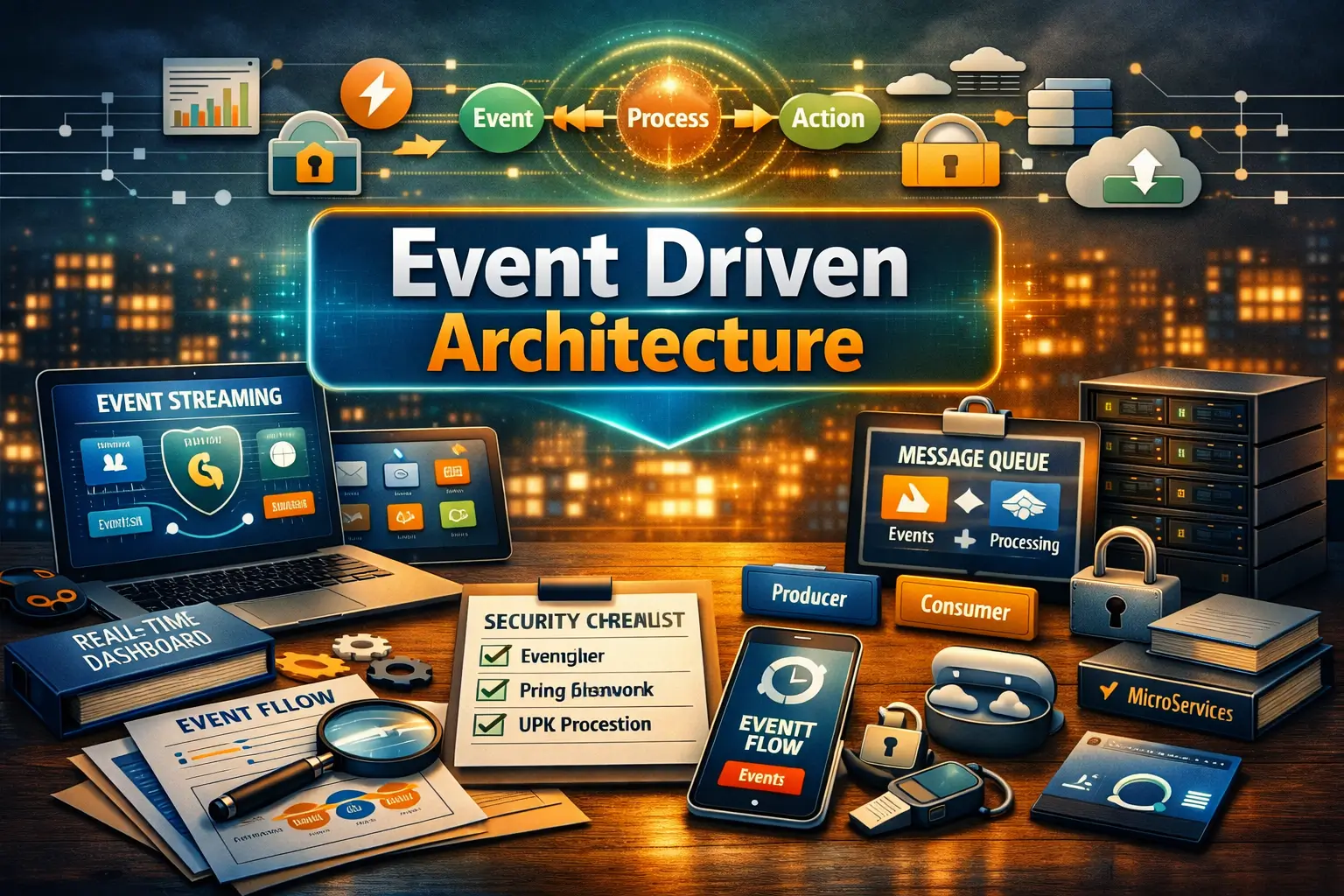
Event Driven Architecture Course
The Event Driven Architecture Course is designed to provide learners with a deep understanding of how modern distributed systems are built using events, messaging systems, and asynchronous communication patterns. As applications become more complex and real-time data processing becomes essential, Event Driven Architecture (EDA) has emerged as a critical approach for building scalable, resilient, and loosely coupled systems.
This course introduces the core principles of event-driven systems, including event producers, consumers, message brokers, pub/sub models, and event streaming platforms such as Kafka and RabbitMQ. Learners will understand how events flow through distributed systems and how to design architectures that respond to real-time changes efficiently.
Whether you are a software developer, backend engineer, system architect, or DevOps professional, this course provides the foundational and advanced knowledge needed to build modern event-driven systems used in enterprise-scale applications.
Course Overview
The course explains how event-driven systems differ from traditional request-response architectures and why they are essential for scalability and real-time processing. Learners will explore how events are generated, processed, and consumed across distributed services.
You will also gain insight into key architectural patterns such as event sourcing, CQRS, and asynchronous messaging, which are widely used in cloud-native applications.
What You Will Learn
By completing this course, you will be able to:
- Understand event-driven architecture principles.
- Design scalable event-based systems.
- Work with message brokers like Kafka and RabbitMQ.
- Implement pub/sub communication models.
- Build asynchronous microservices.
- Apply event streaming concepts.
- Use event sourcing and CQRS patterns.
- Design fault-tolerant distributed systems.
- Handle real-time data processing workflows.
- Improve system scalability and responsiveness.
- Implement decoupled service communication.
- Manage event flows in cloud environments.
- Monitor event-driven systems effectively.
- Reduce system coupling and improve flexibility.
- Design modern cloud-native architectures.
Course Curriculum
The curriculum begins with the fundamentals of event-driven systems and gradually progresses into messaging systems, event streaming, microservices integration, architectural patterns like CQRS and event sourcing, and real-world cloud-based event architectures.
Learners will explore practical scenarios such as real-time notifications, payment processing systems, IoT event streams, and large-scale distributed applications.
Skills You Will Gain
After completing the course, you will develop skills in:
- Event Driven Architecture
- Distributed Systems Design
- Message Queue Systems
- Kafka Fundamentals
- RabbitMQ Basics
- Event Streaming
- Microservices Architecture
- Asynchronous Programming
- System Design
- Scalability Engineering
- Real-Time Data Processing
- Event Sourcing
- CQRS Pattern
- Cloud Architecture
- Observability & Monitoring
Benefits of the Course
This course helps learners understand how to build modern, scalable, and resilient systems used in high-performance applications. Event-driven design improves system responsiveness, reduces coupling between services, and enables real-time processing of large-scale data.
Organizations benefit from improved scalability, fault tolerance, and faster system communication. Professionals skilled in event-driven architecture are highly valued in cloud computing, backend engineering, and distributed systems roles.
Who Should Enroll
This course is ideal for:
- Backend Developers
- Software Engineers
- System Architects
- DevOps Engineers
- Cloud Engineers
- Full Stack Developers
- Computer Science Students
- Microservices Developers
- Technical Leads
- Data Engineers
- IT Professionals
- Startup Founders
- API Developers
- Anyone interested in system design
Career Opportunities
After completing the Event Driven Architecture Course, learners may pursue roles such as:
- Backend Engineer
- Distributed Systems Engineer
- Cloud Architect
- Software Engineer
- Microservices Architect
- Data Engineer
- DevOps Engineer
- Solutions Architect
- Platform Engineer
- System Design Engineer
These roles are in high demand across cloud platforms, fintech companies, SaaS products, enterprise IT systems, and large-scale technology organizations.
Certification Details
Upon completion, learners receive a Certificate of Completion recognizing their expertise in event-driven architecture, distributed systems design, and real-time data processing systems. This certification strengthens your professional profile and supports career advancement in backend engineering and cloud architecture roles.
If you want to build modern scalable systems that process real-time events efficiently, the Event Driven Architecture Course provides essential skills for today’s distributed software world.
9. FAQ SECTION
1. What is the Event Driven Architecture Course?
It teaches how to design scalable systems using events, messaging, and asynchronous communication.
2. Is this course suitable for beginners?
Yes. It starts from fundamentals and progresses to advanced system design concepts.
3. What topics are covered?
Kafka, RabbitMQ, event streaming, microservices, CQRS, and event sourcing.
4. Do I need prior experience?
Basic programming knowledge is helpful but not required.
5. Is the course online?
Yes. It is fully online and self-paced.
6. Will I receive a certificate?
Yes. A certificate is provided after completion.
7. Who should enroll?
Developers, system architects, DevOps engineers, and software engineers.
8. What skills will I gain?
Event-driven design, distributed systems, messaging systems, and real-time processing.
9. Can this course help my career?
Yes. Event-driven architecture skills are highly demanded in cloud and backend roles.
10. Why is event-driven architecture important?
It enables scalable, decoupled, and real-time systems for modern applications.



Reviews
There are no reviews yet.