
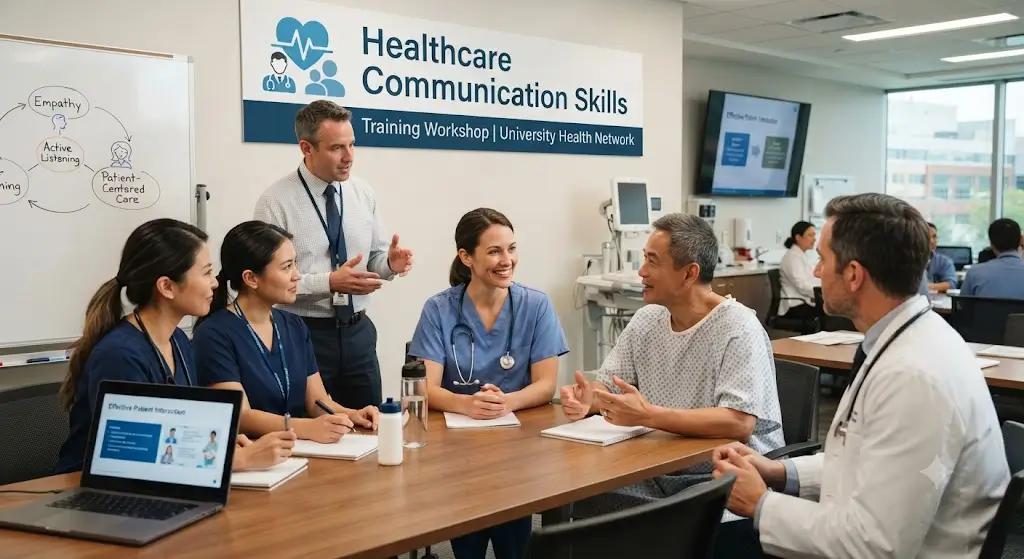
Healthcare Communication Skills Course: Build Strong Patient Interaction Skills
The Healthcare Communication Skills Course is a comprehensive, beginner-friendly, and career-focused training program designed to help learners communicate effectively in healthcare environments. Communication is one of the most important skills in healthcare, directly impacting patient care and treatment success.
First, this course introduces learners to healthcare communication fundamentals, including patient interaction, teamwork, and professional behavior. Understanding these basics is essential for careers in healthcare, nursing, and clinical support roles.
Additionally, the course presents concepts in a structured and simple format, making it suitable for beginners as well as professionals seeking to strengthen their healthcare soft skills. Whether you are a medical student, nursing student, healthcare worker, or aspiring professional, this course provides practical communication skills that support career growth.
Why Learn Healthcare Communication Skills?
Modern healthcare systems depend on strong communication between professionals and patients. Moreover, healthcare workers must communicate clearly, empathetically, and professionally.
Learning communication skills helps you:
- Improve patient interaction
- Build empathy and trust
- Enhance teamwork in hospitals
- Handle difficult conversations
- Develop professional behavior
- Reduce communication errors
As a result, learners become well-prepared for careers in healthcare, nursing, and clinical support services.
What You Will Learn
Introduction to Healthcare Communication
First, learners will understand communication principles in healthcare.
Patient Interaction Skills
Next, learners will study how to communicate with patients effectively.
Active Listening & Empathy
Additionally, learners will explore emotional understanding techniques.
Non-Verbal Communication
Moreover, learners will learn body language and tone usage.
Team Communication
Therefore, learners will study collaboration in healthcare teams.
Handling Difficult Conversations
Furthermore, learners will understand conflict and stress communication.
Real-World Scenarios
Finally, learners will explore practical hospital communication cases.
Skills You Will Gain
After completing this course, learners will develop:
- Patient communication skills
- Empathy and listening ability
- Professional behavior
- Teamwork skills
- Conflict management
- Healthcare soft skills
- Confidence in communication
- Clinical interaction readiness
Who Should Enroll?
This course is suitable for:
- Medical students
- Nursing students
- Paramedical students
- Healthcare workers
- Hospital staff
- Clinical trainees
- Healthcare administrators
- Anyone working in patient care
No prior experience is required.
Career Opportunities
Completing this course can support careers such as:
- Nurse
- Healthcare Assistant
- Medical Receptionist
- Patient Care Coordinator
- Hospital Administrator
- Clinical Support Staff
- Medical Technician
- Public Health Worker
- Healthcare Counselor
- Medical Assistant
Industries Hiring
Professionals with healthcare communication skills are valuable in:
- Hospitals
- Clinics
- Nursing homes
- Diagnostic centers
- Rehabilitation centers
- Healthcare NGOs
- Public health organizations
- Medical training institutes
- Telemedicine services
- Pharmaceutical companies
Certification Benefits
Upon successful completion, learners receive a certificate validating their healthcare communication skills.
Benefits include:
- Improved employability
- Strong healthcare soft skills
- Professional credibility
- Career advancement opportunities
- Better patient care ability
9. FAQ SECTION
1. What is a Healthcare Communication Skills Course?
It teaches how to communicate effectively in healthcare environments.
2. Who should enroll in this course?
Medical, nursing, and healthcare students or professionals.
3. Do I need prior experience?
No, it is beginner friendly.
4. What skills will I learn?
Patient communication, empathy, and teamwork.
5. How long is the course?
Typically, 4–8 weeks.
6. Will I get a certificate?
Yes, after completion.
7. Why is communication important in healthcare?
It improves patient care and reduces errors.
8. Which industries hire communication-trained professionals?
Hospitals, clinics, and healthcare organizations.
9. Can this course help my career?
Yes, it supports healthcare and patient care careers.
10. Is it suitable for beginners?
Yes, fully designed for beginners.


Reviews
There are no reviews yet.