
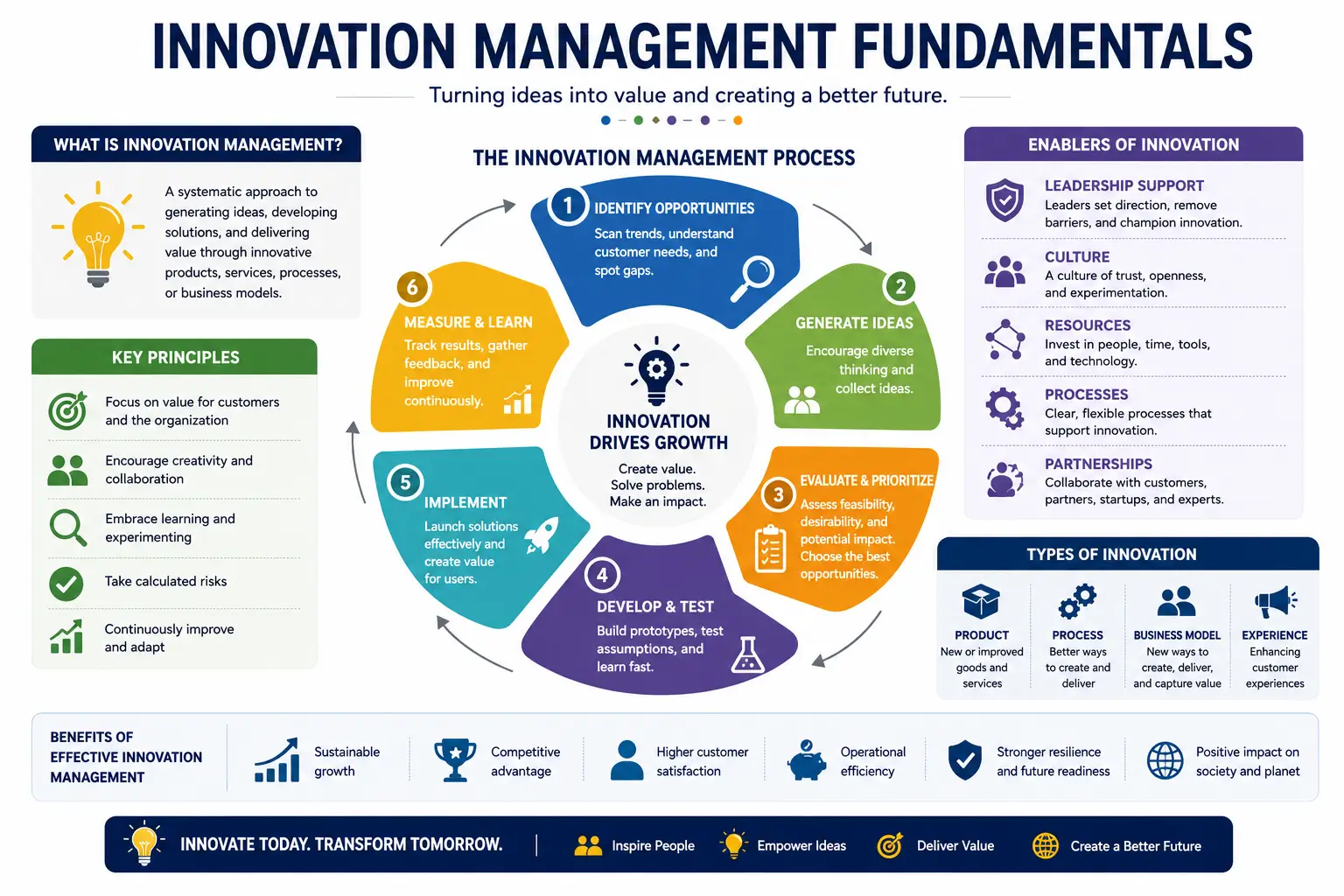
Innovation Management Fundamentals Course
The Innovation Management Fundamentals Course is a comprehensive and in-depth training program designed to help learners understand how innovation is created, managed, structured, and implemented within modern organizations. In today’s rapidly evolving business environment, innovation is not just an advantage—it is a necessity. Companies that fail to innovate often struggle to remain competitive, while those that continuously innovate lead markets, create new opportunities, and achieve long-term success.
This course provides a complete foundation in innovation management, covering the entire lifecycle of innovation—from idea generation to implementation and scaling. It is designed for students, professionals, entrepreneurs, and managers who want to understand how innovation drives business growth and transformation.
Introduction to Innovation Management
Innovation management refers to the structured process of managing ideas, creativity, development, and execution to create value for an organization. It involves transforming new concepts into practical solutions such as products, services, systems, or business models.
In this course, learners begin by understanding what innovation truly means in a business context. Innovation is not limited to invention or technology—it includes improving processes, enhancing services, optimizing systems, and finding better ways to solve problems.
Organizations today operate in highly competitive environments where customer needs, technology, and market trends change rapidly. Therefore, innovation management helps businesses stay relevant, efficient, and competitive.
Importance of Innovation in Modern Business
Innovation is the backbone of modern business success. Without innovation, organizations risk becoming outdated and irrelevant. Companies like Apple, Google, Amazon, and Tesla have demonstrated how continuous innovation leads to global leadership.
This course explains why innovation is essential:
- It helps businesses stay competitive in dynamic markets
- It enables product and service differentiation
- It improves operational efficiency and productivity
- It supports business growth and expansion
- It drives customer satisfaction and loyalty
- It creates new revenue streams and opportunities
Learners will understand how innovation is directly connected to profitability, sustainability, and long-term business survival.
Innovation Lifecycle
A major part of this course focuses on the innovation lifecycle, which explains how ideas evolve into real-world solutions. The innovation lifecycle includes several stages:
1. Idea Generation
This is the stage where creative thinking is used to generate new ideas. Ideas can come from employees, customers, market research, or technological advancements.
2. Idea Screening
Not all ideas are practical or valuable. In this stage, organizations evaluate ideas based on feasibility, cost, impact, and alignment with business goals.
3. Concept Development
Selected ideas are developed into structured concepts. This includes defining objectives, target users, and expected outcomes.
4. Prototype Development
A prototype is created to test the idea in real conditions. This helps identify potential issues before full-scale implementation.
5. Testing and Validation
The prototype is tested to ensure it meets requirements. Feedback is collected and improvements are made.
6. Implementation
The final idea is implemented into the organization as a product, service, or process.
7. Scaling and Improvement
Successful innovations are scaled and continuously improved based on performance and feedback.
Understanding this lifecycle is essential for managing innovation effectively in any organization.
Creative Thinking and Idea Generation
Creativity is the foundation of innovation. Without creative thinking, innovation cannot exist. This course teaches learners how to develop creative thinking skills and apply them in business situations.
Techniques covered include:
- Brainstorming methods
- Mind mapping
- Lateral thinking techniques
- Problem reframing
- Reverse thinking
- Customer-driven idea generation
Learners also understand how organizations encourage creativity through culture, leadership, and collaborative environments.
Design Thinking Approach
Design thinking is a human-centered approach to innovation. It focuses on understanding user needs and developing solutions that are practical, desirable, and feasible.
The design thinking process includes:
Empathize
Understanding user problems and needs.
Define
Clearly identifying the problem statement.
Ideate
Generating multiple possible solutions.
Prototype
Building a simple version of the solution.
Test
Testing the solution and improving it based on feedback.
This approach is widely used in product development, service design, and business innovation strategies.
Types of Innovation
Innovation can take different forms depending on business goals and industry requirements.
Product Innovation
Creating new or improved products.
Process Innovation
Improving internal workflows and systems.
Service Innovation
Enhancing customer experience and service delivery.
Business Model Innovation
Changing how a business creates and delivers value.
Technological Innovation
Using new technologies to improve performance.
Learners will understand how each type of innovation contributes to organizational success.
Innovation Strategy and Planning
Innovation must be strategic, not random. Organizations need structured planning to ensure innovation aligns with business goals.
This course covers:
- Innovation strategy development
- Long-term planning methods
- Market analysis for innovation
- Competitive advantage strategies
- Risk assessment in innovation
- Resource allocation for innovation projects
Learners will understand how companies build innovation roadmaps to achieve sustainable growth.
Role of Leadership in Innovation
Leadership plays a critical role in driving innovation within organizations. Without strong leadership, innovation efforts often fail.
This course explores:
- Leadership styles that support innovation
- Creating an innovation-friendly culture
- Encouraging employee creativity
- Managing innovation teams
- Decision-making in innovation projects
- Overcoming resistance to change
Leaders are responsible for creating environments where innovation can thrive.
Innovation in Organizations
Organizations must integrate innovation into their structure and culture. This course explains how companies manage innovation at different levels.
Topics include:
- Organizational innovation systems
- Cross-functional collaboration
- Innovation teams and roles
- Internal innovation programs
- Employee involvement in innovation
- Open innovation concepts
Learners will understand how large organizations manage continuous innovation.
Challenges in Innovation Management
Innovation is powerful, but it also comes with challenges.
Common challenges include:
- Resistance to change
- Lack of resources
- Poor communication
- Unclear goals
- Risk of failure
- Market uncertainty
This course teaches how organizations overcome these challenges using structured processes and leadership support.
Skills You Will Gain
By completing this course, learners will develop:
- Innovation management skills
- Creative thinking ability
- Problem-solving techniques
- Strategic planning knowledge
- Design thinking understanding
- Leadership and teamwork skills
- Project management skills
- Analytical thinking ability
- Business innovation awareness
- Decision-making skills
These skills are highly valuable in modern business environments.
Benefits of Innovation Management
Innovation management offers several benefits for organizations and individuals:
- Improved business performance
- Competitive advantage in the market
- Increased productivity
- Better customer satisfaction
- Enhanced problem-solving ability
- Stronger organizational growth
Organizations that focus on innovation are more adaptable and successful in changing environments.
Career Opportunities
After completing this course, learners can pursue roles such as:
- Innovation Manager
- Product Manager
- Business Analyst
- Strategy Consultant
- R&D Specialist
- Startup Founder
- Project Manager
- Business Development Executive
- Corporate Innovation Officer
These roles exist across industries such as IT, manufacturing, consulting, healthcare, and startups.
Who Should Take This Course?
This course is ideal for:
- Students
- Entrepreneurs
- Business professionals
- Managers
- Product developers
- Startup founders
- Innovation enthusiasts
- Corporate teams
No prior experience is required.
Conclusion
Innovation is the driving force behind business success in the modern world. Organizations that embrace innovation are more competitive, adaptable, and successful. This course provides a complete foundation in innovation management, helping learners understand how ideas are transformed into impactful solutions.
By mastering innovation processes, creative thinking, design thinking, and strategic planning, learners will be prepared to contribute effectively to any organization or even build their own innovative ventures.
The Innovation Management Fundamentals Course equips learners with the knowledge and skills needed to thrive in today’s fast-changing business environment.
FAQ SECTION
1. What is Innovation Management?
Innovation Management is the structured process of generating, developing, and implementing new ideas to improve products, services, or business processes.
2. What will I learn in this course?
You will learn innovation strategy, design thinking, creative problem-solving, idea development, product innovation, and innovation lifecycle management.
3. Is this course suitable for beginners?
Yes, this course is designed for beginners as well as professionals who want to understand innovation processes.
4. Do I need any technical background?
No technical background is required. Basic understanding of business or creativity is enough.
5. What skills will I gain from this course?
You will gain skills in creative thinking, innovation strategy, problem-solving, design thinking, and business innovation planning.
6. Who should enroll in this course?
Students, entrepreneurs, managers, product developers, and business professionals should enroll in this course.
7. Why is innovation important in business?
Innovation helps businesses stay competitive, improve efficiency, develop new products, and grow in changing markets.
8. Does this course include practical learning?
Yes, it includes practical innovation methods like design thinking, idea generation, and real-world problem-solving techniques.
9. What career opportunities can I get after this course?
You can explore roles such as Innovation Manager, Product Manager, Business Analyst, Strategy Consultant, and Startup Founder.
10. How does this course help in real business life?
It helps you understand how companies create and manage ideas, solve problems creatively, and build successful business strategies.




Reviews
There are no reviews yet.