
Build Modern Cloud Skills with a Kubernetes Fundamentals Course
The Kubernetes Fundamentals Course is designed to help learners understand one of the most important technologies in modern cloud computing and DevOps environments. Kubernetes has become the industry standard for container orchestration, enabling organizations to deploy, manage, scale, and automate applications efficiently across cloud and on-premises infrastructures.
As businesses increasingly adopt cloud-native technologies, the demand for Kubernetes professionals continues to grow. This course introduces learners to containerization concepts, Kubernetes architecture, cluster management, application deployment, and cloud-native operations.
Whether you are a software developer, DevOps engineer, system administrator, cloud professional, or IT student, this course provides a strong foundation in Kubernetes and modern infrastructure management.
Kubernetes Fundamentals Course Overview
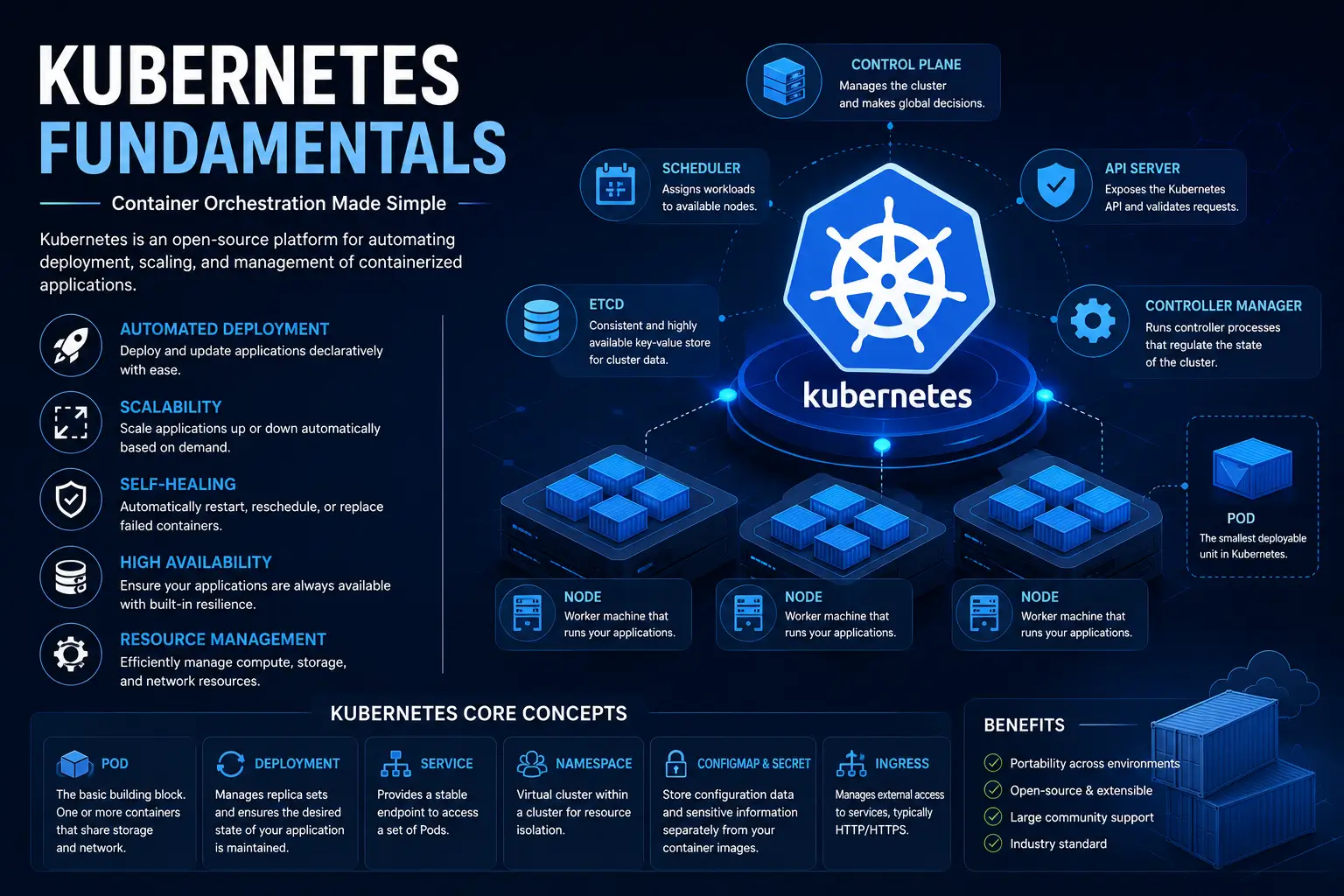
Kubernetes is an open-source platform used to automate the deployment, scaling, and management of containerized applications. It helps organizations improve reliability, scalability, and operational efficiency while supporting modern software development practices.
The Kubernetes Fundamentals Course explores how Kubernetes clusters operate, how applications are deployed, and how cloud-native environments are managed effectively.
Why Learn Kubernetes Fundamentals?
Kubernetes is widely used by organizations across industries to support scalable and resilient applications.
Benefits of learning Kubernetes Fundamentals include:
- Understanding container orchestration
- Learning cloud-native technologies
- Improving DevOps knowledge
- Understanding scalable infrastructure
- Enhancing cloud computing expertise
- Building automation skills
- Increasing career opportunities
- Preparing for advanced DevOps certifications
What You Will Learn in This Kubernetes Fundamentals Course
Throughout the course, learners will explore:
- Kubernetes fundamentals
- Containerization concepts
- Kubernetes architecture
- Cluster management
- Application deployment
- Service discovery
- Scaling and load balancing
- Resource management
- Monitoring and maintenance
- Kubernetes best practices
Containerization Concepts
Learn how containers package applications and dependencies to improve portability and deployment efficiency.
Kubernetes Architecture
Understand the core components of Kubernetes including nodes, pods, services, deployments, and control planes.
Cluster Management
Explore how Kubernetes manages resources and coordinates containerized applications across clusters.
Application Deployment and Scaling
Learn how applications are deployed, updated, scaled, and monitored within Kubernetes environments.
Cloud-Native Development
Discover how Kubernetes supports modern cloud-native software development and operations.
Skills You Will Gain from the Kubernetes Fundamentals Course
After completing this course, learners will be able to:
- Understand Kubernetes architecture
- Manage containerized workloads
- Analyze Kubernetes deployments
- Understand cluster operations
- Apply container orchestration principles
- Support cloud-native environments
- Evaluate Kubernetes workflows
- Improve DevOps and cloud computing knowledge
Career Benefits
Kubernetes expertise is highly valued in today’s technology industry.
Potential career opportunities include:
- Kubernetes Administrator
- DevOps Engineer
- Cloud Engineer
- Site Reliability Engineer (SRE)
- Platform Engineer
- Cloud Infrastructure Specialist
- Systems Administrator
- Cloud Operations Engineer
- Infrastructure Engineer
- DevOps Consultant
Who Should Enroll?
This course is ideal for:
- Software developers
- DevOps engineers
- Cloud professionals
- IT administrators
- System engineers
- Computer science students
- Technology enthusiasts
- Anyone interested in cloud-native technologies
Basic knowledge of Linux and cloud computing is helpful but not mandatory.
Certification Benefits
Upon successful completion of the Kubernetes Fundamentals Course, learners receive a certificate validating their understanding of Kubernetes and container orchestration technologies.
Benefits include:
- Enhanced professional credibility
- Improved cloud computing knowledge
- Increased employability
- Better DevOps expertise
- Preparation for advanced Kubernetes certifications
Conclusion
The Kubernetes Fundamentals Course provides a strong foundation in container orchestration, cluster management, cloud-native applications, and DevOps practices. Learners gain practical knowledge that helps them understand how modern organizations deploy and manage scalable applications. Whether you are starting a DevOps career or enhancing your cloud expertise, this course offers valuable industry-relevant skills.
FAQ SECTION
1. What is Kubernetes?
Kubernetes is an open-source platform used to automate the deployment, scaling, and management of containerized applications.
2. Is this Kubernetes Fundamentals Course suitable for beginners?
Yes, the course is designed for beginners and IT professionals interested in cloud technologies.
3. What skills will I learn?
You will learn Kubernetes architecture, container orchestration, cluster management, deployment strategies, and cloud-native concepts.
4. Do I need Docker knowledge?
Basic Docker knowledge is helpful but not required.
5. Why is Kubernetes important?
Kubernetes simplifies application deployment, scaling, and management in modern cloud environments.
6. What industries use Kubernetes?
Technology, finance, healthcare, e-commerce, telecommunications, and cloud service providers widely use Kubernetes.
7. Will I receive a certificate?
Yes, learners receive a course completion certificate.
8. Is Kubernetes useful for DevOps careers?
Yes, Kubernetes is one of the most in-demand skills for DevOps and cloud professionals.
9. Does the course cover cluster management?
Yes, cluster management is a key part of the curriculum.
10. What should I learn after this course?
Advanced Kubernetes administration, Docker, cloud architecture, CI/CD pipelines, and DevOps engineering courses are recommended.





Reviews
There are no reviews yet.