
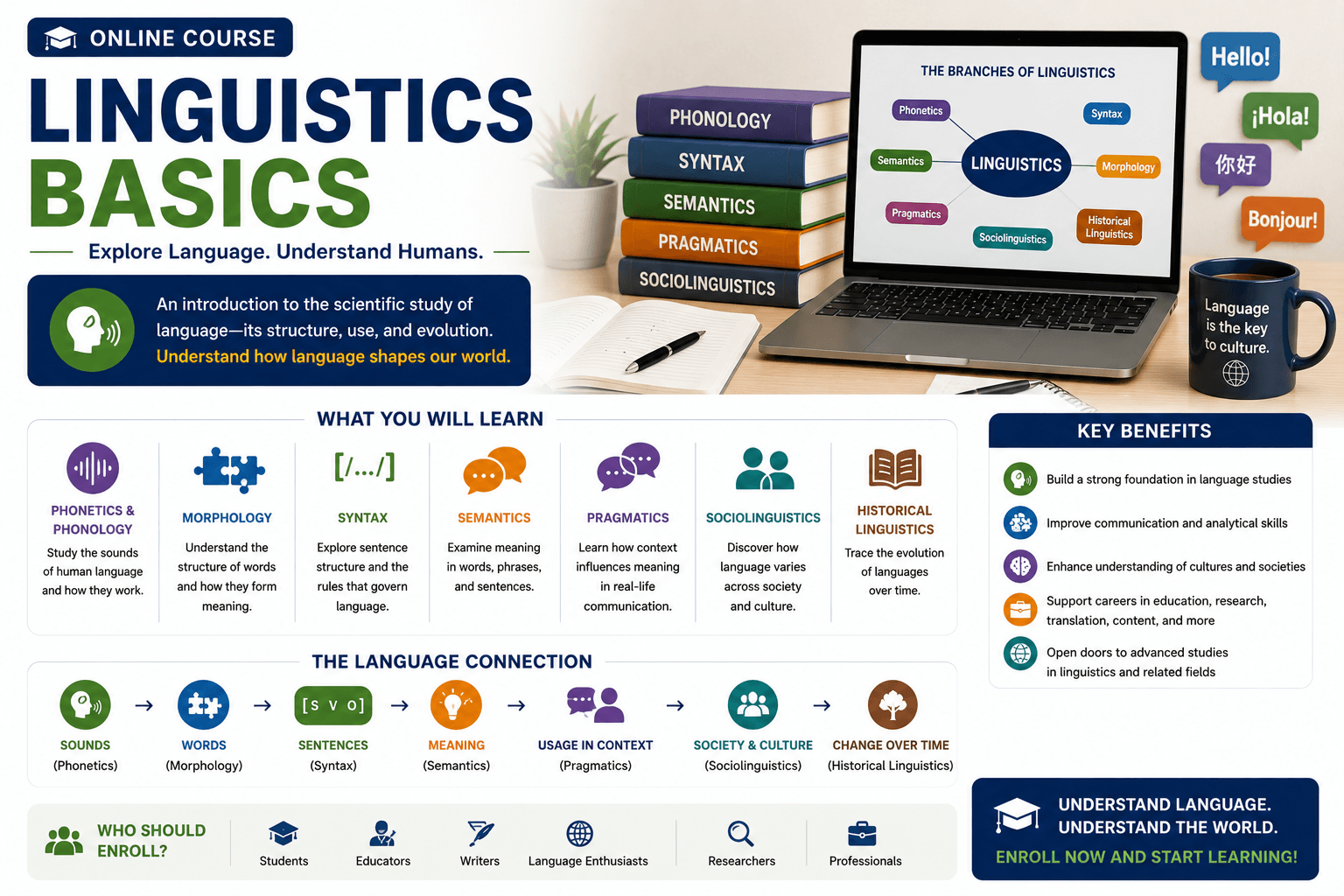
The Linguistics Basics Course is a beginner-friendly program designed to introduce learners to the scientific study of language. Linguistics helps us understand how languages are formed, structured, spoken, interpreted, and used in everyday communication.
In today’s global world, language skills are increasingly important in education, communication, artificial intelligence, content creation, translation, and international business. This course provides a strong foundation in linguistic concepts and language analysis techniques.
Whether you are a student, language enthusiast, teacher, researcher, or professional, this course will help you understand the fascinating world of human language.
Why Learn Linguistics?
Language is a powerful tool that connects people, cultures, and societies. Studying linguistics allows learners to understand the structure and function of languages beyond simply speaking them.
This course helps students analyze how language evolves, how sounds are produced, and how meaning is created.
Linguistics is valuable in many fields, including:
- Education
- Translation
- Content Writing
- Journalism
- Artificial Intelligence
- Natural Language Processing (NLP)
- Speech Technology
- Communication Studies
- Research
- International Business
What You Will Learn
Introduction to Linguistics
Understand the fundamentals, history, and branches of linguistics.
Phonetics
Learn how speech sounds are produced and classified.
Phonology
Understand sound patterns and pronunciation systems.
Morphology
Study how words are formed and structured.
Syntax
Learn how sentences are constructed.
Semantics
Understand how language conveys meaning.
Pragmatics
Learn how language is used in different contexts.
Sociolinguistics
Explore the relationship between language and society.
Language Analysis
Develop analytical skills to study and interpret language patterns.
Skills You Will Gain
After completing this course, you will develop:
- Language analysis skills
- Critical thinking abilities
- Communication skills
- Research skills
- Analytical reasoning
- Cultural awareness
- Problem-solving abilities
- Academic writing skills
- Linguistic interpretation skills
- Language observation techniques
Who Should Enroll?
This course is ideal for:
- Students
- Language enthusiasts
- Teachers
- Researchers
- Content writers
- Journalists
- Translators
- Communication professionals
- AI enthusiasts
- Working professionals
No prior knowledge is required.
Career Opportunities
Completing a Linguistics Basics Course can support careers in:
- Linguistics Research
- Language Teaching
- Translation Services
- Content Writing
- Editing and Proofreading
- Journalism
- Speech Technology
- Natural Language Processing (NLP)
- AI Language Training
- Communication Consulting
Industries Hiring
Professionals with linguistics knowledge are valuable in:
- Educational institutions
- Media organizations
- Publishing companies
- Technology companies
- AI startups
- Research organizations
- Translation agencies
- Corporate communication departments
Certification Benefits
Upon successful completion, learners receive a certificate that validates their foundational understanding of linguistics.
Benefits include:
- Improved academic skills
- Better communication abilities
- Enhanced analytical thinking
- Career diversification
- Professional development opportunities
9. FAQ SECTION
1. What is a Linguistics Basics Course?
A Linguistics Basics Course introduces learners to the scientific study of language, including its structure, sounds, meanings, and usage.
2. Who should take this course?
Students, teachers, writers, translators, researchers, and language enthusiasts can benefit from this course.
3. Do I need prior knowledge?
No. This course is designed specifically for beginners.
4. What topics will I learn?
You will learn phonetics, phonology, syntax, semantics, morphology, pragmatics, and sociolinguistics.
5. How long does the course take to complete?
Most courses can be completed within 4 to 8 weeks, depending on the learning schedule.
6. Will I receive a certificate?
Yes. A certificate is awarded after successful completion.
7. Is linguistics useful for career growth?
Yes. Linguistics can support careers in education, communication, AI, translation, and research.
8. Can this course help with language learning?
Yes. Understanding language structures can improve language learning abilities.
9. Is linguistics useful in artificial intelligence?
Yes. Linguistics plays a major role in Natural Language Processing (NLP) and AI language technologies.
10. Is this course suitable for students in India?
Yes. This course is highly relevant for students interested in languages, communication, and emerging technologies.



Reviews
There are no reviews yet.