
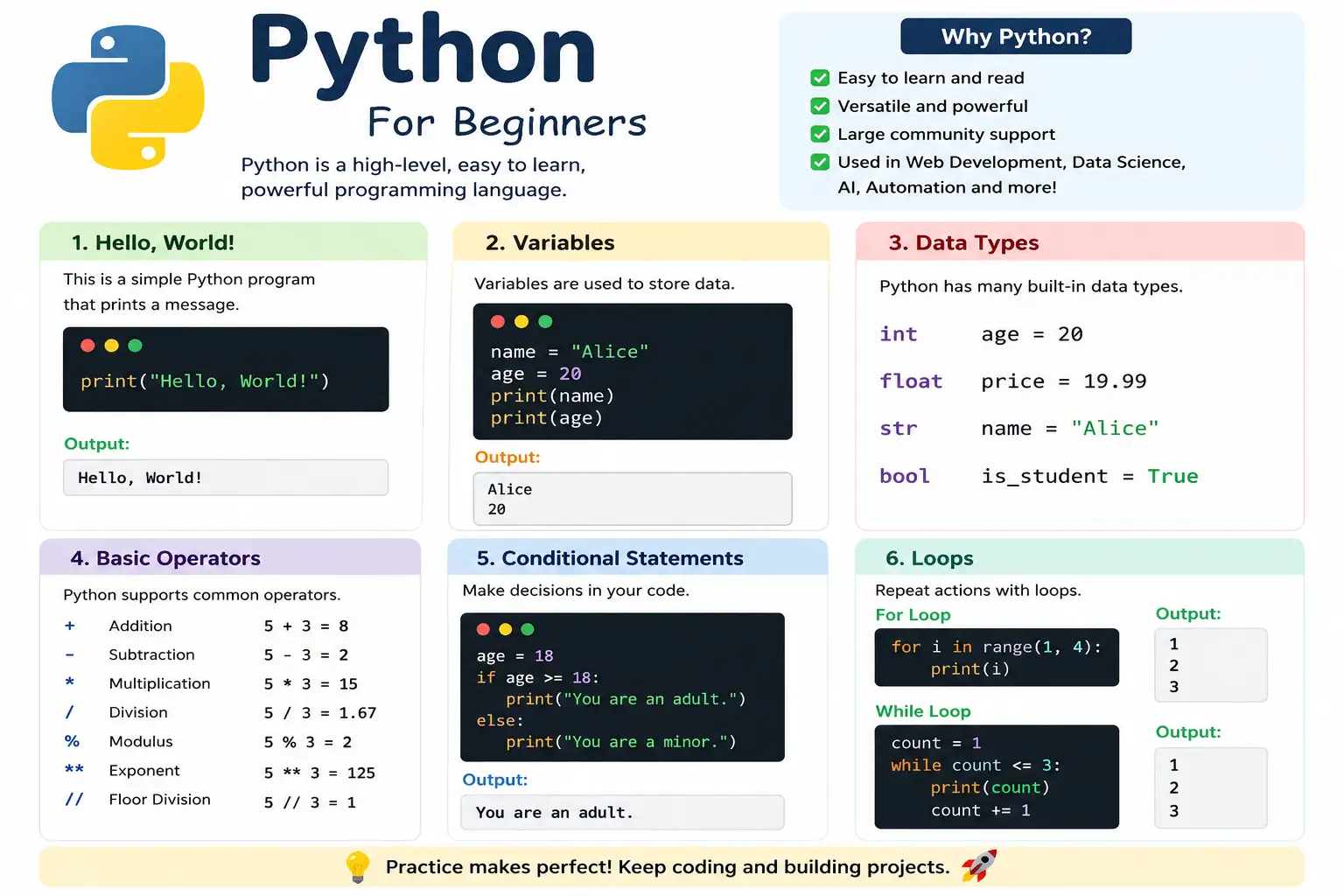
The Python for Beginners Course is a comprehensive, beginner-friendly training program designed to help learners build a strong foundation in one of the world’s most popular programming languages.
Python is widely used for software development, web development, data science, artificial intelligence, automation, cybersecurity, and machine learning. Due to its simple syntax and versatility, Python is considered one of the best programming languages for beginners.
This course introduces learners to Python programming fundamentals and helps them develop practical coding skills that are highly valued by employers.
Whether you are a student, fresh graduate, working professional, entrepreneur, or aspiring developer, this course will help you begin your programming journey with confidence.
Why Learn Python?
Python is one of the most in-demand technical skills globally. Organizations across industries rely on Python because it is efficient, powerful, and easy to learn.
Python is widely used in:
- Software development
- Data science
- Artificial intelligence
- Machine learning
- Automation
- Cybersecurity
- Web development
- Data analytics
- Cloud computing
- Scientific research
Learning Python can significantly improve your career opportunities.
What You Will Learn
Introduction to Python
Understand Python fundamentals and its applications.
Python Installation and Setup
Learn how to set up a Python development environment.
Variables and Data Types
Understand how Python stores and processes information.
Operators and Expressions
Learn arithmetic, logical, and comparison operators.
Conditional Statements
Use decision-making statements such as:
- if
- else
- elif
Loops
Understand repetition using:
- for loops
- while loops
Functions
Learn how to create reusable blocks of code.
Lists, Tuples, and Dictionaries
Work with Python data structures.
Error Handling
Understand debugging and exception handling.
Introduction to Python Projects
Build simple beginner-friendly projects.
Skills You Will Gain
After completing this course, learners will develop:
- Python programming skills
- Logical thinking abilities
- Problem-solving skills
- Coding confidence
- Debugging techniques
- Algorithmic thinking
- Data handling skills
- Software development fundamentals
- Automation basics
- Technical problem-solving skills
Who Should Enroll?
This course is suitable for:
- Students
- Fresh graduates
- Job seekers
- Working professionals
- Software development aspirants
- Data science enthusiasts
- Engineers
- Entrepreneurs
- Career changers
- Technology enthusiasts
No prior coding experience is required.
Career Opportunities
Completing a Python for Beginners Course can support careers such as:
- Python Developer
- Software Developer
- Data Analyst
- Data Scientist
- Machine Learning Engineer
- Automation Engineer
- Web Developer
- AI Engineer
- Cybersecurity Analyst
- Backend Developer
Industries Hiring
Python professionals are highly demanded in:
- IT companies
- Startups
- FinTech companies
- Healthcare organizations
- E-commerce businesses
- Data analytics firms
- Research organizations
- Educational institutions
Certification Benefits
Upon successful completion, learners receive a certificate validating their Python programming skills.
Benefits include:
- Enhanced employability
- Improved coding skills
- Strong technical foundation
- Better career opportunities
- Future-ready technology skills
9. FAQ SECTION
1. What is a Python for Beginners Course?
A Python for Beginners Course teaches learners the fundamentals of Python programming from scratch.
2. Who should enroll in this course?
Students, professionals, job seekers, and anyone interested in programming can enroll.
3. Do I need prior coding experience?
No. This course is designed for complete beginners.
4. What topics will I learn?
You will learn Python syntax, variables, loops, functions, data structures, and basic projects.
5. How long does the course take?
Most Python beginner courses can be completed within 6 to 10 weeks.
6. Will I receive a certificate?
Yes. A certificate is awarded upon successful completion.
7. Is Python a good career option in India?
Yes. Python is one of the most in-demand skills across the IT industry.
8. Can I learn Python without a technical background?
Yes. Python is beginner-friendly and easy to learn.
9. What jobs can I pursue after learning Python?
You can pursue roles such as Python Developer, Data Analyst, or Software Developer.
10. Is Python useful for AI and Data Science?
Yes. Python is widely used in Artificial Intelligence, Machine Learning, and Data Science.


Reviews
There are no reviews yet.