
INTRODUCTION
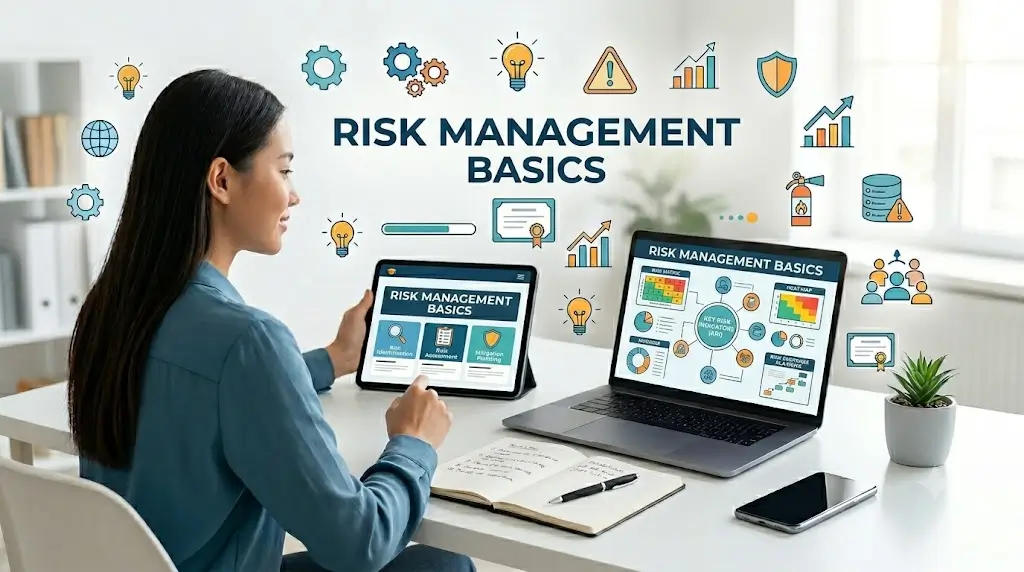
The Risk Management Basics Course is a structured beginner-level program designed to help learners understand how organizations identify, evaluate, and manage risks that can affect business operations, financial stability, and long-term success. Risk management is a critical business function that helps organizations prepare for uncertainties and reduce potential losses.
In today’s dynamic business environment, companies face multiple types of risks including financial, operational, technological, and strategic risks. Therefore, effective risk management is essential for sustainable growth and stability.
This course introduces learners to fundamental risk management principles used across industries such as finance, healthcare, IT, manufacturing, and corporate governance.
WHAT IS RISK MANAGEMENT?
Risk management is the process of identifying potential risks, analyzing their impact, and implementing strategies to minimize or control them.
Additionally, it involves preparing for uncertainties and ensuring that businesses can continue operations even during disruptions.
A strong risk management system improves decision-making and protects organizational assets.
COURSE OVERVIEW
This course provides a clear understanding of how organizations handle uncertainty and protect their operations.
Learners will explore how risks are identified, categorized, and evaluated using structured methods.
Moreover, the course explains how businesses develop strategies to reduce risk impact and improve resilience.
As a result, learners gain practical knowledge of real-world risk management practices.
WHY RISK MANAGEMENT IS IMPORTANT
Risk management is important because every business faces uncertainties that can affect performance and profitability.
Moreover, without proper risk control, organizations may suffer financial losses, operational disruptions, or reputational damage.
Consequently, companies with strong risk management systems are better prepared for challenges and crises.
This course helps learners understand the importance of proactive risk planning in business success.
TYPES OF BUSINESS RISKS
Organizations face different types of risks:
Financial Risk
Risks related to money, investments, and financial stability.
Operational Risk
Risks arising from internal processes, systems, or human errors.
Strategic Risk
Risks related to business decisions and market competition.
Compliance Risk
Risks related to laws, regulations, and policies.
Cybersecurity Risk
Risks related to data breaches and digital threats.
RISK IDENTIFICATION
Risk identification involves recognizing potential threats that may affect business operations.
This section explains how organizations analyze internal and external environments to detect risks early.
Additionally, early identification helps prevent major losses.
RISK ANALYSIS AND ASSESSMENT
Risk analysis evaluates the likelihood and impact of identified risks.
Moreover, organizations prioritize risks based on severity and probability.
This section helps learners understand how data is used in decision-making.
RISK MITIGATION STRATEGIES
Risk mitigation involves taking actions to reduce the impact of risks.
This section explains strategies such as avoidance, reduction, transfer, and acceptance of risks.
Additionally, proper mitigation ensures business continuity.
BUSINESS CONTINUITY PLANNING
Business continuity planning ensures that organizations continue operations during disruptions.
This section explains how companies prepare backup plans and recovery strategies.
Moreover, it improves organizational resilience and stability.
MONITORING AND CONTROL
Risk management is an ongoing process that requires continuous monitoring.
This section explains how organizations track risks and update strategies when needed.
Additionally, regular evaluation improves risk effectiveness.
SKILLS YOU WILL GAIN
After completing this course, learners will develop:
Risk analysis skills
Decision-making ability
Problem-solving skills
Business awareness
Analytical thinking
Risk assessment understanding
Strategic planning skills
Financial awareness
Operational understanding
Critical thinking ability
BENEFITS OF THE COURSE
The Risk Management Basics Course helps learners understand how businesses handle uncertainty and protect operations. Additionally, it improves analytical and decision-making skills.
Furthermore, risk management knowledge is highly valuable in finance, corporate governance, IT, and business operations.
Benefits include:
Strong risk management foundation
Better decision-making skills
Improved analytical thinking
Career opportunities in finance and business
Enhanced problem-solving ability
Industry-relevant knowledge
Future-ready business skills
Corporate risk awareness
WHO SHOULD ENROLL
This course is suitable for:
Students
Business learners
Finance aspirants
Managers
Entrepreneurs
Corporate employees
Risk analysts (beginners)
Management students
IT professionals
Career changers
CAREER OPPORTUNITIES
After completing this course, learners may pursue roles such as:
Risk Management Assistant
Business Analyst Trainee
Compliance Assistant
Financial Risk Support Executive
Operations Risk Analyst Intern
Corporate Governance Assistant
Audit Support Executive
Risk Analyst Trainee
Business Continuity Assistant
Management Support Executive
CERTIFICATION DETAILS
Upon successful completion of the Risk Management Basics Course, learners receive a certification recognizing their understanding of risk identification, assessment, and mitigation strategies.
CONCLUSION
The Risk Management Basics Course provides a strong foundation in identifying, analyzing, and managing business risks. It helps learners understand how organizations protect themselves from uncertainties and maintain stability.
Therefore, mastering risk management skills opens valuable career opportunities in finance, corporate governance, IT, and business management roles.
FAQ SECTION
1. What is Risk Management Basics Course?
It is a beginner-level course that teaches risk identification and control.
2. Who should take this course?
This course is suitable for students, managers, and business learners.
3. Do I need experience?
No, it is beginner-friendly.
4. What will I learn in this course?
You will learn risk analysis, assessment, and mitigation techniques.
5. What is risk management?
It is the process of identifying and controlling business risks.
6. Is this useful for finance careers?
Yes, it is highly valuable in finance and corporate roles.
7. Will I learn cybersecurity risks?
Yes, basic cybersecurity risk awareness is included.
8. Is this useful for decision-making?
Yes, it improves decision-making skills.
9. Will I get a certificate?
Yes, a completion certificate is provided.
10. Is this useful for career growth?
Yes, it supports corporate and business careers.



Reviews
There are no reviews yet.