
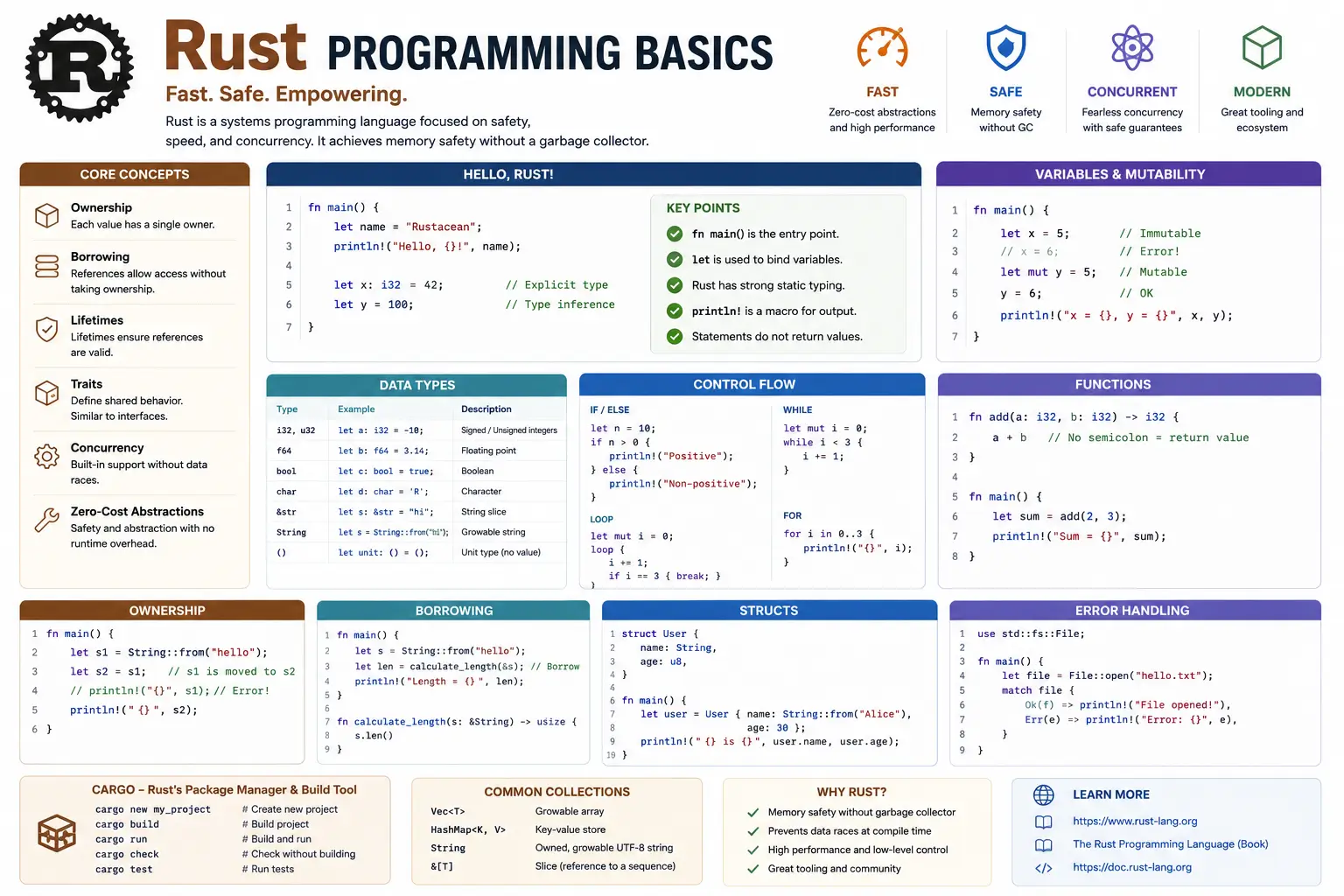
Introduction to Rust Programming Basics
Rust is a modern systems programming language designed to deliver performance, reliability, and memory safety without sacrificing developer productivity. It has gained widespread adoption across industries because it helps developers build efficient software while minimizing common programming errors.
The Rust Programming Basics Course provides a strong foundation in Rust programming concepts and practical software development techniques. Through structured lessons, coding exercises, and real-world examples, learners will understand how Rust enables developers to create robust applications with confidence.
As organizations increasingly prioritize software security and performance, Rust continues to emerge as one of the most valuable programming languages for modern development.
Why Learn Rust Programming?
Rust combines speed with safety, making it an excellent choice for modern software projects.
Benefits include:
- High performance execution
- Memory safety without garbage collection
- Reduced software vulnerabilities
- Reliable concurrency support
- Modern programming features
- Growing industry demand
- Strong developer community
Rust helps developers build applications that are both efficient and secure.
What You Will Learn
This Rust Programming Basics Course introduces essential programming concepts and Rust-specific features.
Topics include:
- Rust language fundamentals
- Variables and data types
- Functions and modules
- Ownership and borrowing
- Pattern matching
- Collections and data structures
- Error handling
- Memory management
- Debugging techniques
- Application development basics
These concepts provide a solid foundation for systems programming and software development.
Core Areas Covered
Introduction to Rust Programming
Understand the purpose and advantages of Rust.
Topics include:
- Rust ecosystem
- Installation and setup
- Development tools
- Programming fundamentals
Rust Syntax and Fundamentals
Learn how to write clear and efficient Rust code.
Topics include:
- Syntax rules
- Expressions
- Statements
- Operators
Variables, Data Types, and Functions
Understand how data is stored and processed.
Topics include:
- Variables
- Constants
- Primitive data types
- Functions
Ownership and Borrowing
Explore Rust’s unique memory management system.
Topics include:
- Ownership rules
- Borrowing concepts
- References
- Lifetimes introduction
Control Flow and Pattern Matching
Build application logic using Rust features.
Topics include:
- Conditional statements
- Loops
- Match expressions
- Pattern matching
Structs, Enums, and Collections
Create flexible and maintainable applications.
Topics include:
- Structs
- Enums
- Vectors
- Hash maps
Error Handling and Debugging
Develop reliable software systems.
Topics include:
- Result types
- Option types
- Error handling strategies
- Debugging techniques
Memory Safety and Performance
Learn why Rust is known for safety and efficiency.
Topics include:
- Memory management
- Resource optimization
- Safe concurrency concepts
- Performance considerations
Skills You Will Gain
Upon completing this course, learners will be able to:
- Write Rust programs confidently
- Understand ownership and borrowing
- Build memory-safe applications
- Apply modern programming principles
- Manage errors effectively
- Optimize software performance
- Debug Rust applications
- Prepare for advanced Rust development
These skills are highly valuable in software engineering and systems programming careers.
Benefits of the Course
Industry-Relevant Programming Skills
Learn one of the fastest-growing programming languages in the technology industry.
Strong Foundation for Systems Programming
Develop practical knowledge used in secure and high-performance software projects.
Career Advancement Opportunities
Rust developers are increasingly sought after across technology sectors.
Practical Learning Experience
Gain hands-on coding experience through projects and exercises.
Professional Certification
Earn a Rust Programming Basics Certification demonstrating your understanding of Rust development fundamentals.
Who Should Enroll?
This course is ideal for:
- Beginners
- Students
- Software Developers
- Systems Programmers
- Backend Developers
- Cybersecurity Professionals
- Technology Enthusiasts
- Computer Science Learners
No prior Rust experience is required.
Career Opportunities
This course can support careers such as:
- Rust Developer
- Software Engineer
- Systems Programmer
- Backend Developer
- Cloud Engineer
- Security Engineer
- Application Developer
- Infrastructure Engineer
The growing adoption of Rust across industries continues to create exciting career opportunities.
Certification Benefits
Upon successful completion, learners receive a Rust Programming Basics Certification.
Benefits include:
- Enhanced professional credibility
- Recognition of programming expertise
- Improved employability
- Stronger technical portfolio
- Career growth opportunities
Conclusion
The Rust Programming Basics Course equips learners with the knowledge and practical skills needed to develop secure, reliable, and high-performance software applications. By covering Rust fundamentals, ownership concepts, memory management, data structures, and application development principles, this course provides a strong foundation for success in modern software engineering and systems programming careers.
FAQ SECTION
1. What is Rust Programming?
Rust is a modern systems programming language focused on performance, memory safety, and reliability.
2. Is this course suitable for beginners?
Yes, the course is designed for beginners and starts with fundamental programming concepts.
3. Will I receive a certificate?
Yes, learners receive a certificate upon successful completion.
4. Do I need prior programming experience?
No, prior programming experience is helpful but not required.
5. Why is Rust becoming popular?
Rust helps developers create fast and secure software while preventing many common programming errors.
6. What is ownership in Rust?
Ownership is Rust’s memory management system that ensures memory safety without requiring garbage collection.
7. Who should take this course?
Students, software developers, systems programmers, backend developers, and technology enthusiasts.
8. What skills will I gain?
Rust programming, memory management, debugging, systems development, and software engineering fundamentals.
9. Is Rust a good career choice?
Yes, Rust is increasingly used in cloud computing, cybersecurity, infrastructure, and systems programming.
10. Is the course fully online?
Yes, learners can study online at their own pace.



Reviews
There are no reviews yet.