
INTRODUCTION
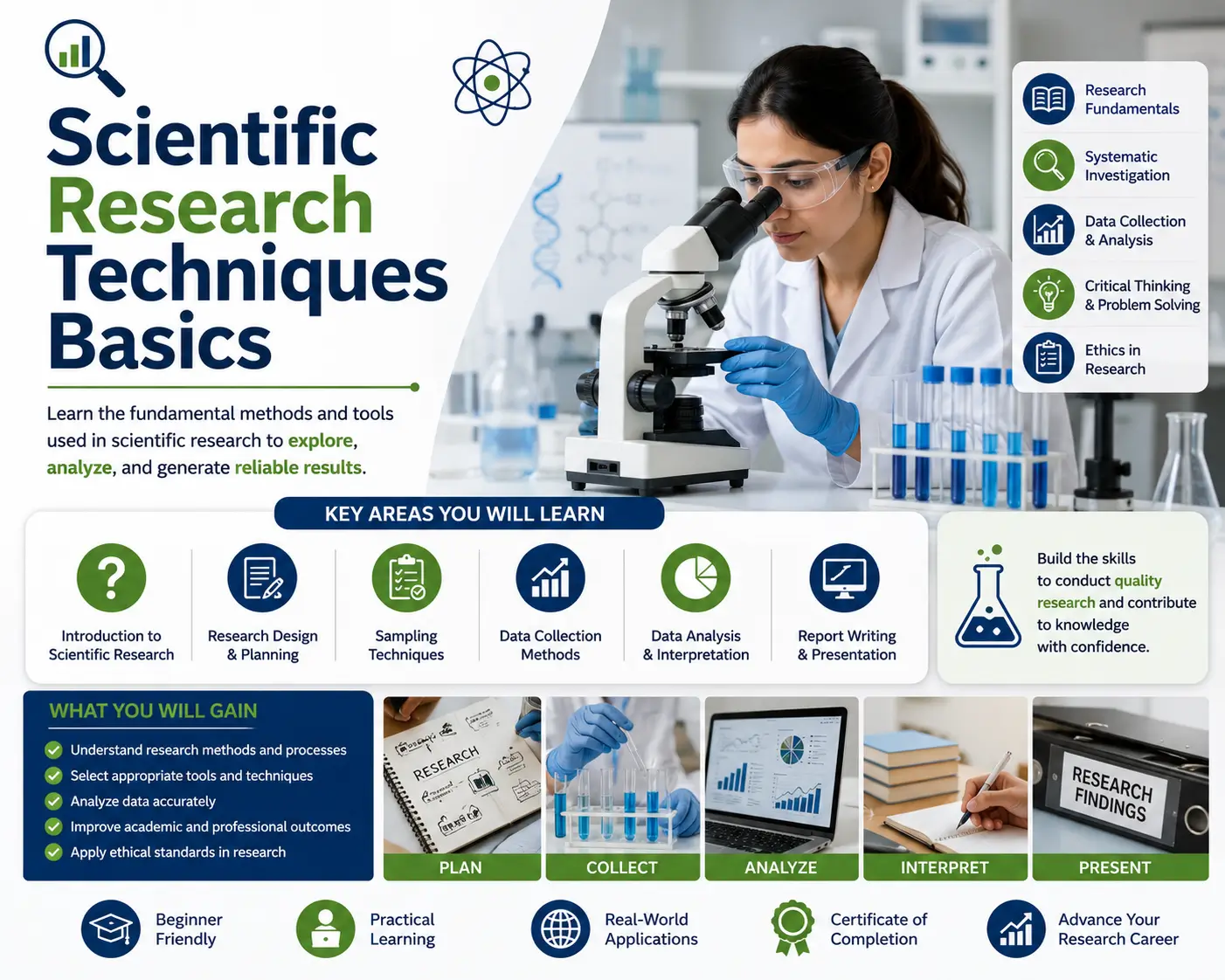
The Scientific Research Techniques Basics Course is a structured beginner-level academic training program designed to help learners understand how scientific research is conducted in a systematic and reliable way. Research plays a vital role in discovering new knowledge, solving problems, and improving decision-making across various fields.
Moreover, scientific research follows a structured process that ensures accuracy, validity, and consistency. Therefore, understanding research techniques is essential for students, academics, and professionals.
WHAT IS SCIENTIFIC RESEARCH?
Scientific research is a systematic method of investigating problems.
Additionally, it involves collecting data, analyzing results, and drawing conclusions.
It helps in discovering new knowledge and verifying existing theories.
Scientific research is based on evidence and logical reasoning.
Therefore, it is widely used in education, science, and industry.
IMPORTANCE OF RESEARCH TECHNIQUES
Research techniques are important because they ensure accuracy and reliability.
Moreover, they help structure the entire research process properly.
Consequently, researchers can avoid errors and bias.
In addition, they improve the quality of scientific findings.
Without proper techniques, research results may become invalid.
RESEARCH PROCESS OVERVIEW
The scientific research process includes several steps.
First, a research problem is identified.
Next, a hypothesis is formed based on the problem.
Then, data is collected using appropriate methods.
After that, data is analyzed and interpreted.
Finally, conclusions are drawn based on results.
RESEARCH PROBLEM IDENTIFICATION
A research problem defines what needs to be studied.
Moreover, it provides direction for the entire research process.
A well-defined problem improves clarity and focus.
Therefore, selecting the right topic is very important.
HYPOTHESIS FORMULATION
A hypothesis is a testable statement in research.
Additionally, it predicts possible outcomes of a study.
It guides the direction of data collection and analysis.
A strong hypothesis improves research accuracy.
RESEARCH DESIGN
Research design is the overall plan of a study.
Moreover, it defines methods and procedures used in research.
It ensures structure and consistency in data collection.
Therefore, it is a key part of scientific research.
DATA COLLECTION METHODS
Data collection is the process of gathering information.
It includes surveys, interviews, observation, and experiments.
Additionally, both primary and secondary data are used.
Accurate data collection improves research reliability.
SAMPLING TECHNIQUES
Sampling is selecting a subset of a population for study.
Moreover, it helps reduce time and cost in research.
Common sampling methods include random and stratified sampling.
Therefore, sampling is essential for efficient research.
DATA ANALYSIS BASICS
Data analysis involves interpreting collected information.
Additionally, it helps identify patterns and trends.
It can be qualitative or quantitative.
Accurate analysis leads to valid conclusions.
INTERPRETATION OF RESULTS
Interpretation explains what research findings mean.
Moreover, it connects results with research objectives.
It helps in drawing logical conclusions.
Therefore, interpretation is a crucial research step.
REPORT WRITING IN RESEARCH
Research findings must be documented properly.
Additionally, scientific reports follow a structured format.
They include introduction, methodology, results, and conclusion.
Proper reporting improves communication of research.
REAL-LIFE APPLICATIONS
Scientific research techniques are used in education, healthcare, business, and technology.
Moreover, they support innovation and problem-solving.
They are also essential in academic studies and industrial research.
Therefore, research skills are highly valuable in modern industries.
SKILLS YOU WILL GAIN
After completing this course, learners will develop:
Research planning skills
Data collection skills
Analytical thinking
Problem-solving ability
Hypothesis development skills
Data interpretation skills
Critical thinking skills
Report writing skills
Scientific reasoning ability
Academic research skills
BENEFITS OF THE COURSE
This course helps learners understand structured research methods.
Moreover, it improves academic and professional skills.
Additionally, it builds a strong foundation for higher studies.
Benefits include:
Improved research ability
Better academic performance
Stronger analytical thinking
Enhanced problem-solving skills
Career opportunities in research fields
Better decision-making ability
Scientific thinking development
Professional growth
WHO SHOULD ENROLL
This course is suitable for:
Students
Researchers
Academics
Science learners
Data analysts (beginners)
Business professionals
Healthcare students
Social science learners
Anyone interested in research
CAREER OPPORTUNITIES
After completing this course, learners may pursue roles such as:
Research Assistant
Academic Research Support Staff
Data Analyst Trainee
Survey Research Assistant
Lab Assistant (Research)
Business Research Assistant
Scientific Documentation Assistant
Junior Research Executive
Field Research Officer
Education Research Assistant
CERTIFICATION DETAILS
Upon successful completion of the Scientific Research Techniques Basics Course, learners receive a certificate recognizing their understanding of scientific research methods, data analysis, and research design fundamentals.
CONCLUSION
The Scientific Research Techniques Basics Course provides a strong foundation in scientific investigation and structured research methods. It helps learners understand how knowledge is created, tested, and validated.
Therefore, mastering research techniques opens opportunities in academia, science, business, healthcare, and innovation-driven industries.
FAQ SECTION
1. What is Scientific Research Techniques Basics Course?
It is a beginner-level course that teaches research methods and techniques.
2. Who should take this course?
Students, researchers, and academics.
3. Do I need experience?
No, it is beginner-friendly.
4. What will I learn in this course?
You will learn research design, data collection, and analysis.
5. Is this useful for students?
Yes, it helps in academic research.
6. Will I learn hypothesis building?
Yes, it is included.
7. Is this useful for careers?
Yes, it supports research and analytical jobs.
8. Will I get a certificate?
Yes, a completion certificate is provided.
9. Is this useful for higher studies?
Yes, it is highly beneficial for advanced education.
10. Is this useful for business research?
Yes, it supports business and market research roles.




Reviews
There are no reviews yet.