
Introduction
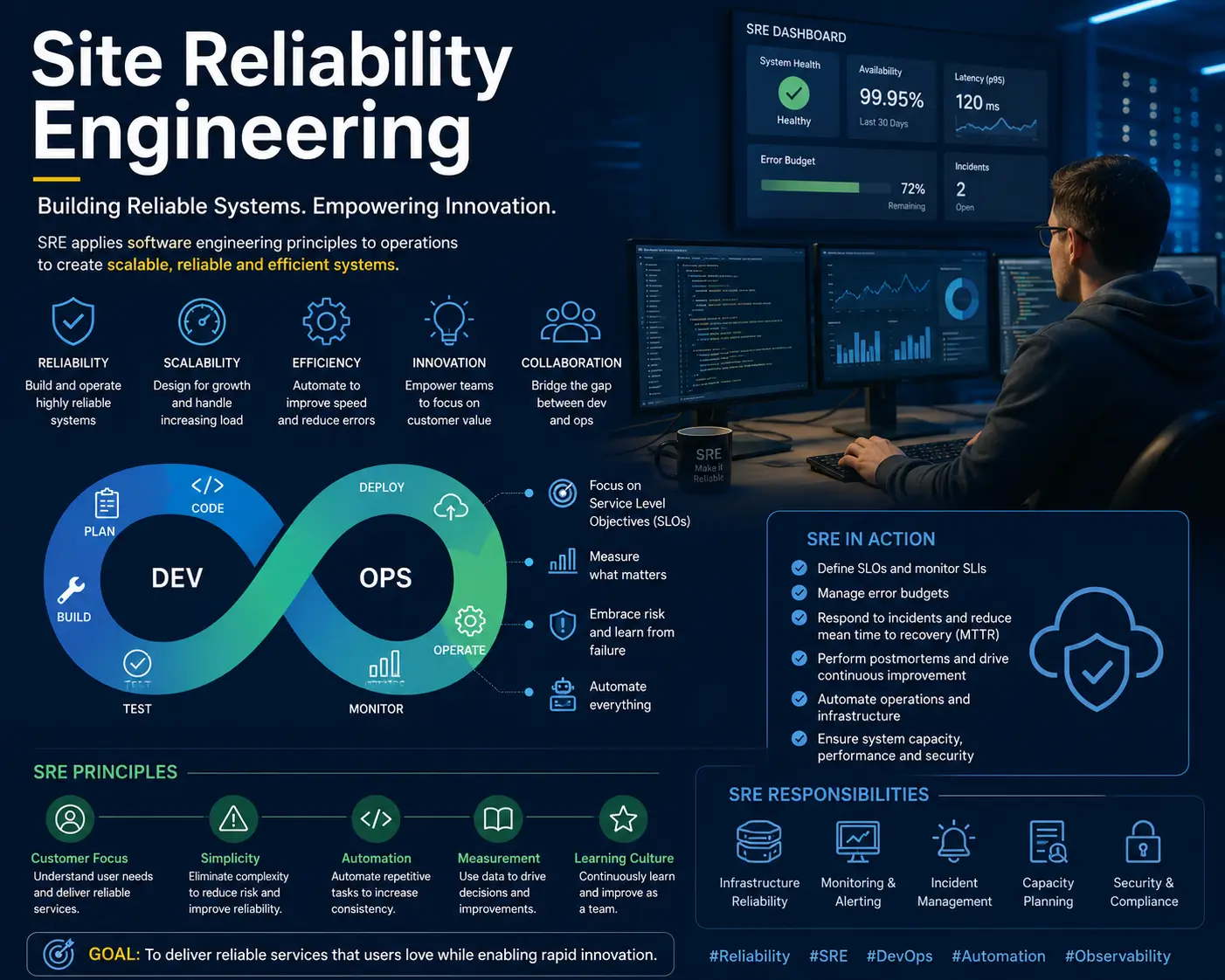
The Site Reliability Engineering (SRE) Course is a comprehensive training program designed to help learners understand how modern software systems are built, maintained, and scaled for maximum reliability. As digital platforms continue to grow rapidly, organizations face increasing challenges in maintaining uptime, performance, and stability. Therefore, Site Reliability Engineering has become a critical discipline in cloud computing and IT operations.
SRE combines software engineering with IT operations to ensure systems remain reliable, scalable, and efficient. As a result, businesses can reduce downtime, improve user experience, and maintain consistent service quality even under heavy workloads.
Whether you are a student, developer, DevOps learner, or IT professional, this course provides a strong foundation in system reliability concepts and practices.
Course Overview
Modern applications require continuous availability and high performance. Therefore, companies rely on SRE practices to manage system reliability at scale.
In this course, learners explore monitoring systems, automation, incident management, and performance optimization. Additionally, participants gain practical knowledge of how engineering teams maintain system health in real-time environments.
The course blends theory with practical understanding, making it easier to apply SRE principles in real-world IT and cloud systems.
What You Will Learn
The course covers essential Site Reliability Engineering concepts. First, learners understand the basics of SRE and its connection with DevOps and cloud computing. Next, they study monitoring, logging, and observability techniques.
Furthermore, learners explore incident response, root cause analysis, system automation, and performance tuning. In addition, they learn about SLOs (Service Level Objectives), SLIs (Service Level Indicators), and error budgets.
As a result, learners gain a complete understanding of how reliable systems are designed and maintained.
Skills You Will Gain
- Site Reliability Engineering fundamentals
- System monitoring and observability
- Incident management techniques
- Automation and scripting concepts
- Cloud reliability understanding
- Performance optimization skills
- Root cause analysis
- Scalable system thinking
- DevOps collaboration skills
- IT operations awareness
Moreover, these skills are highly useful in software engineering, DevOps, cloud computing, and IT infrastructure roles.
Benefits of the Course
The Site Reliability Engineering Course provides strong benefits for learners interested in system stability and cloud operations. First, it builds a solid understanding of how large-scale systems are managed in production environments.
Additionally, learners understand how to reduce downtime and improve system performance. Furthermore, they gain insights into modern DevOps and cloud reliability practices.
Because demand for reliable systems is increasing, SRE professionals are highly valued in the IT industry. As a result, learners become better prepared for future technology careers.
Who Should Enroll?
This course is ideal for:
- Students and graduates
- Software developers
- DevOps engineers
- IT professionals
- Cloud engineers
- System administrators
- QA engineers
- Infrastructure engineers
- Technology enthusiasts
- Anyone interested in cloud reliability
No prior SRE experience is required. Therefore, beginners can easily start learning from the basics.
Career Opportunities
After completing this course, learners can pursue roles such as:
- Site Reliability Engineer (Associate)
- DevOps Engineer
- Cloud Operations Engineer
- Infrastructure Engineer
- System Reliability Analyst
- IT Operations Specialist
- Platform Support Engineer
- Automation Engineer Assistant
- Technical Support Engineer
- Reliability Associate
Additionally, these skills are applicable across SaaS companies, IT firms, fintech, e-commerce platforms, and cloud service providers.
Certification
Upon completion of the Site Reliability Engineering Course, learners receive a certification that validates their understanding of system reliability, monitoring, automation, incident management, and cloud operations. This certification helps improve career opportunities in DevOps and cloud engineering roles.
Conclusion
The Site Reliability Engineering (SRE) Course provides a strong foundation for understanding how modern digital systems are built, monitored, and maintained for high performance and reliability. As organizations continue to scale their cloud infrastructure, the need for stable, efficient, and automated systems is increasing rapidly. Therefore, SRE has become one of the most important practices in today’s IT and DevOps industry.
Throughout this course, learners gain practical knowledge of monitoring, incident management, automation, observability, and system optimization. As a result, they become better equipped to handle real-world challenges in production environments and ensure continuous system availability.
Overall, this course not only builds technical understanding but also develops a reliability-focused mindset that is essential for modern cloud and software engineering roles. Whether your goal is to start a career in DevOps, cloud engineering, or IT operations, this course provides the skills, confidence, and clarity needed to move forward successfully.
In conclusion, mastering Site Reliability Engineering opens the door to high-demand career opportunities and prepares learners for the future of scalable, resilient, and intelligent digital systems.
FAQ Section
1. What is Site Reliability Engineering (SRE)?
Site Reliability Engineering is a practice that combines software engineering and IT operations to ensure systems are reliable, scalable, and efficient.
2. Is this course suitable for beginners?
Yes, the course is designed for beginners and does not require prior SRE experience.
3. What topics are covered in this course?
The course covers monitoring, incident management, automation, observability, SLOs, SLIs, and system reliability concepts.
4. Will I receive a certificate after completion?
Yes, learners receive a certificate after successfully completing the course.
5. Do I need programming knowledge?
Basic understanding of IT concepts is helpful, but not mandatory.
6. Who should take this course?
Developers, DevOps engineers, IT professionals, students, and cloud enthusiasts should take this course.
7. Is SRE related to DevOps?
Yes, SRE is closely related to DevOps and focuses more on system reliability and operational stability.
8. What skills will I gain?
You will gain skills in system monitoring, automation, incident response, performance tuning, and cloud reliability.
9. Why is SRE important?
SRE is important because it helps organizations maintain high uptime, reduce system failures, and improve performance.
10. What career options are available after this course?
You can pursue roles like Site Reliability Engineer, DevOps Engineer, Cloud Operations Engineer, and Infrastructure Engineer.




Reviews
There are no reviews yet.