
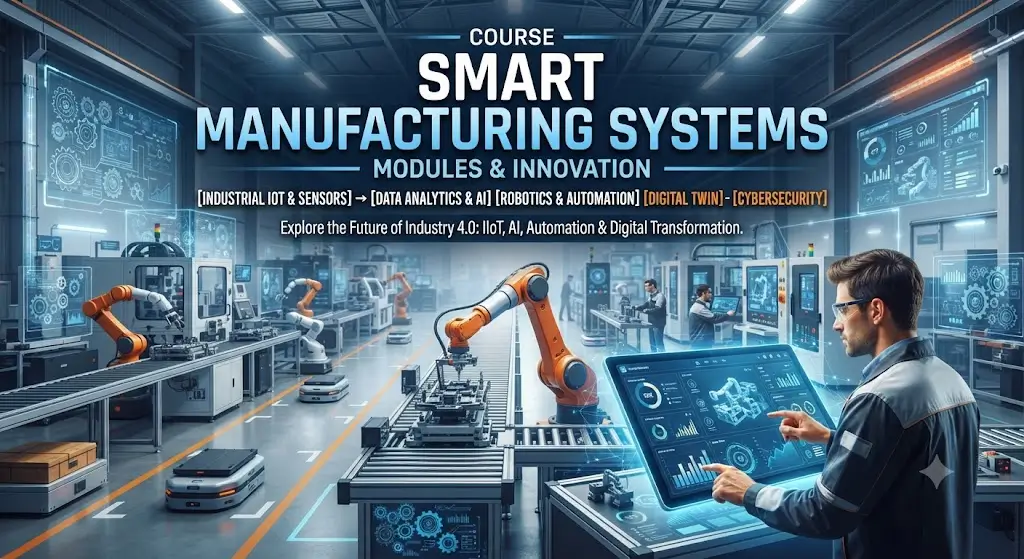
Introduction to Smart Manufacturing Systems
The Smart Manufacturing Systems Course is a professional training program designed to help learners understand how modern manufacturing has evolved into intelligent, connected, and automated systems. Industry 4.0 technologies are transforming traditional factories into smart production ecosystems.
Smart manufacturing systems integrate automation, IoT, robotics, artificial intelligence, and data analytics to optimize production processes. Professionals in this field focus on improving efficiency, reducing downtime, and enabling real-time decision-making.
This course combines manufacturing engineering, digital technologies, automation systems, and industrial analytics to provide practical knowledge applicable across industries such as automotive, aerospace, electronics, heavy machinery, and consumer goods.
Why Smart Manufacturing Systems Matter
Smart manufacturing increases productivity, reduces operational costs, and improves product quality. Traditional manufacturing systems often lack flexibility and real-time responsiveness.
Smart systems enable predictive maintenance, real-time monitoring, and adaptive production processes. They help industries remain competitive in a rapidly evolving global market.
The Smart Manufacturing Systems Course enables learners to understand and implement next-generation manufacturing technologies.
Course Overview
The Smart Manufacturing Systems Course introduces learners to frameworks and technologies used in modern industrial environments.
Participants begin by studying Industry 4.0 principles and automation systems. The course explores IoT-enabled manufacturing, robotics, and data analytics.
Learners also study production optimization, digital twins, and smart factory architecture.
Practical case studies demonstrate how leading industries implement smart manufacturing solutions.
Topics Covered
Throughout the Smart Manufacturing Systems Course, learners will study:
Industry 4.0 Fundamentals
Understand the evolution of modern manufacturing systems.
Industrial Automation
Learn automated production processes and control systems.
IoT in Manufacturing
Connect machines and systems for real-time data exchange.
Robotics Systems
Understand robotic applications in production lines.
Predictive Maintenance
Use data to prevent machine failures.
Manufacturing Analytics
Analyze production performance data.
Smart Factory Design
Design fully connected manufacturing environments.
Digital Twins
Simulate real-world manufacturing systems digitally.
Production Optimization
Improve efficiency and reduce waste.
Cyber-Physical Systems
Integrate physical and digital manufacturing processes.
Skills You Will Gain
After completing the Smart Manufacturing Systems Course, learners will develop valuable professional skills including:
- Smart manufacturing system design
- Industrial automation understanding
- IoT integration in manufacturing
- Robotics and production systems knowledge
- Data-driven manufacturing optimization
- Predictive maintenance techniques
- Manufacturing analytics
- System design thinking
- Problem-solving in industrial environments
- Digital transformation understanding
- Production planning optimization
- Analytical thinking
- Engineering systems analysis
- Smart factory management
- Technology integration skills
These competencies are valuable across automotive, aerospace, electronics, industrial manufacturing, and logistics sectors.
Benefits of the Course
The Smart Manufacturing Systems Course provides practical knowledge for understanding and managing modern industrial systems.
Participants gain confidence in automation technologies, smart factory systems, and data-driven manufacturing. The course also strengthens analytical thinking and engineering problem-solving skills.
As industries shift toward automation and Industry 4.0, professionals with smart manufacturing expertise are highly in demand.
Who Should Enroll?
This course is suitable for:
- Manufacturing engineers
- Industrial engineers
- Mechanical engineers
- Automation engineers
- Robotics professionals
- Engineering students
- Production managers
- Technical professionals
- Industry 4.0 enthusiasts
- R&D engineers
Basic engineering knowledge is recommended.
Career Opportunities
After completing the Smart Manufacturing Systems Course, learners may pursue careers such as:
- Smart Manufacturing Engineer
- Industrial Automation Engineer
- Robotics Engineer
- Production Systems Engineer
- Manufacturing Data Analyst
- Industry 4.0 Specialist
- Plant Operations Manager
- Process Improvement Engineer
- Digital Manufacturing Consultant
- Systems Integration Engineer
- Industrial Technology Specialist
- R&D Engineer
- Manufacturing Strategy Consultant
- Automation Project Manager
- Chief Manufacturing Technologist (future path)
Certification
Upon successful completion of the Smart Manufacturing Systems Course, learners receive a professional certificate recognizing their expertise in Industry 4.0 systems, automation, IoT manufacturing, and smart factory design. This certification supports career advancement across industrial engineering and manufacturing sectors.
Frequently Asked Questions (FAQs)
1. What is the Smart Manufacturing Systems Course?
It teaches how modern automated and digital factories operate.
2. Who should enroll in this course?
Engineers, students, and manufacturing professionals can benefit.
3. Do I need advanced programming skills?
No. Basic engineering knowledge is enough.
4. What topics are covered?
Automation, IoT, robotics, and smart factories.
5. Is this course practical?
Yes. It focuses on real industrial systems.
6. Will I learn Industry 4.0 concepts?
Yes. Industry 4.0 is a core part of the course.
7. How does this help career growth?
It builds modern manufacturing and automation skills.
8. Does it include real examples?
Yes. It includes industrial case studies.
9. Can this improve job opportunities?
Yes. Smart manufacturing is a fast-growing field.
10. What industries use this skill?
Automotive, aerospace, electronics, and industrial manufacturing.





Reviews
There are no reviews yet.