
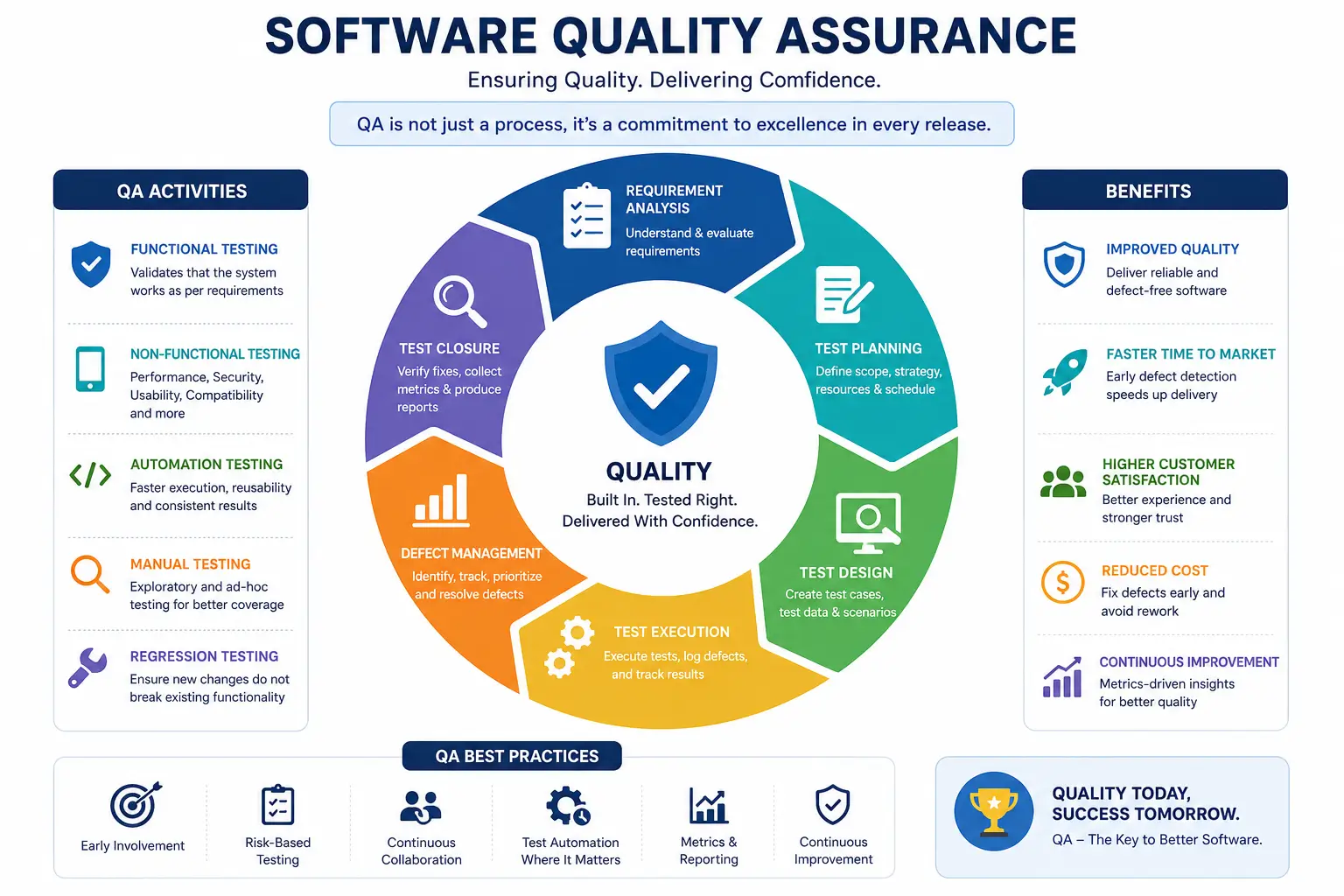
Introduction to Software Quality Assurance
Software quality plays a crucial role in the success of modern applications. Organizations depend on reliable, secure, and high-performing software to support business operations and customer satisfaction. Software Quality Assurance (QA) ensures that applications meet quality standards before deployment.
The Software Quality Assurance Course introduces learners to the principles, methodologies, and best practices used to maintain software quality throughout the development lifecycle. Participants will learn how testing, quality control, and defect management contribute to successful software delivery.
As software complexity continues to increase, quality assurance professionals remain essential members of development teams.
Why Learn Software Quality Assurance?
Quality assurance helps organizations minimize defects, improve user experiences, and reduce development risks.
Benefits include:
- Improved software reliability
- Better user satisfaction
- Reduced software defects
- Enhanced software security
- Improved project outcomes
- Strong quality management skills
- Increased career opportunities
QA professionals help organizations deliver software products that meet customer expectations and business requirements.
What You Will Learn
This Software Quality Assurance Course covers the essential concepts and practices used in software testing and quality management.
Topics include:
- Software quality assurance fundamentals
- Testing methodologies
- Manual testing techniques
- Test planning and execution
- Defect tracking and reporting
- Quality management principles
- Performance testing basics
- Security testing fundamentals
- QA documentation
- Industry best practices
These topics provide a solid foundation for quality assurance and software testing careers.
Core Areas Covered
Introduction to Software Quality Assurance
Learn the purpose and importance of quality assurance in software development.
Topics include:
- QA principles
- Quality standards
- Quality control
- Software quality metrics
Software Development Lifecycle and QA
Understand how QA integrates into software development processes.
Topics include:
- SDLC phases
- QA roles and responsibilities
- Agile and QA
- Continuous improvement
Software Testing Fundamentals
Testing helps identify defects and validate software functionality.
Topics include:
- Testing concepts
- Testing levels
- Testing types
- Test execution
Manual Testing Techniques
Manual testing remains a key QA skill.
Topics include:
- Functional testing
- Regression testing
- User acceptance testing
- Exploratory testing
Test Planning and Test Cases
Effective planning improves testing outcomes.
Topics include:
- Test strategies
- Test case design
- Test scenarios
- Risk assessment
Defect Tracking and Management
Defect management supports quality improvement.
Topics include:
- Bug reporting
- Defect lifecycle
- Root cause analysis
- Resolution tracking
Performance and Security Testing Basics
Quality extends beyond functionality.
Topics include:
- Performance evaluation
- Load testing concepts
- Security testing fundamentals
- Risk identification
Test Documentation and Reporting
Documentation supports quality management and project communication.
Topics include:
- Test reports
- QA documentation
- Quality metrics
- Reporting standards
Skills You Will Gain
Upon completing this course, learners will be able to:
- Understand software quality assurance processes
- Design effective test cases
- Perform manual testing activities
- Identify and report defects
- Support software quality initiatives
- Apply QA best practices
- Create test documentation
- Contribute to software project success
These skills are highly valued across software development and IT organizations.
Benefits of the Course
Industry-Relevant Expertise
Learn QA practices used in professional software development environments.
Career Growth Opportunities
Software testing and QA skills remain in strong demand worldwide.
Practical Understanding
Gain hands-on knowledge of testing methodologies and quality assurance workflows.
Strong Foundation for Advanced Learning
Build the knowledge required for advanced testing and automation courses.
Professional Certification
Earn a Software Quality Assurance Certification demonstrating your understanding of software testing and quality management.
Who Should Enroll?
This course is ideal for:
- Aspiring QA Engineers
- Software Testers
- Software Developers
- IT Professionals
- Computer Science Students
- Business Analysts
- Project Managers
- Product Managers
No prior QA experience is required.
Career Opportunities
This course can support careers such as:
- QA Engineer
- Software Tester
- Quality Analyst
- Test Engineer
- QA Specialist
- Application Tester
- Quality Control Analyst
- Software Quality Manager
The increasing emphasis on software quality continues to create opportunities for skilled QA professionals.
Certification Benefits
Upon successful completion, learners receive a Software Quality Assurance Certification.
Benefits include:
- Enhanced professional credibility
- Recognition of QA expertise
- Improved employability
- Stronger technical profile
- Career advancement opportunities
Conclusion
The Software Quality Assurance Course equips learners with the knowledge and practical skills needed to ensure software quality throughout the development lifecycle. By exploring software testing, defect management, quality control, performance evaluation, and QA best practices, learners gain valuable capabilities applicable across industries. Whether you are a beginner or an experienced technology professional, this course provides a strong foundation for a successful career in software quality assurance.
10. FAQ SECTION
1. What is Software Quality Assurance?
Software Quality Assurance (QA) is the process of ensuring that software products meet defined quality standards and function as expected.
2. Is this course suitable for beginners?
Yes, the course is designed for beginners as well as professionals seeking QA knowledge.
3. Will I receive a certificate?
Yes, learners receive a certificate after successfully completing the course.
4. What is the difference between QA and testing?
QA focuses on improving processes to prevent defects, while testing identifies defects in software products.
5. Do I need programming knowledge?
No, programming knowledge is not required for learning software quality assurance fundamentals.
6. What types of testing are covered?
The course covers manual testing, functional testing, regression testing, and quality assurance concepts.
7. Who should take this course?
Aspiring QA engineers, software testers, developers, IT professionals, students, and project managers.
8. What skills will I gain?
Software testing, defect tracking, test planning, quality management, and QA documentation skills.
9. Is software testing a good career?
Yes, software testing and quality assurance offer strong career opportunities in the technology sector.
10. Is the course fully online?
Yes, learners can complete the course online at their own pace.





Reviews
There are no reviews yet.