
INTRODUCTION
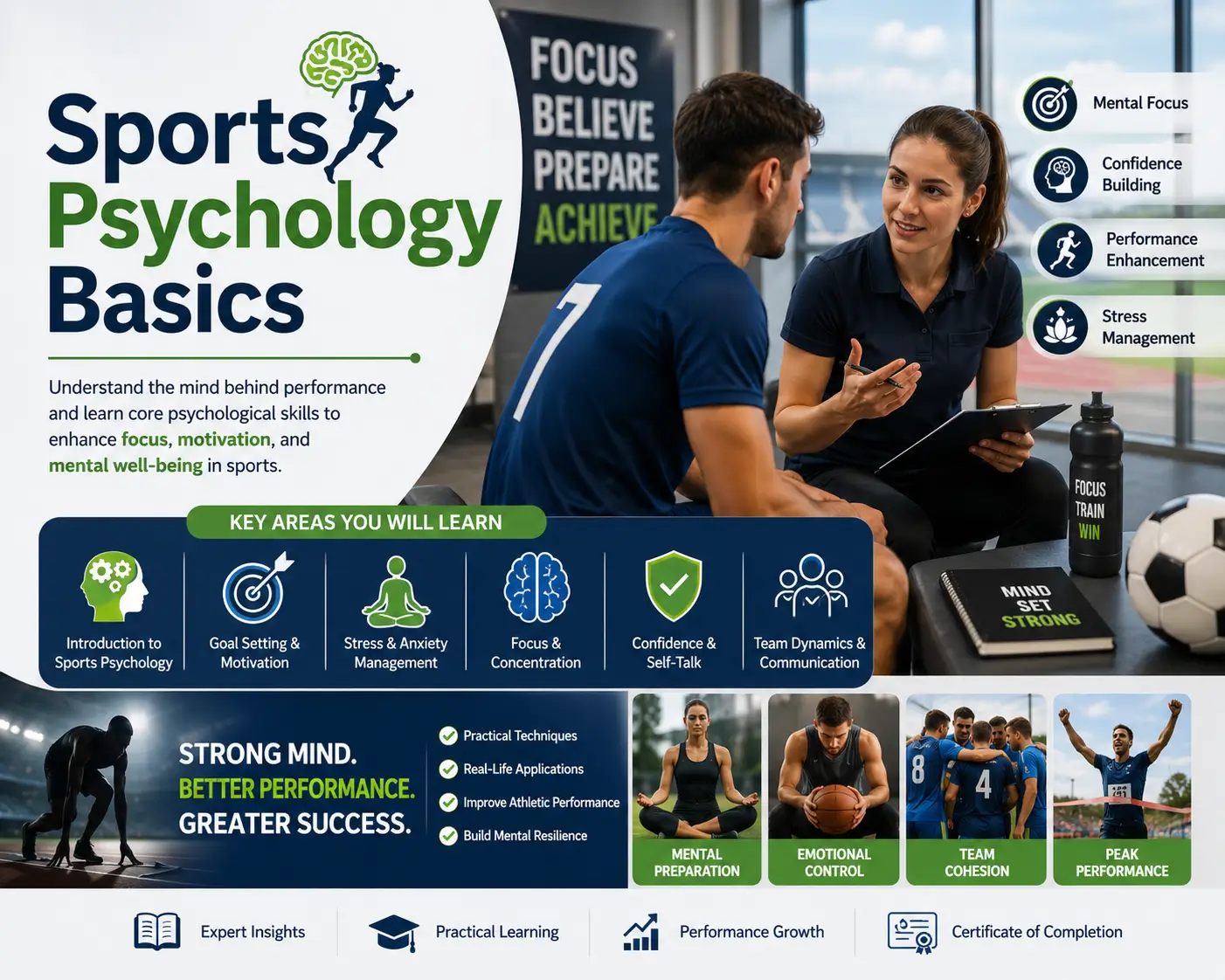
The Sports Psychology Basics Course is a structured beginner-level sports science and mental performance training program designed to help learners understand how psychological factors influence sports performance. In modern sports, physical ability alone is not enough to achieve success. Mental strength, focus, confidence, and emotional control play an equally important role.
Athletes at all levels—from beginners to professionals—face pressure, anxiety, competition stress, and performance expectations. Sports psychology helps athletes manage these challenges and perform at their best.
This course introduces learners to the science of sports psychology and how it can be applied to improve athletic performance, coaching effectiveness, and overall mental well-being in sports environments.
WHAT IS SPORTS PSYCHOLOGY?
Sports psychology is the study of how the mind affects sports performance.
Additionally, it focuses on emotions, thoughts, and behavior in athletic environments.
It helps athletes improve focus, confidence, and motivation.
It also supports mental health and emotional balance in sports.
Sports psychology is used by coaches, trainers, and athletes worldwide.
COURSE OVERVIEW
This course provides a step-by-step introduction to sports psychology concepts.
Learners will understand mental strategies used by successful athletes.
Moreover, the course explains real-life sports performance scenarios.
As a result, learners gain practical mental training skills.
The course is beginner-friendly and easy to understand.
IMPORTANCE OF SPORTS PSYCHOLOGY
Mental strength is as important as physical strength in sports.
Moreover, pressure and stress can affect performance significantly.
Consequently, athletes need mental training to perform consistently.
Sports psychology improves confidence and reduces anxiety.
This course helps learners understand its importance in modern sports.
ATHLETE MINDSET DEVELOPMENT
A strong mindset is essential for sports success.
This section explains positive thinking and self-belief techniques.
Additionally, it helps athletes stay focused under pressure.
A strong mindset improves consistency and performance.
MOTIVATION IN SPORTS
Motivation drives athletes to train and perform.
This section explains intrinsic and extrinsic motivation.
Moreover, it teaches how to stay motivated during challenges.
Motivation is key to long-term success in sports.
CONFIDENCE BUILDING
Confidence is critical for peak performance.
This section explains how athletes build self-confidence.
Additionally, it helps overcome fear of failure.
Confident athletes perform better in competitions.
STRESS AND ANXIETY MANAGEMENT
Sports competitions often create pressure and stress.
This section explains techniques to control anxiety.
Moreover, it helps athletes stay calm under pressure.
Stress management improves performance consistency.
FOCUS AND CONCENTRATION
Focus is essential for winning performance.
This section explains attention control techniques.
Additionally, it helps reduce distractions during play.
Strong concentration improves decision-making skills.
GOAL SETTING IN SPORTS
Goal setting helps athletes track progress.
This section explains short-term and long-term goals.
Moreover, it improves discipline and direction.
Clear goals lead to better performance outcomes.
TEAM DYNAMICS AND COORDINATION
Team sports require coordination and communication.
This section explains teamwork psychology.
Additionally, it improves trust among players.
Strong teamwork enhances overall performance.
MENTAL TRAINING TECHNIQUES
Mental training improves performance consistency.
This section includes visualization and self-talk techniques.
Moreover, it helps athletes prepare mentally for competitions.
Mental training builds resilience and confidence.
PERFORMANCE UNDER PRESSURE
Athletes often perform under high-pressure situations.
This section explains coping strategies for competition stress.
Additionally, it improves decision-making during matches.
Pressure handling is a key sports psychology skill.
COACHING PSYCHOLOGY BASICS
Coaches play an important role in athlete psychology.
This section explains how coaches motivate athletes.
Moreover, it improves communication between coach and player.
Good coaching psychology leads to better results.
REAL-LIFE APPLICATIONS
Sports psychology is used in professional sports teams, fitness training, coaching academies, and athletic development programs.
Moreover, it is used in schools, universities, and sports organizations.
It helps athletes, coaches, and fitness professionals worldwide.
SKILLS YOU WILL GAIN
After completing this course, learners will develop:
Mental toughness
Focus and concentration skills
Confidence building techniques
Stress management skills
Motivation strategies
Goal-setting ability
Team coordination understanding
Performance improvement skills
Emotional control
Athlete mindset development
BENEFITS OF THE COURSE
The Sports Psychology Basics Course helps improve both mental and sports performance.
Additionally, it builds discipline and confidence.
Furthermore, sports psychology is widely used in professional athletics.
Benefits include:
Improved athletic performance
Better mental control
Stronger confidence
Reduced performance anxiety
Enhanced focus
Better teamwork skills
Coaching understanding
Personal development
WHO SHOULD ENROLL
This course is suitable for:
Students
Athletes
Sports coaches
Fitness trainers
Physical education learners
Sports enthusiasts
Team players
Psychology beginners
School and college athletes
Anyone interested in sports performance
CAREER OPPORTUNITIES
After completing this course, learners may pursue roles such as:
Sports Psychology Assistant (Entry Level)
Fitness Mental Coach Assistant
Sports Team Support Staff
Athlete Development Assistant
Sports Coaching Assistant
Wellness & Performance Trainee
School Sports Trainer Assistant
Fitness Center Support Staff
Sports Performance Analyst (Basic Level)
Youth Sports Mentor Assistant
CERTIFICATION DETAILS
Upon successful completion of the Sports Psychology Basics Course, learners receive a certification recognizing their understanding of mental training, athlete psychology, and performance improvement techniques.
CONCLUSION
The Sports Psychology Basics Course provides a strong foundation in understanding how the mind influences sports performance. It helps learners develop mental strength, confidence, and focus required for success in competitive environments.
Therefore, mastering sports psychology opens opportunities in sports coaching, athletic development, fitness training, and professional sports support roles.
FAQ SECTION
1. What is Sports Psychology Basics Course?
It is a beginner-level course that teaches mental training for sports performance.
2. Who should take this course?
Athletes, coaches, and sports enthusiasts.
3. Do I need experience?
No, it is beginner-friendly.
4. What will I learn in this course?
You will learn confidence, focus, and motivation techniques.
5. Is this useful for athletes?
Yes, it improves performance and mindset.
6. Will I learn stress management?
Yes, mental control techniques are included.
7. Is this useful for coaches?
Yes, it helps in athlete development.
8. Will I get a certificate?
Yes, a completion certificate is provided.
9. Is this useful for sports careers?
Yes, it supports coaching and sports development roles.
10. Is this useful for competition preparation?
Yes, it improves performance under pressure.




Reviews
There are no reviews yet.