
INTRODUCTION
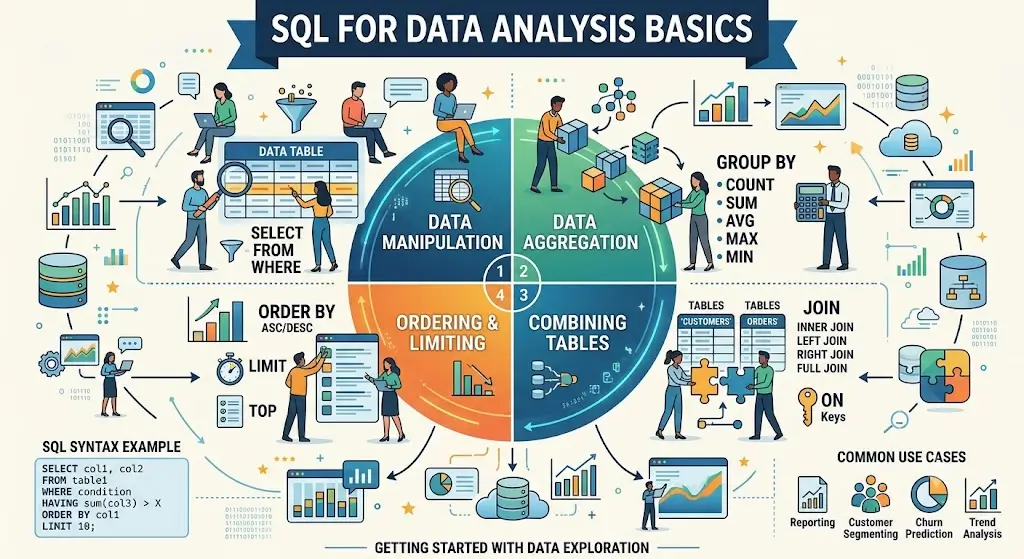
The SQL for Data Analysis Basics Course is a structured beginner-level program designed to help learners understand how to use SQL to work with data stored in relational databases. SQL (Structured Query Language) is a powerful tool used by data analysts, business intelligence professionals, and developers to extract, manipulate, and analyze data efficiently.
In today’s data-driven world, organizations rely heavily on SQL to manage large volumes of structured data. Therefore, SQL skills are essential for careers in data analytics and database management.
This course introduces learners to fundamental SQL concepts and practical data analysis techniques.
WHAT IS SQL?
SQL (Structured Query Language) is a programming language used to communicate with databases.
Additionally, it helps users retrieve, insert, update, and delete data.
A strong understanding of SQL is essential for working with structured data systems.
COURSE OVERVIEW
This course provides a step-by-step understanding of SQL for data analysis.
Learners will explore how databases store and organize data.
Moreover, the course explains how to write queries to extract meaningful insights.
As a result, learners gain practical experience in database querying.
WHY SQL IS IMPORTANT
SQL is important because it is widely used in data analytics and business intelligence.
Moreover, it allows users to work efficiently with large datasets.
Consequently, SQL is one of the most in-demand technical skills globally.
This course helps learners understand its importance in real-world applications.
DATABASE BASICS
Databases store structured information in tables.
This section explains how tables, rows, and columns work.
Additionally, it builds the foundation for SQL learning.
BASIC SQL QUERIES
SQL queries are used to retrieve data from databases.
This section explains SELECT statements and filtering data.
Moreover, it helps extract useful information from datasets.
FILTERING AND SORTING DATA
Filtering helps refine data based on conditions.
Sorting organizes data in ascending or descending order.
Additionally, it improves data readability and analysis.
SQL JOINS
Joins combine data from multiple tables.
This section explains how relationships between tables work.
Moreover, it enhances data analysis capabilities.
DATA AGGREGATION
Aggregation helps summarize data using functions like SUM and COUNT.
This section explains how to analyze grouped data.
Additionally, it supports business reporting.
REAL-WORLD APPLICATIONS
SQL is used in many industries.
This section explains applications in finance, marketing, healthcare, and business analytics.
Moreover, it supports data-driven decision-making.
SKILLS YOU WILL GAIN
After completing this course, learners will develop:
SQL query writing skills
Data analysis skills
Database understanding
Filtering and sorting techniques
Data aggregation skills
Join operations knowledge
Analytical thinking
Problem-solving ability
Reporting skills
Data interpretation skills
BENEFITS OF THE COURSE
The SQL for Data Analysis Basics Course helps learners understand how to work with structured data efficiently. Additionally, it improves technical and analytical skills.
Furthermore, SQL is one of the most in-demand skills in data analytics and IT industries.
Benefits include:
Strong database foundation
Better analytical skills
Career opportunities in data roles
Industry-relevant technical knowledge
Improved data handling ability
High-demand technical skill
Future-ready career preparation
Strong problem-solving skills
WHO SHOULD ENROLL
This course is suitable for:
Students
Data enthusiasts
IT beginners
Business analysts (beginners)
Career changers
Developers (beginners)
Finance professionals
Marketing professionals
Researchers
Tech learners
CAREER OPPORTUNITIES
After completing this course, learners may pursue roles such as:
SQL Developer (Beginner Level)
Data Analyst Trainee
Database Assistant
Reporting Analyst
Business Intelligence Assistant
Data Support Executive
Analytics Trainee
MIS Executive
Database Management Assistant
Junior Data Analyst
CERTIFICATION DETAILS
Upon successful completion of the SQL for Data Analysis Basics Course, learners receive a certification recognizing their ability to write SQL queries, analyze data, and work with relational databases.
CONCLUSION
The SQL for Data Analysis Basics Course provides a strong foundation in database querying, data analysis, and reporting techniques. It helps learners understand how to extract meaningful insights from structured data.
Therefore, mastering SQL opens valuable career opportunities in data analytics, business intelligence, database management, and IT industries.
FAQ SECTION
1. What is SQL for Data Analysis Basics Course?
It is a beginner-level course that teaches SQL and data analysis.
2. Who should take this course?
This course is suitable for beginners and students.
3. Do I need coding experience?
No, it is beginner-friendly.
4. What will I learn in this course?
You will learn SQL queries, joins, and data analysis.
5. What is SQL used for?
It is used to manage and analyze data in databases.
6. Is this useful for jobs?
Yes, SQL is highly in demand.
7. Will I learn database concepts?
Yes, basic database concepts are included.
8. Is data analysis included?
Yes, SQL-based analysis is covered.
9. Will I get a certificate?
Yes, a completion certificate is provided.
10. Is this useful for career growth?
Yes, it supports data and analytics careers.



Reviews
There are no reviews yet.