
INTRODUCTION
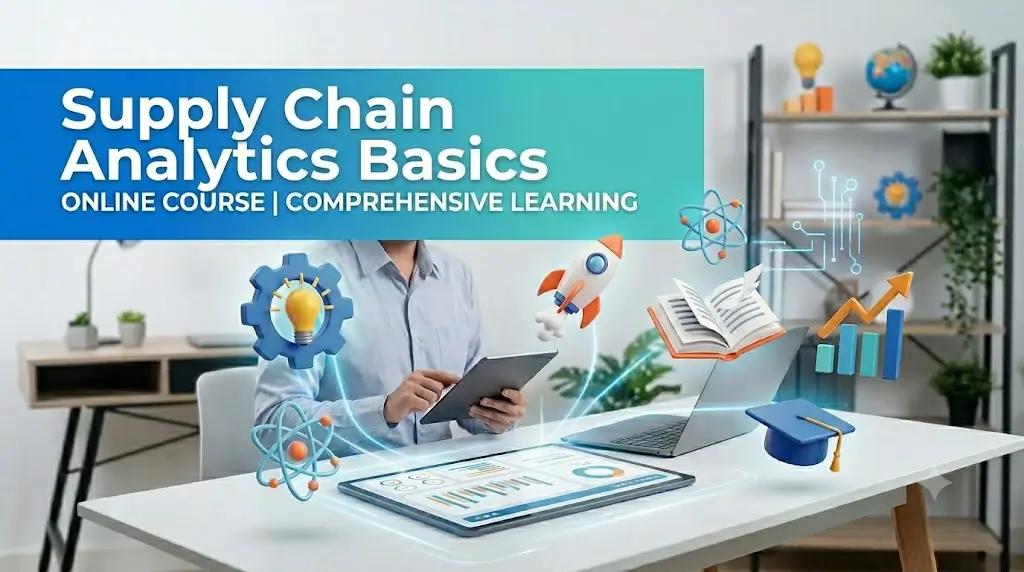
The Supply Chain Analytics Basics Course is a structured beginner-level program designed to help learners understand how data analytics is used to improve supply chain operations, efficiency, and decision-making. Supply chain analytics combines data analysis with logistics and operations management to optimize the flow of goods, services, and information.
In today’s data-driven world, businesses rely on analytics to reduce costs, improve delivery speed, and enhance customer satisfaction. Therefore, supply chain analytics has become a critical skill in industries such as retail, manufacturing, e-commerce, and logistics.
This course introduces learners to fundamental analytics concepts used in supply chain management systems.
WHAT IS SUPPLY CHAIN ANALYTICS?
Supply chain analytics is the process of using data, statistical methods, and technology to analyze and improve supply chain operations.
Additionally, it helps organizations make informed decisions related to procurement, inventory, logistics, and demand forecasting.
A strong analytics system improves efficiency and reduces operational costs.
COURSE OVERVIEW
This course provides a clear understanding of how data is collected, analyzed, and applied in supply chain systems.
Learners will explore how businesses optimize inventory, forecast demand, and improve logistics performance using analytics.
Moreover, the course explains how data-driven decisions improve supply chain efficiency and profitability.
As a result, learners gain practical knowledge of real-world supply chain analytics applications.
WHY SUPPLY CHAIN ANALYTICS IS IMPORTANT
Supply chain analytics is important because it helps organizations make smarter and faster decisions.
Moreover, it reduces waste, improves resource utilization, and enhances customer satisfaction.
Consequently, companies using analytics in supply chain operations perform better in competitive markets.
This course helps learners understand the importance of data-driven decision-making in logistics and operations.
DEMAND FORECASTING
Demand forecasting predicts future customer demand using historical data.
This section explains how businesses estimate product demand to avoid shortages or overstocking.
Additionally, accurate forecasting improves inventory planning and cost efficiency.
INVENTORY OPTIMIZATION
Inventory optimization ensures that the right amount of stock is maintained at the right time.
This section explains how analytics helps reduce storage costs and improve product availability.
Moreover, it ensures smooth supply chain operations.
LOGISTICS ANALYTICS
Logistics analytics focuses on transportation, delivery, and distribution efficiency.
This section explains how companies analyze shipping routes, delivery times, and logistics costs.
Additionally, it improves speed and reduces operational delays.
PERFORMANCE METRICS
Performance metrics help organizations measure supply chain efficiency.
This section explains key indicators such as delivery time, cost per unit, and order accuracy.
Moreover, these metrics help improve decision-making.
SUPPLY CHAIN VISUALIZATION
Visualization tools help present complex data in simple formats such as charts and dashboards.
This section explains how businesses use visualization to understand trends and performance.
Additionally, it improves communication and decision-making.
SKILLS YOU WILL GAIN
After completing this course, learners will develop:
Supply chain analytics skills
Data interpretation ability
Demand forecasting understanding
Inventory optimization skills
Logistics analysis knowledge
Business intelligence awareness
Problem-solving ability
Decision-making skills
Performance measurement skills
Analytical thinking
BENEFITS OF THE COURSE
The Supply Chain Analytics Basics Course helps learners build strong data-driven decision-making skills. Additionally, it improves analytical and operational thinking.
Furthermore, supply chain analytics skills are highly valuable in logistics, retail, manufacturing, and e-commerce industries.
Benefits include:
Strong analytics foundation
Better supply chain understanding
Improved decision-making skills
Career opportunities in logistics and analytics
Data-driven business skills
Industry-relevant knowledge
Future-ready analytics expertise
Operational efficiency understanding
WHO SHOULD ENROLL
This course is suitable for:
Students
Business learners
Data enthusiasts
Supply chain aspirants
Operations professionals
Logistics managers
Analysts (beginners)
Management students
E-commerce professionals
Career changers
CAREER OPPORTUNITIES
After completing this course, learners may pursue roles such as:
Supply Chain Analyst Trainee
Logistics Data Assistant
Operations Analyst Intern
Inventory Analyst Assistant
Business Intelligence Trainee
Demand Planning Assistant
Procurement Analyst Support
Warehouse Data Assistant
Supply Chain Coordinator
Analytics Support Executive
CERTIFICATION DETAILS
Upon successful completion of the Supply Chain Analytics Basics Course, learners receive a certification recognizing their understanding of data-driven supply chain management, logistics analytics, and operational optimization.
CONCLUSION
The Supply Chain Analytics Basics Course provides a strong foundation in data-driven logistics, inventory management, and supply chain optimization. It helps learners understand how analytics improves efficiency and business performance.
Therefore, mastering supply chain analytics skills opens valuable career opportunities in logistics, operations, retail, and business analytics roles.
FAQ SECTION
1. What is Supply Chain Analytics Basics Course?
It is a beginner-level course that teaches data-driven supply chain management.
2. Who should take this course?
This course is suitable for students, analysts, and supply chain learners.
3. Do I need experience?
No, it is beginner-friendly.
4. What will I learn in this course?
You will learn analytics, forecasting, and logistics optimization.
5. What is supply chain analytics?
It is the use of data to improve supply chain decisions.
6. Is this useful for analytics careers?
Yes, it is highly valuable in data and logistics roles.
7. Will I learn forecasting?
Yes, demand forecasting is included.
8. Is this useful for e-commerce?
Yes, it is widely used in e-commerce operations.
9. Will I get a certificate?
Yes, a completion certificate is provided.
10. Is this useful for career growth?
Yes, it supports analytics and operations careers.




Reviews
There are no reviews yet.