
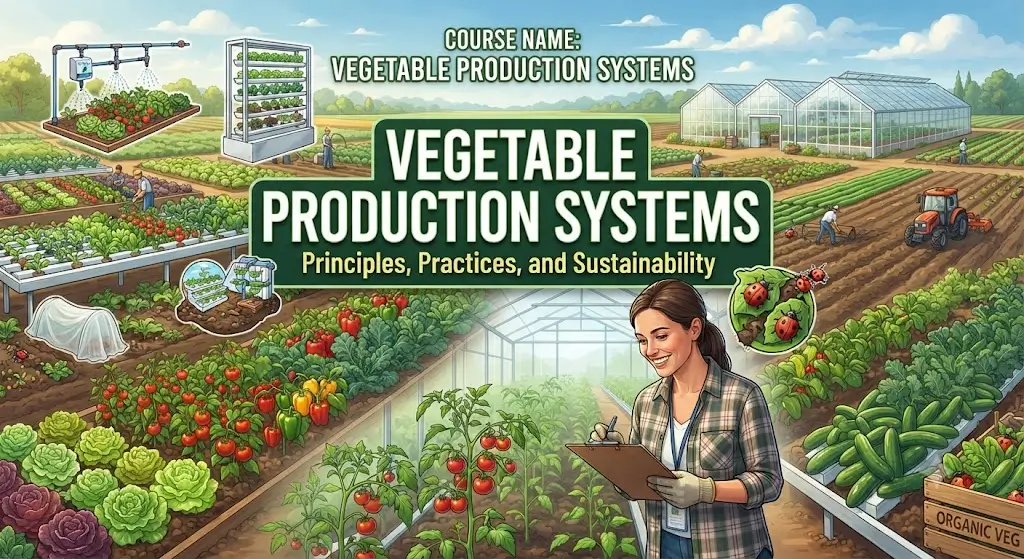
Vegetable Production Systems Course
The Vegetable Production Systems Course is designed to help farmers, horticulturists, agricultural professionals, greenhouse operators, agribusiness entrepreneurs, researchers, students, and individuals interested in commercial vegetable farming develop the knowledge and practical skills required to cultivate healthy, high-yield vegetable crops using modern production techniques. With increasing demand for nutritious vegetables and sustainable farming practices, efficient vegetable production systems are essential for improving crop quality, maximizing productivity, and increasing farm profitability.
This course introduces the core principles of vegetable production systems, including soil preparation, seed selection, nursery management, crop planning, irrigation, plant nutrition, greenhouse cultivation, integrated pest and disease management, weed control, harvesting, post-harvest handling, sustainable farming practices, and vegetable farm business management. Learners will gain practical knowledge of producing high-quality vegetable crops while minimizing production costs and environmental impact.
Whether you work in vegetable farming, horticulture, agribusiness, agricultural consulting, greenhouse management, research, or rural development, this course provides a comprehensive foundation in vegetable production systems.
Course Overview
The course explores the complete vegetable production cycle, from land preparation and seedling production to crop establishment, irrigation, nutrition management, pest control, harvesting, storage, marketing, and sustainable farm management. Learners will understand how modern production techniques improve vegetable quality, increase yields, optimize resource use, and strengthen commercial farming operations.
The curriculum combines agricultural science with practical exercises, farm management projects, industry case studies, and best practices to prepare learners for careers in commercial vegetable production.
What You Will Learn
By completing this course, you will be able to:
- Understand vegetable production systems.
- Prepare soil for vegetable cultivation.
- Select quality seeds and planting materials.
- Manage vegetable nurseries effectively.
- Plan vegetable crop production.
- Improve irrigation efficiency.
- Apply balanced plant nutrition.
- Use greenhouse and protected cultivation techniques.
- Manage pests, diseases, and weeds.
- Improve vegetable yield and quality.
- Apply sustainable farming practices.
- Handle harvesting and post-harvest operations.
- Improve farm productivity.
- Support commercial vegetable farming.
- Strengthen vegetable farm management.
Course Curriculum
The curriculum begins with vegetable production fundamentals before progressing through soil preparation, seedling production, irrigation management, crop nutrition, greenhouse cultivation, integrated pest management, harvesting, post-harvest handling, farm business management, sustainability, case studies, and future innovations in vegetable farming.
Practical assignments help learners apply vegetable production techniques using real-world farming scenarios.
Skills You Will Gain
After completing the course, you will develop skills in:
- Vegetable Production Systems
- Vegetable Crop Management
- Soil Fertility Management
- Seed Selection
- Nursery Management
- Irrigation Management
- Plant Nutrition
- Greenhouse Cultivation
- Integrated Pest Management (IPM)
- Weed Management
- Harvesting Techniques
- Post-Harvest Handling
- Sustainable Vegetable Farming
- Farm Business Management
- Commercial Vegetable Production
Benefits of the Course
This course helps learners improve vegetable yields, produce high-quality crops, optimize farm resources, reduce production losses, and adopt environmentally responsible farming practices. Strong vegetable production skills enable growers to increase profitability, improve market competitiveness, strengthen food security, and support sustainable agricultural development.
These skills are highly valuable across vegetable farms, greenhouse operations, agribusiness companies, agricultural cooperatives, food production organizations, research institutions, government agriculture departments, consulting firms, export companies, and retail supply chains.
Who Should Enroll
This course is ideal for:
- Vegetable Farmers
- Horticulturists
- Agricultural Professionals
- Greenhouse Operators
- Nursery Managers
- Agribusiness Entrepreneurs
- Agricultural Consultants
- Researchers
- Students of Agriculture
- Farm Supervisors
- Extension Officers
- Rural Development Professionals
- Food Production Specialists
- Farm Managers
- Anyone interested in vegetable farming
Career Opportunities
After completing the Vegetable Production Systems Course, learners may strengthen their qualifications for roles such as:
- Vegetable Farm Manager
- Horticulturist
- Crop Production Supervisor
- Greenhouse Manager
- Agricultural Consultant
- Nursery Manager
- Farm Operations Manager
- Agricultural Extension Officer
- Agribusiness Manager
- Commercial Vegetable Farmer
These skills are valuable across vegetable farms, greenhouse businesses, agribusiness companies, agricultural cooperatives, research organizations, government agriculture departments, export companies, consulting firms, food production companies, and sustainable farming enterprises.
Certification Details
Upon successful completion, learners receive a Certificate of Completion recognizing their expertise in Vegetable Production Systems and modern vegetable farming practices. This certification enhances your professional profile and supports career advancement in horticulture, commercial farming, greenhouse management, agribusiness, agricultural consulting, food production, and sustainable agriculture.
If you want to improve vegetable crop production, increase farm productivity, and build expertise in modern vegetable farming, the Vegetable Production Systems Course provides practical, industry-relevant knowledge for today’s agricultural sector.
FAQ SECTION
1. What is the Vegetable Production Systems Course?
It teaches modern techniques for cultivating, managing, and harvesting vegetable crops using efficient and sustainable production systems.
2. Is this course suitable for beginners?
Yes. The course starts with vegetable farming fundamentals and is suitable for beginners as well as experienced agricultural professionals.
3. What topics are covered?
Soil preparation, seed selection, nursery management, irrigation, greenhouse cultivation, plant nutrition, pest and disease management, harvesting, post-harvest handling, and farm management.
4. Do I need previous farming experience?
No. The course is designed for beginners, students, farmers, entrepreneurs, agricultural professionals, and anyone interested in vegetable production.
5. Is the course online?
Yes. The course is fully online and self-paced.
6. Will I receive a certificate?
Yes. A certificate is awarded after successfully completing the course.
7. Who should enroll?
Vegetable farmers, horticulturists, greenhouse operators, nursery managers, agricultural consultants, agribusiness professionals, researchers, students, entrepreneurs, and anyone interested in commercial vegetable farming.
8. What skills will I gain?
Vegetable crop management, nursery management, irrigation, greenhouse cultivation, integrated pest management, harvesting, post-harvest handling, sustainable farming, and vegetable farm business management.
9. Can this course help my career?
Yes. Vegetable production skills are highly valued across commercial farms, greenhouse operations, agribusiness companies, research institutions, government agriculture departments, food production organizations, consulting firms, and export businesses.
10. Why are Vegetable Production Systems important?
Vegetable Production Systems help increase crop yields, improve vegetable quality, optimize water and nutrient use, reduce production losses, promote sustainable farming, strengthen food security, improve farm profitability, and support the growing demand for fresh, nutritious vegetables.




Reviews
There are no reviews yet.