
Introduction
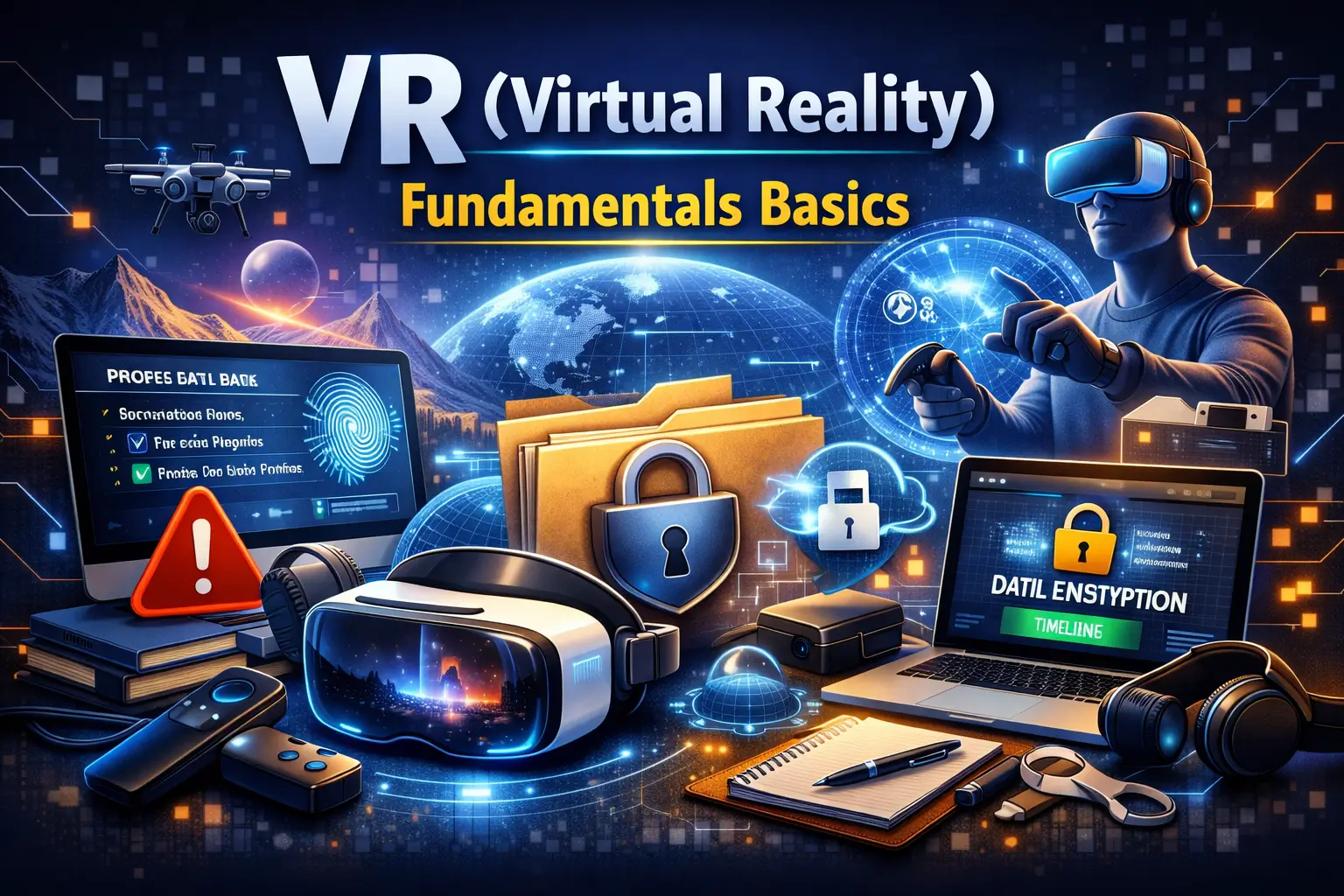
The VR (Virtual Reality) Fundamentals Basics Course is a structured beginner-level program designed to help learners understand how virtual reality creates fully immersive digital environments that replace or simulate real-world experiences. Unlike augmented reality, which overlays digital objects onto the real world, virtual reality completely immerses users into a computer-generated environment. Therefore, VR has become one of the most powerful technologies in modern digital innovation.
Course Overview
Virtual reality works by using specialized hardware such as VR headsets, motion sensors, and controllers to simulate a 3D environment that users can interact with in real time. Additionally, VR systems track head and body movements to create a realistic and immersive experience.
Furthermore, this course explains how VR environments are designed, how interaction systems work, and how immersive experiences are created. As a result, learners gain a strong conceptual understanding of VR technology and its applications.
Why Choose This Course?
Virtual reality is widely used in gaming, simulation training, education, healthcare, and industrial design. Moreover, companies are investing heavily in VR-based solutions to improve training efficiency and user engagement.
Consequently, learning VR fundamentals provides strong career opportunities in game development, immersive media, and XR technologies.
This course simplifies VR concepts so beginners can easily understand how virtual environments are built and used in real-world applications.
What You Will Learn
Virtual Reality Fundamentals
Understand core concepts of VR and how it creates immersive digital environments.
VR Hardware and Devices
Learn about headsets, sensors, controllers, and motion tracking systems.
Immersive Environment Design
Understand how virtual worlds are created and structured.
3D Interaction Systems
Learn how users interact with objects in virtual environments.
VR Applications
Explore VR use cases in gaming, training, education, and healthcare.
Introduction to VR Development Tools
Learn basic awareness of tools like Unity and VR SDKs.
Skills You Will Gain
After completing this course, learners will develop:
Virtual reality understanding
Immersive technology awareness
3D environment knowledge
VR interaction concepts
Spatial thinking skills
Problem-solving ability
Digital simulation understanding
Creative design thinking
Technology awareness
XR fundamentals
Benefits of the Course
The VR (Virtual Reality) Fundamentals Basics Course helps learners build essential knowledge required in immersive technology industries. Additionally, it improves understanding of how virtual environments are created and experienced.
Furthermore, VR skills are highly valuable in gaming, simulation, education, and industrial training sectors. As a result, learners gain strong exposure to future-ready technology careers.
Benefits include:
Strong foundation in VR technology
Better understanding of immersive systems
Exposure to XR industry concepts
Improved creative and technical thinking
Career opportunities in VR/AR/XR fields
Understanding of 3D simulation systems
Industry-relevant technical knowledge
Future technology readiness
Who Should Enroll?
This course is suitable for:
Students
Game developers
Designers
IT beginners
Tech enthusiasts
3D artists
Software developers
Engineering students
UX/UI designers
Innovation learners
Career Opportunities
After completing this course, learners may pursue roles such as:
VR Assistant Developer
3D Designer Trainee
Immersive Technology Intern
Game Development Assistant
VR Content Creator
XR Designer Trainee
Simulation Assistant
Junior VR Developer Assistant
Digital Experience Designer Trainee
Immersive Tech Support Executive
Certification Details
Upon successful completion of the VR (Virtual Reality) Fundamentals Basics Course, learners receive a certification recognizing their understanding of virtual reality concepts, immersive systems, and VR application fundamentals.
Conclusion
The VR (Virtual Reality) Fundamentals Basics Course provides a strong foundation in immersive technology, 3D simulation systems, and virtual environment design. Furthermore, VR continues to expand across industries and is shaping the future of digital interaction.
Therefore, developing VR knowledge helps learners build future-ready skills and prepares them for advanced careers in virtual reality, game development, and immersive technologies.
FAQ SECTION
1. What is VR (Virtual Reality) Fundamentals Basics Course?
It is a beginner-level course that teaches how virtual reality works.
2. Who should take this course?
This course is suitable for students, designers, and tech enthusiasts.
3. Do I need coding knowledge?
No, it is beginner-friendly.
4. What will I learn in this course?
You will learn VR basics, devices, and applications.
5. Where is VR used?
It is used in gaming, training, education, and healthcare.
6. Is VR different from AR?
Yes, VR creates a fully virtual world while AR enhances the real world.
7. Can I build VR apps after this?
This course gives a foundational understanding.
8. Will I learn Unity basics?
Introductory awareness of VR tools is included.
9. Will I get a certificate?
Yes, a completion certificate is provided.
10. Is this useful for careers?
Yes, it is useful for VR, gaming, and immersive tech careers.



Reviews
There are no reviews yet.