
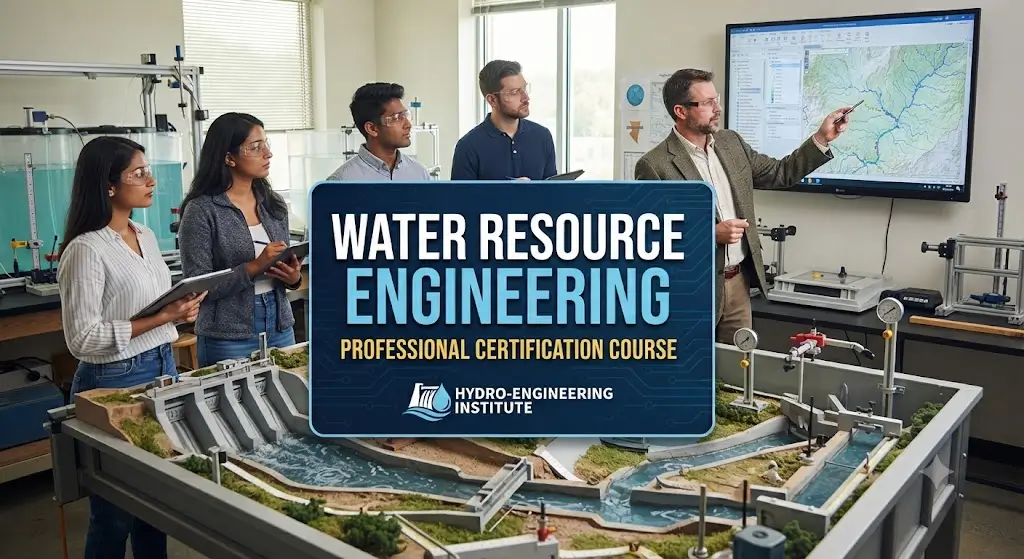
Introduction to Water Resource Engineering
The Water Resource Engineering Course is a professional training program designed to help learners understand how water systems are planned, developed, and managed for human use and environmental sustainability. Water resource engineering is a key branch of civil engineering that ensures efficient utilization and conservation of water resources.
This field involves analyzing rainfall patterns, managing river systems, designing irrigation networks, and developing infrastructure for water storage, distribution, and flood control. Engineers must ensure sustainable and safe water availability for agriculture, urban populations, and industries.
This course combines civil engineering principles, hydrology, environmental science, and infrastructure planning to provide practical knowledge applicable across water supply projects, irrigation systems, dams, and urban drainage systems.
Why Water Resource Engineering Matters
Water is essential for life, agriculture, industry, and urban development. Poor water management can lead to floods, droughts, water scarcity, and environmental degradation.
Understanding water resource engineering enables professionals to design efficient water systems, prevent flooding, manage irrigation effectively, and ensure sustainable water usage.
The Water Resource Engineering Course enables learners to develop strong expertise in hydrology and water infrastructure planning.
Course Overview
The Water Resource Engineering Course introduces learners to the principles and applications of water system design and management.
Participants begin by studying hydrological cycles and rainfall analysis. The course explores water supply systems, irrigation engineering, dam and reservoir concepts, drainage design, and flood control methods.
Learners also study watershed management, groundwater systems, and environmental impact considerations.
Practical case studies demonstrate real-world water infrastructure and management projects.
Benefits of the Course
The Water Resource Engineering Course provides practical knowledge for managing and designing sustainable water systems.
Participants gain confidence in analyzing water systems, designing infrastructure, managing flood risks, and optimizing water usage. The course also strengthens analytical and environmental engineering skills.
As water scarcity and climate challenges increase globally, professionals with water resource expertise are in high demand.
Career Opportunities
After completing the Water Resource Engineering Course, learners may pursue careers such as:
- Water Resource Engineer
- Civil Engineer
- Hydrologist
- Irrigation Engineer
- Flood Control Engineer
- Environmental Engineer
- Water Supply Engineer
- Project Engineer
- Infrastructure Engineer
- Drainage Engineer
- Watershed Manager
- Government Water Engineer
- Technical Consultant
- Senior Water Engineer (future path)
Certification
Upon successful completion of the Water Resource Engineering Course, learners receive a professional certificate recognizing their expertise in hydrology, water system design, irrigation engineering, flood control, and sustainable water management. This certification supports career advancement across civil engineering, environmental engineering, irrigation departments, and infrastructure sectors.
Frequently Asked Questions (FAQs)
1. What is the Water Resource Engineering Course?
It teaches how to design and manage water systems for civil and environmental applications.
2. Who should enroll in this course?
Civil engineers, environmental engineers, hydrology professionals, and students can benefit.
3. Do I need prior experience?
Basic civil engineering knowledge is recommended.
4. What topics are covered?
Hydrology, irrigation, water supply, drainage, and flood control systems.
5. Is this course practical?
Yes. It includes real-world water engineering applications.
6. Will I learn irrigation design?
Yes. Irrigation engineering is included in detail.
7. How does this help my career?
It builds essential skills for water and environmental engineering roles.
8. Does it include flood control?
Yes. Flood management systems are covered.
9. Can this improve my job opportunities?
Yes. Water resource engineers are in high demand globally.
10. What industries use water resource engineering?
Civil engineering, irrigation departments, environmental agencies, infrastructure development, and government water authorities.




Reviews
There are no reviews yet.