
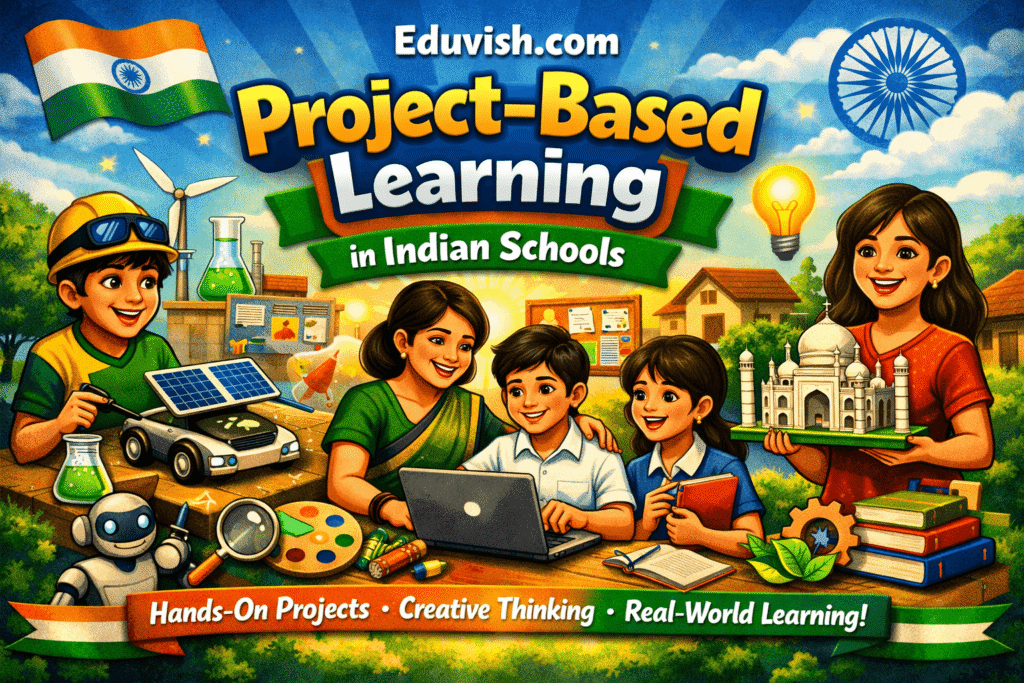
Introduction
Education in India is evolving rapidly. Traditional rote learning is giving way to innovative methods that encourage creativity, collaboration, and critical thinking. One of the most effective approaches gaining momentum is Project‑Based Learning (PBL). At Eduvish.com, we explore how PBL is transforming classrooms across India, empowering students to learn by doing and preparing them for real‑world challenges.
What Is Project‑Based Learning?
Project‑Based Learning is an instructional approach where students learn by actively engaging in projects that solve real‑life problems. Instead of memorizing facts, students apply knowledge to create tangible outcomes — such as models, presentations, or community initiatives. This method encourages inquiry, teamwork, and reflection, making learning more meaningful and enjoyable.
Why Project‑Based Learning Matters in Indian Schools
- Encourages critical thinking: Students analyze, evaluate, and create solutions.
- Promotes collaboration: Group projects teach teamwork and communication.
- Enhances creativity: Learners explore innovative ideas.
- Connects theory to practice: Concepts are applied to real‑world situations.
- Builds confidence: Students take ownership of their learning journey.
The Evolution of Learning in India
Indian education has long been dominated by exam‑centric teaching. However, with the National Education Policy (NEP 2020) emphasizing experiential learning, schools are shifting toward student‑centric education. PBL aligns perfectly with NEP’s vision — fostering holistic development and preparing students for the 21st‑century workforce.
Key Components of Project‑Based Learning
- Inquiry and Research – Students ask questions and explore answers.
- Planning and Design – They outline steps and resources needed.
- Execution – Learners create, test, and refine their projects.
- Presentation – Students showcase their findings.
- Reflection – They evaluate what worked and what didn’t.
Benefits of Project‑Based Learning
| Benefit | Description |
|---|---|
| Deep understanding | Students grasp concepts beyond textbooks. |
| Skill development | Enhances problem‑solving, communication, and leadership. |
| Engagement | Learning becomes interactive and fun. |
| Real‑world relevance | Projects mirror real‑life challenges. |
| Improved retention | Students remember lessons longer through application. |
Examples of Project‑Based Learning in Indian Schools
- Environmental Awareness Projects – Students design campaigns to reduce plastic use.
- STEM Innovation Challenges – Learners build solar models or water‑purification systems.
- Community Service Initiatives – Pupils organize cleanliness drives or literacy programs.
- Cultural Heritage Projects – Exploring local art, traditions, and history through creative presentations.
- Entrepreneurship Simulations – Students create mock startups to learn business fundamentals.
Role of Teachers in Project‑Based Learning
Teachers act as facilitators rather than lecturers. They guide students through inquiry, help them manage time, and encourage reflection. This shift from “sage on the stage” to “guide on the side” empowers students to take charge of their learning.
Challenges in Implementing PBL in India
- Limited resources in rural schools.
- Teacher training gaps.
- Assessment difficulties — traditional exams don’t measure creativity.
- Curriculum rigidity.
- Time constraints in academic schedules.
Despite these challenges, many schools are adopting hybrid models that blend traditional teaching with project‑based methods.
How Technology Supports Project‑Based Learning
Digital tools like Google Classroom, Microsoft Teams, and Eduvish resources make collaboration and research easier. Students can share ideas, track progress, and present projects virtually — bridging gaps between urban and rural education.
Impact of PBL on Students
- Improved academic performance
- Enhanced creativity and innovation
- Stronger communication skills
- Better teamwork and leadership
- Increased motivation and curiosity
These outcomes align with India’s vision of nurturing future‑ready learners.