
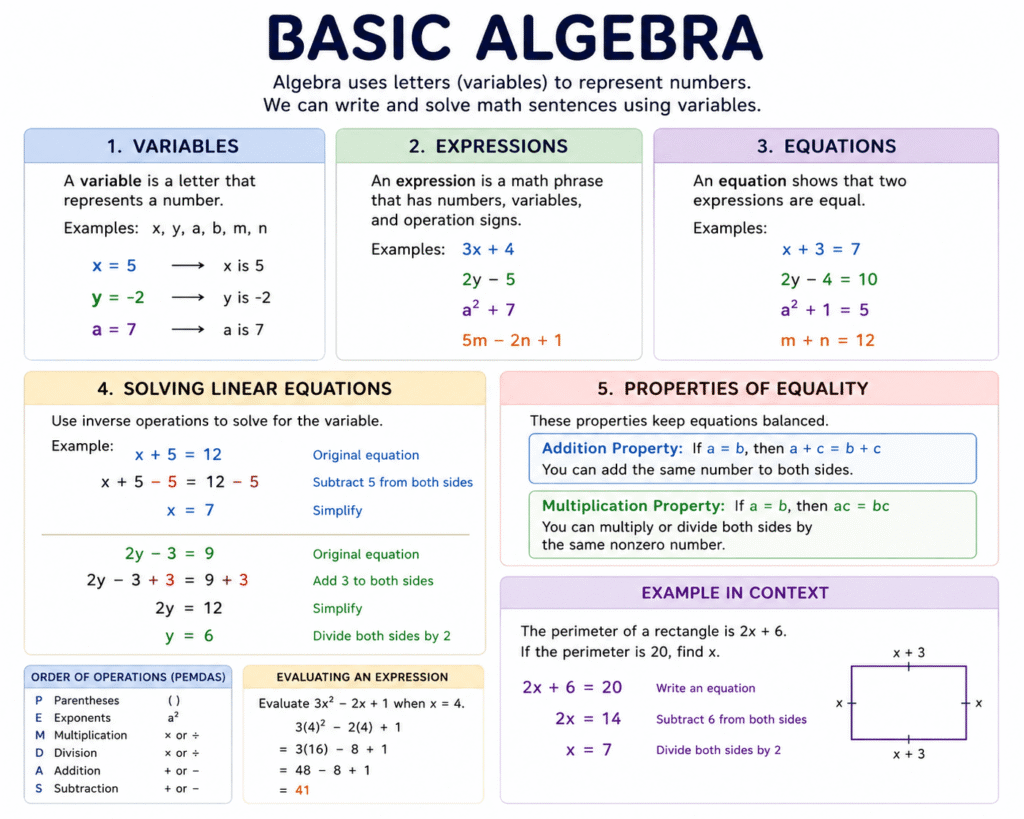
What is Algebra?
Algebra is a branch of mathematics that uses letters (variables) to represent unknown values. Known values are called constants. Together, they form expressions and equations.
Example:
- Expression:
- Equation:
Here, is the variable, and solving gives .
Basic Algebraic Operations
Algebra combines variables and constants using four operations:
| Operation | Symbol | Example |
|---|---|---|
| Addition | + | |
| Subtraction | – | |
| Multiplication | × | |
| Division | ÷ |
Order of Operations (BODMAS Rule)
When solving algebraic expressions, follow BODMAS:
- Brackets
- Orders (powers, roots)
- Division
- Multiplication
- Addition
- Subtraction
Example:
Key Algebraic Formulas
These formulas simplify calculations and are widely used in exams.
Solving Equations
Steps to solve:
- Simplify both sides.
- Move variables to one side.
- Move constants to the other side.
- Solve for the variable.
Example: → →
Real-Life Applications of Algebra
- Finance: Interest calculation, budgeting.
- Science: Chemical equations, physics formulas.
- Technology: Algorithms, coding.
- Daily Life: Comparing prices, planning schedules.
Common Mistakes
- Forgetting BODMAS order.
- Misplacing negative signs.
- Mixing constants and variables incorrectly.
- Not simplifying fractions in equations.
Conclusion
Basic algebra is more than just math — it’s a problem-solving tool used in academics, careers, and everyday life. By mastering operations, formulas, and equations, students can build strong analytical skills and prepare for advanced mathematics.

