
Introduction
The Workforce Analytics Techniques Course is a comprehensive, beginner-to-advanced level training program designed to help learners understand how data-driven decision-making is transforming modern Human Resource (HR) and workforce management systems. In today’s competitive business environment, organizations no longer rely only on intuition or experience to manage employees. Instead, they use workforce analytics to make smarter, faster, and more accurate decisions.
Workforce analytics refers to the process of collecting, analyzing, and interpreting employee-related data to improve productivity, performance, engagement, retention, and overall organizational effectiveness. It helps HR professionals and business leaders understand what is happening inside their workforce and why it is happening.
For example, instead of guessing why employees are leaving an organization, workforce analytics can identify patterns such as workload imbalance, low engagement, poor management, or lack of growth opportunities.
As a result, organizations can take proactive steps to improve retention and performance.
This course is designed for students, HR professionals, managers, analysts, and anyone interested in understanding how data can improve workforce decision-making.
Why Workforce Analytics Matters
In modern organizations, people are the most valuable asset. However, managing people effectively is complex because human behavior is influenced by multiple factors such as motivation, work environment, leadership, compensation, and career growth.
This is where workforce analytics becomes essential.
Workforce analytics helps organizations:
- Understand employee behavior patterns
- Improve hiring decisions
- Increase employee retention
- Optimize workforce productivity
- Reduce hiring costs
- Improve employee satisfaction
- Enhance leadership decision-making
- Identify skill gaps in teams
Moreover, organizations that use workforce analytics are more efficient, competitive, and future-ready.
For example, a company using analytics may discover that employees who receive regular training are 40% more productive than those who do not. Based on this insight, the company can invest more in training programs.
Course Objectives
The primary objective of the Workforce Analytics Techniques Course is to develop the ability to convert raw HR data into meaningful insights that support business decisions.
By the end of this course, learners will be able to:
- Understand workforce data and metrics
- Analyze employee performance trends
- Identify patterns in hiring and retention
- Use data to improve HR decisions
- Create workforce reports and dashboards
- Support strategic HR planning
- Improve organizational efficiency using analytics
In addition, learners will develop analytical thinking and data interpretation skills that are highly valuable in HR and business roles.
Understanding Workforce Analytics
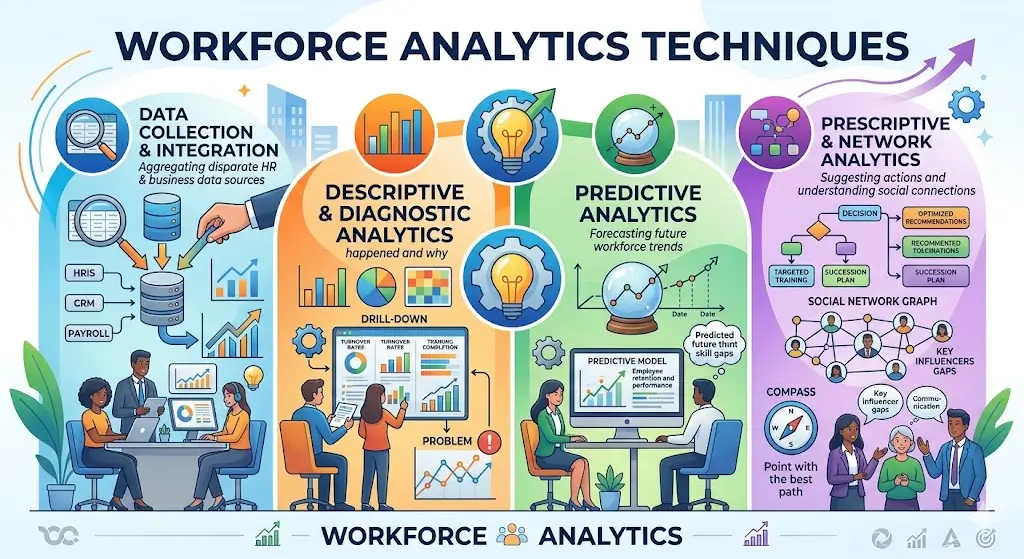
Workforce analytics is divided into several levels of analysis:
1. Descriptive Analytics
This explains what has happened in the workforce.
- Employee turnover rate
- Attendance reports
- Performance summaries
2. Diagnostic Analytics
This explains why something happened.
- Why employees are leaving
- Why productivity is declining
3. Predictive Analytics
This predicts what may happen in the future.
- Which employees are likely to resign
- Future hiring needs
4. Prescriptive Analytics
This suggests actions to improve outcomes.
- How to reduce attrition
- How to improve engagement
As a result, organizations can move from reactive HR management to proactive workforce planning.
Course Overview
This course provides a structured learning path covering the core concepts, tools, and techniques of workforce analytics.
Learners will explore:
- Introduction to workforce analytics
- HR data and metrics understanding
- Employee lifecycle analytics
- Recruitment analytics techniques
- Performance management analysis
- Employee engagement measurement
- Attrition and retention analysis
- Workforce planning techniques
- HR dashboards and reporting
- Data visualization basics
- KPI tracking in HR
- Predictive HR modeling basics
- Decision-making using analytics
- Business intelligence in HR
What You Will Learn
Throughout this course, learners will develop strong analytical and HR data interpretation skills.
You will learn how to:
- Collect and interpret workforce data
- Analyze employee performance trends
- Identify causes of employee turnover
- Measure employee engagement levels
- Evaluate recruitment effectiveness
- Build HR reports and dashboards
- Improve workforce productivity using data
- Support HR decision-making with insights
- Forecast workforce requirements
- Improve organizational planning
By the end of the course, learners will understand how workforce analytics transforms HR into a strategic function.
Key Workforce Metrics Covered
This course introduces important HR and workforce metrics such as:
- Employee turnover rate
- Absenteeism rate
- Productivity per employee
- Hiring success rate
- Time-to-hire
- Cost-per-hire
- Employee engagement score
- Training effectiveness
- Retention rate
- Performance rating distribution
For example, if absenteeism is high in a department, analytics can help identify whether it is due to workload, management style, or workplace environment.
Tools and Techniques in Workforce Analytics
Learners will also be introduced to common tools and techniques used in workforce analytics:
- Excel-based HR analytics
- HR dashboards
- Data visualization tools
- KPI tracking systems
- HR software systems (HRIS)
- Basic statistical methods
- Trend analysis
- Predictive modeling concepts
Moreover, learners will understand how organizations use software systems to automate HR reporting and analysis.
Skills You Will Gain
After completing this course, learners will develop the following skills:
- Data analysis skills
- HR analytics understanding
- Critical thinking
- Decision-making
- Problem-solving
- Reporting and visualization
- Workforce planning
- Communication skills
- Strategic thinking
- Attention to detail
- Business intelligence understanding
- HR metric interpretation
- Analytical reasoning
- Organizational insight
These skills are highly valuable in HR, business analytics, consulting, and management roles.
Benefits of Workforce Analytics
Workforce analytics provides powerful benefits for both individuals and organizations.
For Organizations:
- Better hiring decisions
- Reduced employee turnover
- Improved productivity
- Lower HR costs
- Data-driven HR strategies
- Improved employee engagement
- Strong workforce planning
For Individuals:
- High-demand HR analytics skills
- Better career opportunities
- Strong analytical thinking
- Competitive advantage in HR roles
- Ability to work in modern HR departments
Furthermore, workforce analytics is becoming a core skill in future HR careers.
Who Should Enroll?
This course is ideal for:
- HR professionals
- Business analysts
- Students
- Managers and team leaders
- Recruitment professionals
- Data enthusiasts
- Anyone interested in HR analytics
No advanced technical background is required. Beginners can easily start learning.
Career Opportunities
After completing this course, learners may pursue roles such as:
- HR Analyst
- Workforce Analyst (Entry Level)
- HR Data Assistant
- People Analytics Assistant
- HR Executive
- Recruitment Analyst Assistant
- Business Intelligence Assistant
- HR Reporting Specialist
- Talent Analytics Assistant
- Workforce Planning Assistant
- Entry-level data roles in HR
These roles are in demand across corporate companies, IT firms, consulting agencies, and multinational organizations.
Certification
Upon successful completion of the Workforce Analytics Techniques Course, learners receive a professional certification that validates their skills in HR data analysis, workforce insights, and strategic HR decision-making.
This certification helps learners build credibility in the HR analytics field.
Conclusion
The Workforce Analytics Techniques Course equips learners with the knowledge and skills required to understand, analyze, and optimize workforce performance using data-driven methods.
In a world where decisions are increasingly powered by data, workforce analytics plays a critical role in shaping successful organizations. From improving employee retention to optimizing productivity, analytics transforms how HR functions operate.
Whether you are starting your career or upgrading your HR skills, this course provides a strong foundation in modern workforce analytics and prepares you for the future of data-driven HR management.
FAQ Section
1. What is Workforce Analytics Techniques Course?
It is a course that teaches how to use data to analyze employee performance and improve HR decisions.
2. Who should take this course?
HR professionals, students, managers, and analysts should take this course.
3. Do I need technical skills for this course?
No, it is beginner-friendly.
4. What will I learn in this course?
You will learn HR analytics, employee data analysis, and workforce planning.
5. Is this course useful for HR jobs?
Yes, it is highly useful for modern HR and analytics roles.
6. Does this course include dashboards?
Yes, it covers HR dashboards and reporting systems.
7. Will I get a certificate?
Yes, after completion you will receive a certificate.
8. Can students join this course?
Yes, students can easily join.
9. Is workforce analytics in demand?
Yes, it is a high-demand skill in HR and business sectors.
10. What jobs can I get after this course?
You can work as HR Analyst, Workforce Analyst, or HR Executive in analytics roles.


Reviews
There are no reviews yet.