
Introduction
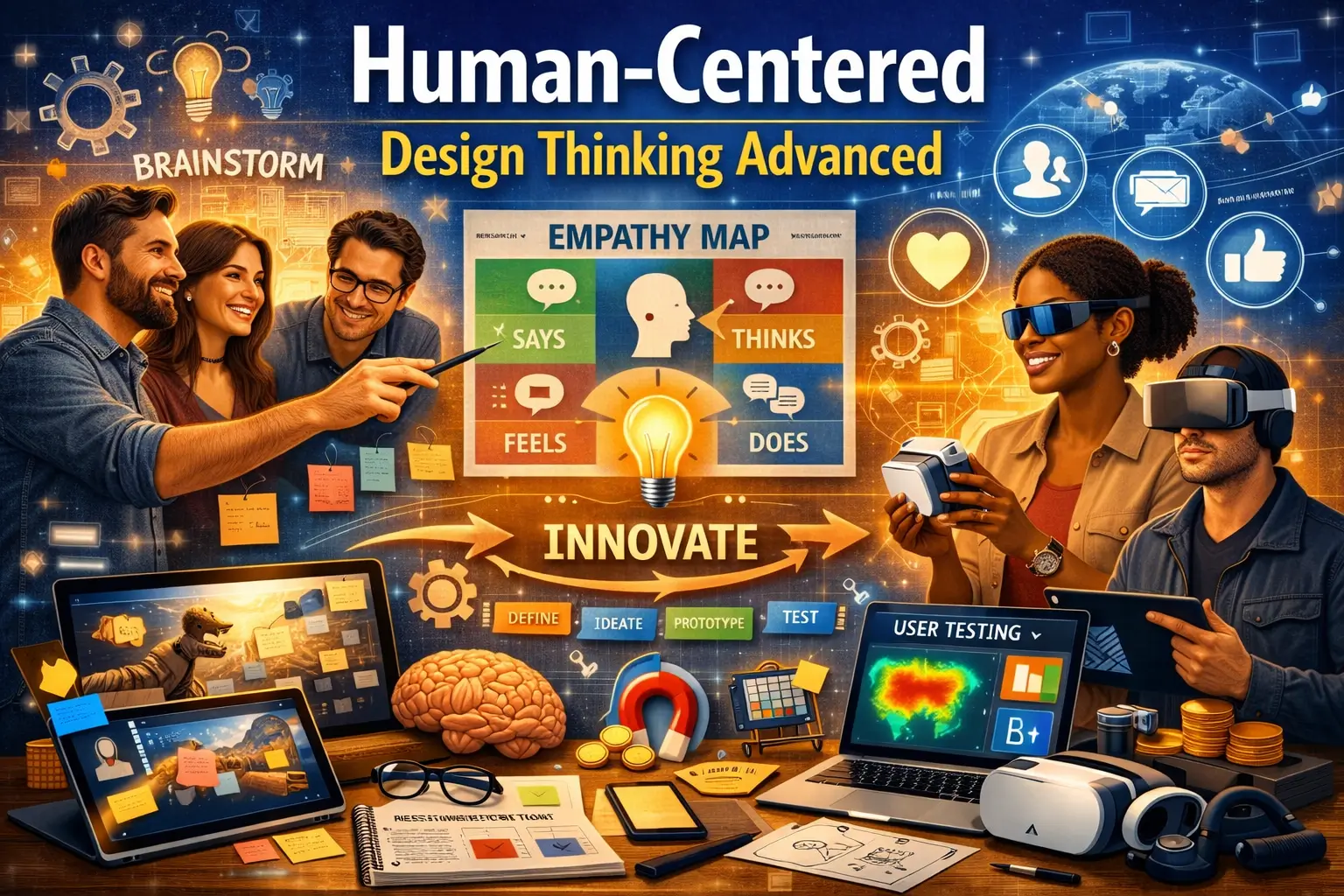
The Human-Centered Design Thinking Advanced course helps learners solve real-world problems by focusing on people, their needs, and their experiences. First, you will understand how empathy and creativity work together to build better products and services.
Moreover, organizations across industries use human-centered approaches to improve customer satisfaction and business outcomes. Therefore, these skills have become highly valuable in today’s workplace.
Human-Centered Design Thinking Course Overview
This course introduces a practical framework for innovation and problem solving. First, you will learn how to identify user needs and pain points. Then, you will discover methods for generating creative ideas and testing solutions.
Moreover, you will explore research, ideation, prototyping, and validation processes. Additionally, you will understand how teams collaborate to build user-focused solutions.
Therefore, this course creates a strong foundation for innovation.
What You Will Learn
First, you will understand empathy-driven problem solving. Then, you will learn how to conduct user research.
Moreover, you will explore brainstorming techniques and prototype development. Additionally, you will learn how to collect feedback and improve solutions continuously.
Therefore, you will gain practical skills that can be applied across industries.
Skills You Will Gain in Human-Centered Design Thinking Course
After completing this course, you will gain:
- Human-centered innovation skills
- Creative problem-solving abilities
- User research techniques
- Prototyping knowledge
- Customer experience improvement strategies
- Collaboration skills
- Design thinking methodologies
- User feedback analysis
- Innovation planning techniques
- Strategic thinking abilities
Moreover, these skills are valuable in product development, business, and digital transformation projects.
Benefits of the Course
This course helps learners become more innovative and user-focused. Moreover, it strengthens communication and teamwork abilities.
Additionally, companies increasingly seek professionals who can create solutions centered around customer needs. Therefore, these skills can improve career opportunities in multiple industries.
Who Should Enroll
This course is ideal for:
- Students
- UX designers
- Product managers
- Entrepreneurs
- Business professionals
- Project managers
- Marketing professionals
- Startup founders
- Innovation teams
- Career changers
Moreover, no previous design experience is required.
Career Opportunities
After completing the course, you may explore roles such as:
- Design Thinking Specialist
- Innovation Associate
- Product Manager
- UX Designer
- Customer Experience Specialist
- Service Designer
- Product Strategist
- Innovation Consultant
- Business Analyst
- Project Coordinator
Moreover, these opportunities exist across technology, healthcare, education, finance, and service industries.
Certification
Upon successful completion, learners receive a certificate that validates their understanding of innovation, empathy-driven design, and user-focused methodologies.
Additionally, this certification can strengthen professional credibility.
Why Choose Human-Centered Design Thinking Course
The Human-Centered Design Thinking Course combines creativity, collaboration, and practical frameworks that organizations use worldwide.
Moreover, the curriculum focuses on real-world applications instead of theory alone. Therefore, learners can immediately apply these skills in professional environments.
Whether your goal is to improve customer experiences, build better products, or drive innovation, this course provides a strong foundation to get started.
FAQ SECTION
1. What is the Human-Centered Design Thinking Course?
It teaches a user-focused approach to innovation and problem-solving.
2. Is this course suitable for beginners?
Yes. It is designed for beginners.
3. What topics are covered?
Empathy, ideation, prototyping, testing, and design thinking methodologies.
4. Will I receive a certificate?
Yes. Participants receive a certificate after successful completion.
5. Do I need design experience?
No. Prior experience is not required.
6. Is the course fully online?
Yes. It offers flexible online learning.
7. What skills will I gain?
You will gain innovation, collaboration, and creative problem-solving skills.
8. Can this course help my career?
Yes. It supports careers in product, UX, innovation, and business roles.
9. Where is human-centered design used?
It is used in technology, healthcare, education, business, and product development.
10. Why is human-centered design important?
It helps organizations create solutions that truly meet user needs.

Reviews
There are no reviews yet.