
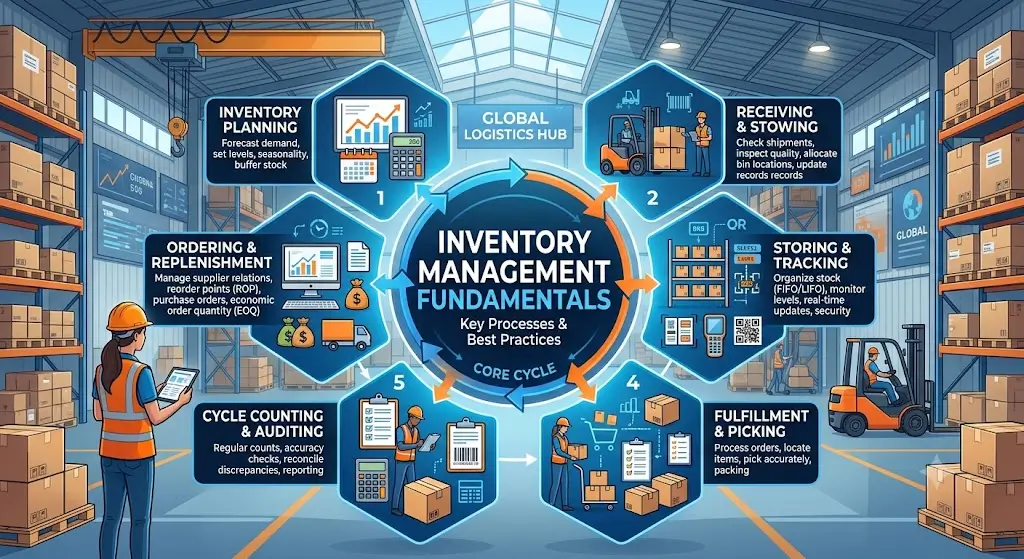
A modern inventory management fundamentals course image featuring warehouse shelves, barcode scanning, and inventory dashboard elementsIntroduction to Inventory Management Fundamentals
Inventory is one of the most valuable assets in many organizations. Proper management of inventory helps businesses maintain operational efficiency, meet customer demand, reduce costs, and improve profitability. The Inventory Management Fundamentals course provides learners with a comprehensive introduction to inventory control principles, stock management techniques, and warehouse operations.
Inventory management involves planning, organizing, monitoring, and controlling inventory throughout its lifecycle. Whether an organization manages raw materials, finished products, spare parts, or retail goods, effective inventory practices are essential for business success.
This course introduces learners to the processes used to track inventory, manage stock levels, maintain accurate records, and support efficient supply chain operations.
Importance of Inventory Management Fundamentals
Organizations rely on inventory to support production, sales, and customer service activities. Poor inventory management can lead to stock shortages, overstocking, operational delays, and increased costs.
Understanding inventory management helps learners:
- Improve stock control awareness
- Support efficient business operations
- Reduce inventory-related risks
- Improve warehouse organization
- Enhance supply chain efficiency
- Support customer satisfaction
- Increase inventory accuracy
- Improve resource utilization
These benefits demonstrate the importance of effective inventory management in modern organizations.
Understanding Inventory Systems
Inventory systems help organizations monitor and control inventory movement.
Inventory Tracking
Learners understand how products and materials are monitored throughout storage and distribution processes.
Stock Monitoring
The course explains methods used to observe inventory levels and identify stock requirements.
Inventory Records
Participants explore the importance of maintaining accurate inventory information.
Product Movement Awareness
Learners gain understanding of how inventory moves through operational systems.
These concepts support efficient inventory management and decision-making.
Stock Control Principles
Stock control is one of the most important aspects of inventory management.
The course introduces:
Inventory Level Management
Understanding how organizations maintain appropriate stock quantities.
Replenishment Awareness
Learning concepts related to stock replacement and inventory planning.
Stock Availability
Exploring methods that help ensure products are available when required.
Inventory Accuracy
Understanding the importance of maintaining reliable inventory records.
Effective stock control supports operational efficiency and customer satisfaction.
Warehouse Operations and Storage Management
Warehouses play a vital role in inventory management.
Learners explore:
Warehouse Organization
Understanding how inventory is arranged and stored efficiently.
Storage Practices
Learning methods used to manage inventory within storage facilities.
Material Handling Awareness
Understanding how inventory is moved and managed safely.
Space Utilization
Exploring efficient use of warehouse space and storage resources.
These concepts contribute to improved warehouse productivity and inventory control.
Inventory Documentation and Record Keeping
Accurate documentation supports effective inventory operations.
The course covers:
Inventory Records
Understanding inventory documentation processes.
Reporting Procedures
Learning how inventory information is recorded and communicated.
Transaction Tracking
Understanding inventory movement records and documentation requirements.
Audit Awareness
Exploring inventory verification and review processes.
Good documentation improves accountability and operational visibility.
Inventory Planning and Forecasting Awareness
Inventory planning helps organizations maintain appropriate stock levels.
Learners gain awareness of:
- Inventory demand concepts
- Stock planning principles
- Resource allocation awareness
- Inventory replenishment concepts
- Forecasting fundamentals
- Operational planning practices
Effective planning helps organizations balance inventory availability and operational efficiency.
Common Inventory Challenges
Organizations face various inventory-related challenges that require effective management.
The course discusses:
Stock Shortages
Understanding the impact of insufficient inventory availability.
Excess Inventory
Learning how overstocking can affect storage and operational costs.
Inventory Inaccuracies
Exploring causes of inventory discrepancies and record errors.
Storage Inefficiencies
Understanding challenges related to warehouse organization and space management.
Awareness of these issues supports better inventory decision-making.
Supply Chain and Inventory Relationship
Inventory management is closely connected to supply chain operations.
Learners understand:
- Inventory flow within supply chains
- Coordination between suppliers and warehouses
- Distribution awareness
- Inventory support for customer service
- Operational continuity concepts
- Supply chain efficiency principles
These concepts help learners understand the broader role of inventory within business operations.
Skills You Will Gain
Upon completing this course, learners may develop:
- Inventory control awareness
- Stock management knowledge
- Warehouse operations understanding
- Inventory planning concepts
- Documentation skills
- Inventory tracking awareness
- Storage management knowledge
- Supply chain awareness
- Record keeping understanding
- Operational efficiency concepts
These skills are valuable in a wide range of business environments.
Benefits of Studying Inventory Management Fundamentals
This course offers several important benefits:
- Improved understanding of inventory systems
- Better stock control awareness
- Increased warehouse management knowledge
- Understanding of inventory planning concepts
- Enhanced operational awareness
- Support for supply chain learning
- Greater inventory accuracy awareness
- Preparation for logistics and warehousing opportunities
The knowledge gained helps learners understand how inventory contributes to business performance and operational success.
Who Should Join
This course is suitable for:
- Students
- Warehouse staff
- Store assistants
- Inventory clerks
- Logistics learners
- Supply chain professionals
- Retail employees
- Business owners
- Procurement support staff
- Beginners interested in inventory operations
No prior experience is required.
Career Opportunities
After completing this course, learners may explore opportunities such as:
- Inventory Assistant
- Stock Control Assistant
- Warehouse Assistant
- Inventory Clerk
- Store Operations Assistant
- Logistics Support Executive
- Supply Chain Assistant
- Warehouse Coordinator Trainee
- Inventory Records Assistant
- Distribution Support Staff
FAQ Section
1. What is Inventory Management Fundamentals?
It is a beginner-friendly course that introduces inventory control and stock management concepts.
2. Who can join this course?
Students, warehouse staff, retail workers, and beginners can join.
3. Do I need prior experience?
No, prior experience is not required.
4. What will I learn?
You will learn inventory control, stock management, warehouse operations, and inventory planning concepts.
5. Why is inventory management important?
It helps organizations maintain stock availability, reduce costs, and improve efficiency.
6. Does the course cover warehouse operations?
Yes, learners gain awareness of warehouse management and storage practices.
7. What skills will I gain?
You will gain inventory control awareness, stock management knowledge, and warehouse operation understanding.
8. Is this course suitable for beginners?
Yes, it is specifically designed for beginners.
9. Can this course support logistics careers?
Yes, it provides foundational knowledge useful in logistics, warehousing, and supply chain sectors.
10. Is Inventory Management Fundamentals relevant to retail businesses?
Yes, inventory management is essential for retail operations and stock control.



Reviews
There are no reviews yet.