
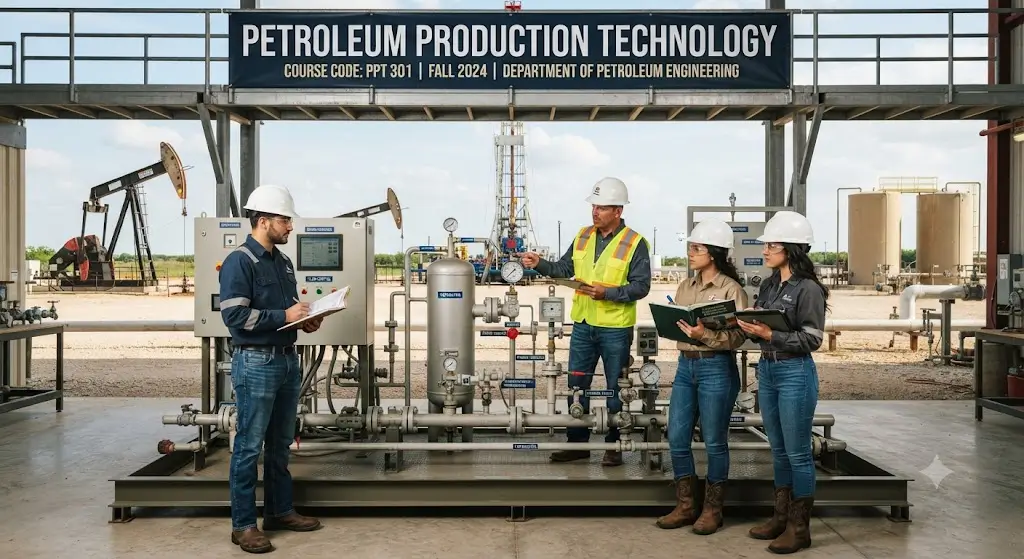
Introduction to Petroleum Production Technology
The Petroleum Production Technology Course is a comprehensive professional training program that introduces learners to the technologies, equipment, and operational practices involved in producing oil and natural gas from underground reservoirs. Petroleum production represents one of the most important stages of the upstream oil and gas industry, transforming reservoir resources into usable energy products through carefully planned engineering processes.
Petroleum production involves a combination of reservoir engineering, well design, production equipment, flow management, monitoring systems, and operational maintenance. Engineers and production professionals work together to maximize hydrocarbon recovery while maintaining operational efficiency, protecting the environment, and ensuring worker safety.
This course combines petroleum engineering principles with practical production technologies to help learners understand how modern oil and gas fields operate. Whether working onshore or offshore, petroleum production professionals require technical knowledge, analytical skills, and operational awareness to manage production systems effectively throughout the life of a field.
Why Petroleum Production Technology Matters
Oil and natural gas remain essential energy resources supporting transportation, manufacturing, electricity generation, petrochemical industries, and economic development. Efficient petroleum production helps maximize reservoir recovery, reduce operational costs, improve equipment reliability, and ensure a stable energy supply.
The Petroleum Production Technology Course explains how production technologies improve well performance, manage production rates, monitor equipment, and optimize hydrocarbon recovery. Modern petroleum operations also emphasize digital technologies, automation, predictive maintenance, and environmental responsibility to improve operational efficiency.
As energy companies continue investing in advanced production technologies, professionals with expertise in petroleum production remain highly valuable across the global oil and gas industry.
Course Overview
The Petroleum Production Technology Course introduces learners to the complete petroleum production process, beginning with reservoir characteristics and extending through production optimization and facility operations.
Participants first study reservoir fundamentals, production mechanisms, well completion methods, and production system design. The course then explores artificial lift systems, well intervention techniques, production tubing, separators, gathering systems, pipelines, flow assurance, and production monitoring.
Learners also examine production optimization strategies, corrosion control, maintenance planning, safety management, environmental protection, digital oilfield technologies, production data analysis, and equipment reliability.
Practical examples and industry case studies help learners understand how production engineers improve operational performance while maintaining safe and environmentally responsible petroleum production.
Topics Covered
Throughout the Petroleum Production Technology Course, learners will study:
Petroleum Production Fundamentals
Understand reservoir behavior, hydrocarbon production mechanisms, production systems, and upstream operations.
Well Completion
Learn well completion methods, production tubing, casing, packers, perforation, and completion equipment.
Artificial Lift Systems
Study pumping systems, gas lift, electrical submersible pumps (ESP), rod pumps, and production enhancement methods.
Production Equipment
Explore separators, valves, flowlines, gathering systems, manifolds, compressors, and surface production facilities.
Flow Assurance
Understand fluid flow behavior, hydrate prevention, wax control, scaling, corrosion management, and pipeline integrity.
Production Optimization
Learn production monitoring, performance analysis, well testing, production forecasting, and efficiency improvement techniques.
Maintenance and Reliability
Study preventive maintenance, equipment reliability, condition monitoring, inspection planning, and asset management.
Health, Safety, and Environment (HSE)
Understand operational safety, hazard identification, emergency response, environmental protection, and regulatory compliance.
Digital Oilfield Technologies
Explore automation, remote monitoring, sensors, production analytics, artificial intelligence, and digital production management.
Production Data Analysis
Learn production reporting, key performance indicators (KPIs), operational dashboards, and data-driven decision-making.
Skills You Will Gain
After completing the Petroleum Production Technology Course, learners will develop valuable professional skills, including:
- Petroleum production operations
- Well completion fundamentals
- Artificial lift systems
- Production optimization
- Flow assurance
- Surface production facilities
- Equipment maintenance
- Reservoir production analysis
- Production monitoring
- Health and safety management
- Environmental compliance
- Digital oilfield technologies
- Operational planning
- Problem-solving
- Technical decision-making
These competencies are highly valued across oil and gas companies, petroleum service providers, engineering consultancies, energy organizations, and offshore production facilities.
Benefits of the Course
The Petroleum Production Technology Course provides practical knowledge that prepares learners for technical and operational roles within the upstream petroleum industry.
Participants gain confidence in understanding production systems, production equipment, operational planning, safety management, and production optimization techniques. The course also strengthens analytical thinking, engineering awareness, communication, and technical decision-making skills.
As energy companies increasingly adopt automation, digital technologies, and sustainable production practices, professionals with petroleum production expertise continue to enjoy strong career opportunities worldwide.
Who Should Enroll?
This course is suitable for:
- Petroleum engineering students
- Production engineers
- Oil and gas technicians
- Field supervisors
- Process engineers
- Maintenance professionals
- Energy sector employees
- Engineering graduates
- Operations managers
- Professionals seeking careers in petroleum production
No advanced petroleum production experience is required.
Career Opportunities
After completing the Petroleum Production Technology Course, learners may pursue careers such as:
- Petroleum Production Engineer
- Production Technologist
- Well Operations Engineer
- Field Production Supervisor
- Production Operations Engineer
- Oilfield Operations Coordinator
- Production Technician
- Artificial Lift Specialist
- Flow Assurance Engineer
- Maintenance Engineer
- Production Planner
- Asset Integrity Engineer
- Petroleum Consultant
- Operations Manager
- Production Performance Analyst
Certification
Upon successful completion of the Petroleum Production Technology Course, learners receive a professional certificate recognizing their expertise in petroleum production systems, well completion, production optimization, flow assurance, maintenance planning, operational safety, and digital oilfield technologies. This certification enhances career opportunities within upstream oil and gas operations, engineering firms, petroleum service companies, and energy organizations.
Frequently Asked Questions (FAQs)
1. What is the Petroleum Production Technology Course?
The course teaches the technologies, equipment, and operational practices used to produce oil and natural gas safely and efficiently.
2. Who should enroll in this course?
Petroleum engineering students, production engineers, technicians, supervisors, energy professionals, and anyone interested in oil and gas production can benefit from this course.
3. Do I need previous petroleum industry experience?
No. The course is designed for beginners as well as professionals seeking to strengthen their production technology knowledge.
4. What topics are covered?
Topics include petroleum production systems, well completion, artificial lift, flow assurance, production optimization, maintenance, HSE, production equipment, and digital oilfield technologies.
5. Will I receive a certificate?
Yes. Participants receive a certificate after successfully completing the course.
6. What skills will I develop?
You will develop skills in petroleum production operations, production monitoring, equipment management, production optimization, safety, and production data analysis.
7. Is this course suitable for petroleum engineering students?
Yes. It provides foundational and practical knowledge that supports careers in upstream oil and gas operations.
8. Can this course improve my petroleum industry career?
Yes. The course prepares learners for technical, operational, supervisory, and engineering roles in petroleum production.
9. Does the course include digital oilfield technologies?
Yes. The course introduces automation, remote monitoring, production analytics, artificial intelligence, and digital production systems.
10. Why is petroleum production technology important?
Petroleum production technology helps maximize hydrocarbon recovery, improve operational efficiency, maintain equipment reliability, ensure worker safety, and support environmentally responsible energy production.




Reviews
There are no reviews yet.