
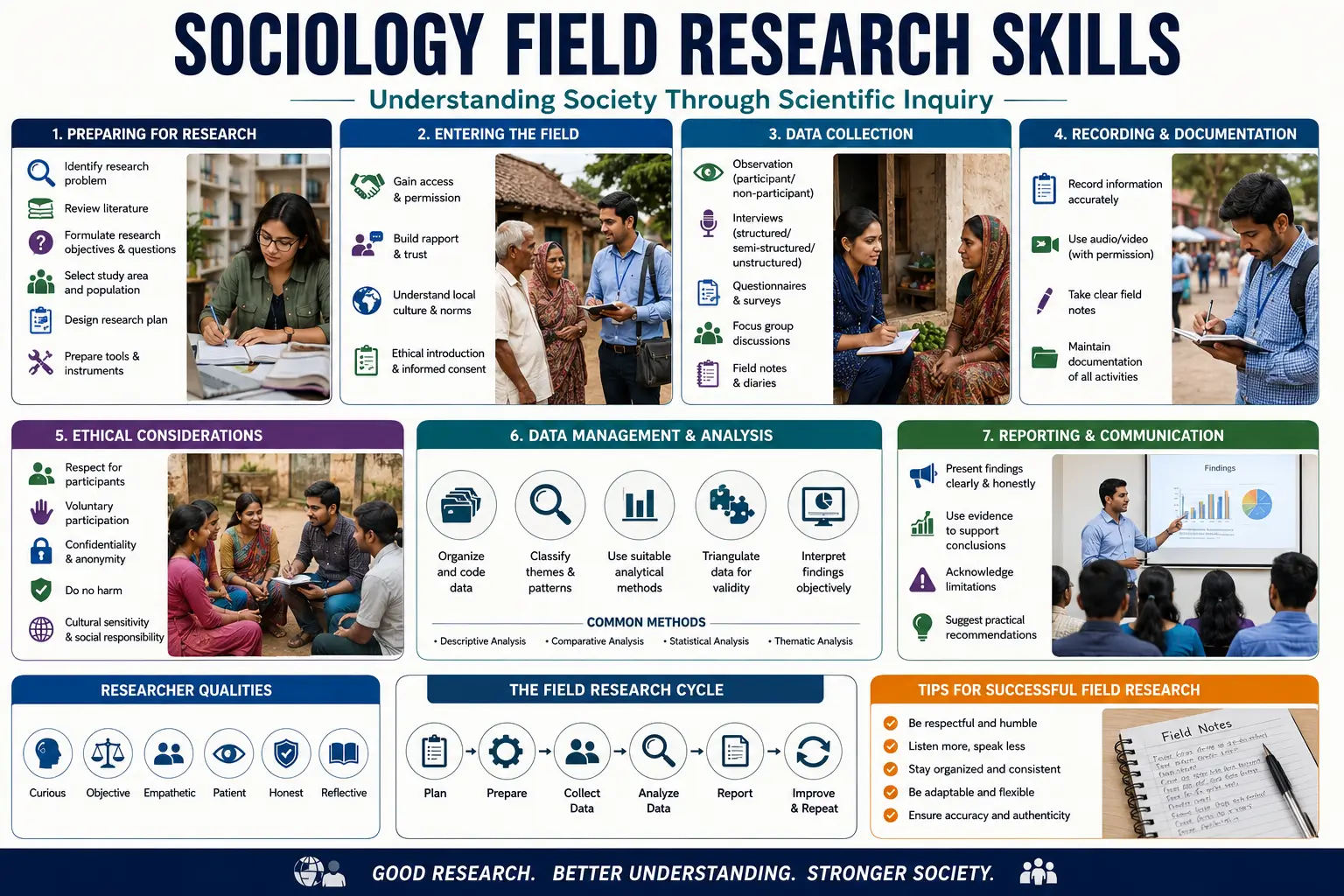
Sociology Field Research Skills is a practical course designed to equip learners with the tools and techniques needed to study social behavior, communities, and cultural dynamics in real-world settings. This program introduces the fundamentals of qualitative and quantitative research, data collection methods, and ethical considerations in sociological fieldwork.
Students will gain insights into participant observation, interviews, surveys, and case studies, while also learning how to analyze social patterns and interpret findings. The course emphasizes critical thinking, cultural sensitivity, and methodological rigor, preparing learners to conduct meaningful sociological research.
By the end of this course, participants will be able to:
- Understand the principles of sociological field research.
- Apply qualitative methods such as interviews and participant observation.
- Use quantitative tools including surveys and statistical analysis.
- Design and conduct case studies to explore social phenomena.
- Evaluate ethical issues in fieldwork and research practices.
- Interpret data to identify trends, behaviors, and cultural dynamics.
- Present findings in clear, structured, and impactful reports.
This course is ideal for students, researchers, and professionals interested in sociology, anthropology, and social sciences. With hands-on assignments, field projects, and real-world case studies, you’ll gain the confidence to conduct sociological research and contribute to understanding human society.
FAQ SECTION
1. What is sociology field research?
Sociology field research involves collecting and analyzing data directly from communities, groups, or social environments to understand social behavior and societal issues.
2. Who should enroll in this course?
Students, researchers, NGO professionals, educators, social workers, and anyone interested in social research can benefit from this course.
3. Do I need prior research experience?
No. The course is designed for beginners and gradually introduces research concepts and methods.
4. What skills will I learn?
You will learn survey design, interviews, observation techniques, sampling methods, data analysis, and research reporting.
5. Does the course cover both qualitative and quantitative research?
Yes. Participants learn both qualitative and quantitative sociological research methods.
6. Are research ethics included?
Yes. Ethical research practices, participant protection, and informed consent are important parts of the curriculum.
7. Is certification provided?
Yes. Learners receive a certificate upon successful completion.
8. Will I conduct practical fieldwork?
Yes. The course includes practical exercises and field research projects.
9. How can these skills help my career?
Field research skills are valuable in academia, public policy, NGOs, market research, social development, and community engagement roles.
10. What career opportunities can benefit from this course?
Social Research Assistant, Field Investigator, Community Development Officer, NGO Research Associate, Policy Analyst, Survey Coordinator, and Sociology Researcher.




Reviews
There are no reviews yet.