
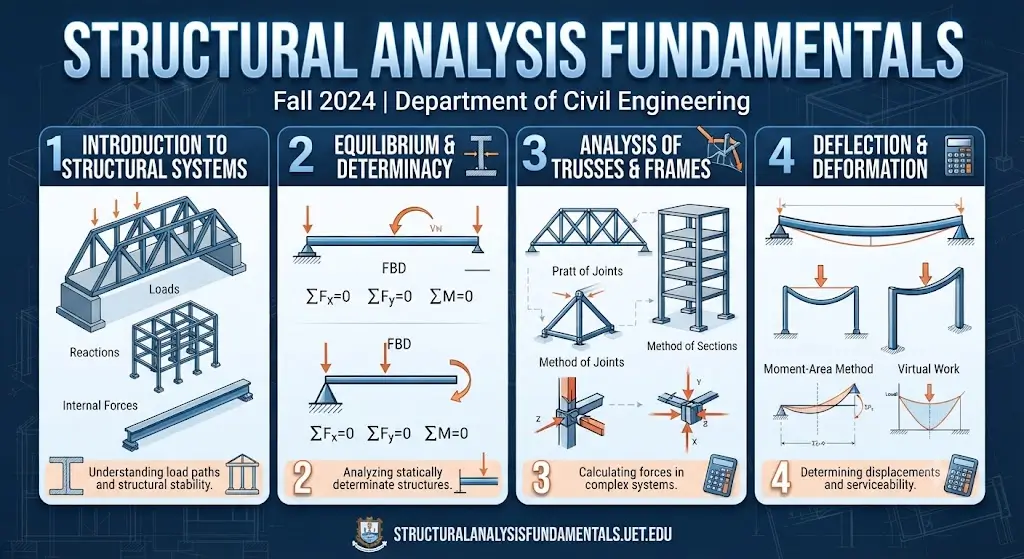
Introduction to Structural Analysis Fundamentals
The Structural Analysis Fundamentals Course is a professional training program designed to help learners understand the principles used to analyze the strength, stability, and behavior of engineering structures. Structural analysis forms the foundation of civil and structural engineering by ensuring that buildings, bridges, towers, and other structures can safely withstand applied loads.
Structural analysis involves calculating forces, reactions, stresses, strains, and deflections to evaluate structural performance under static and dynamic loading conditions. Engineers use analytical methods and engineering principles to design safe, economical, and durable structures.
This course combines engineering mechanics, structural theory, mathematics, and analytical techniques to provide practical knowledge applicable across construction, infrastructure, transportation, industrial facilities, and structural consulting.
Why Structural Analysis Fundamentals Matter
Accurate structural analysis is essential for designing safe and reliable engineering structures. It helps engineers predict structural behavior, optimize material usage, and prevent failures caused by excessive loads or poor design.
Understanding structural analysis improves engineering judgment, enhances design accuracy, supports regulatory compliance, and contributes to long-term structural safety. These skills are fundamental for every structural and civil engineer.
The Structural Analysis Fundamentals Course enables learners to build a strong foundation in engineering analysis and structural design.
Course Overview
The Structural Analysis Fundamentals Course introduces learners to the core principles of structural mechanics and analysis.
Participants begin by studying equilibrium, force systems, and support reactions. The course explores truss analysis, beam behavior, frame analysis, and structural stability.
Learners also study shear force diagrams, bending moment diagrams, deflection calculations, influence lines, and structural analysis methods.
Practical examples and engineering case studies demonstrate how analytical techniques are applied in real-world structural projects.
Topics Covered
Throughout the Structural Analysis Fundamentals Course, learners will study:
Engineering Mechanics
Understand the fundamentals of statics and equilibrium.
Force Analysis
Analyze external and internal forces acting on structures.
Support Reactions
Calculate reactions for different support conditions.
Truss Analysis
Evaluate forces in truss members.
Beam Analysis
Study shear force, bending moment, and deflection.
Frame Analysis
Analyze rigid frame structures and load distribution.
Structural Stability
Understand buckling and structural behavior.
Influence Lines
Analyze moving loads on structures.
Deflection Methods
Calculate structural deformation under loads.
Structural Analysis Techniques
Apply analytical methods used in engineering practice.
Skills You Will Gain
After completing the Structural Analysis Fundamentals Course, learners will develop valuable professional skills including:
- Structural analysis techniques
- Engineering mechanics
- Force and equilibrium analysis
- Truss and frame analysis
- Beam analysis
- Shear force and bending moment calculations
- Deflection analysis
- Structural stability evaluation
- Engineering calculations
- Analytical thinking
- Technical problem-solving
- Structural design support
- Engineering drawing interpretation
- Load analysis
- Safety-focused engineering decisions
These competencies are valuable across construction companies, engineering consultancies, infrastructure projects, government agencies, and structural design firms.
Benefits of the Course
The Structural Analysis Fundamentals Course provides practical knowledge for analyzing engineering structures accurately and efficiently.
Participants gain confidence in engineering calculations, structural evaluation, analytical techniques, and problem-solving. The course also strengthens technical reasoning and prepares learners for advanced structural design topics.
As infrastructure and construction projects continue to expand, professionals with strong structural analysis skills remain highly valued.
Who Should Enroll?
This course is suitable for:
- Civil engineers
- Structural engineers
- Construction engineers
- Design engineers
- Engineering students
- Project engineers
- Site engineers
- Infrastructure professionals
- CAD professionals
- Engineering consultants
Basic knowledge of engineering mathematics is recommended.
Career Opportunities
After completing the Structural Analysis Fundamentals Course, learners may pursue careers such as:
- Structural Engineer
- Structural Design Engineer
- Civil Engineer
- Structural Analyst
- Design Engineer
- Construction Engineer
- Infrastructure Engineer
- Engineering Consultant
- Project Engineer
- Site Engineer
- Bridge Design Engineer
- Building Design Engineer
- Structural CAD Designer
- Technical Engineer
- Chief Structural Engineer (future path)
Certification
Upon successful completion of the Structural Analysis Fundamentals Course, learners receive a professional certificate recognizing their expertise in structural mechanics, force analysis, beam and frame analysis, structural stability, and engineering calculations. This certification supports career advancement across civil engineering, structural engineering, and infrastructure development.
Frequently Asked Questions (FAQs)
1. What is the Structural Analysis Fundamentals Course?
It teaches the principles used to analyze the behavior and safety of engineering structures.
2. Who should enroll in this course?
Civil engineers, structural engineers, engineering students, and construction professionals can benefit.
3. Do I need prior experience?
Basic engineering mathematics and mechanics knowledge is recommended.
4. What topics are covered?
Statics, trusses, beams, frames, structural stability, deflection, and engineering analysis methods.
5. Is this course practical?
Yes. It includes engineering calculations, analytical methods, and real-world structural examples.
6. Will I learn shear force and bending moment diagrams?
Yes. Beam analysis and diagram construction are core topics.
7. How does this help my career?
It provides essential structural engineering skills needed for design, analysis, and infrastructure projects.
8. Does it include real engineering examples?
Yes. The course includes practical case studies and engineering applications.
9. Can this improve my job opportunities?
Yes. Structural analysis is a core competency required in civil and structural engineering careers.
10. What industries use structural analysis?
Construction, infrastructure, transportation, engineering consulting, real estate development, manufacturing, and government engineering projects.




Reviews
There are no reviews yet.