
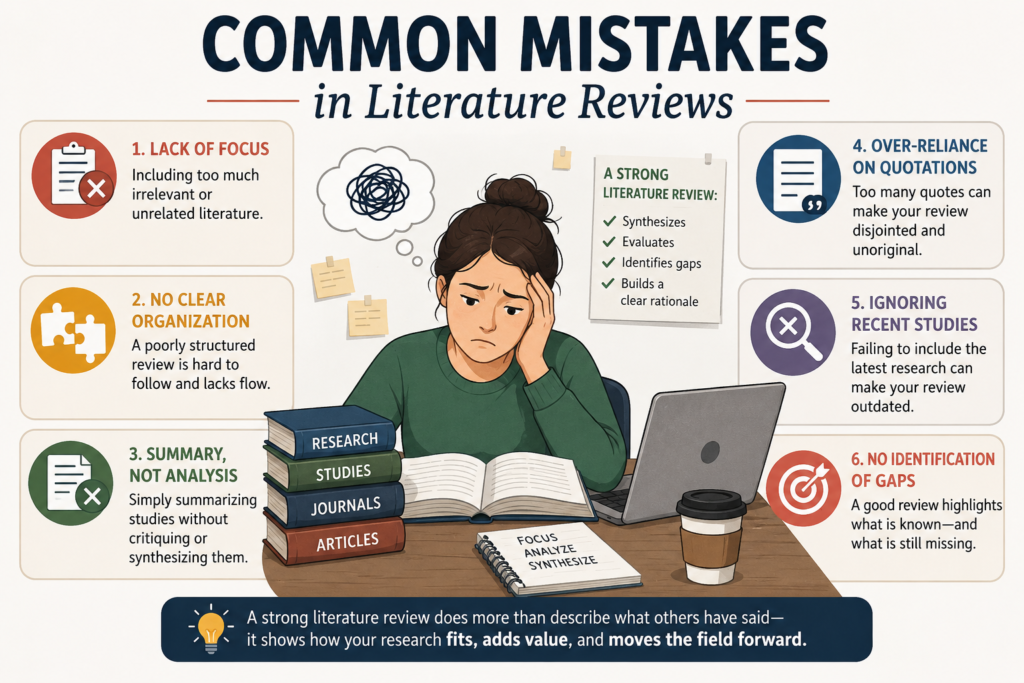
Common Mistakes in Literature Reviews
Introduction
A literature review is a vital part of academic writing, but many students and researchers struggle with it. Mistakes in literature reviews can weaken the credibility of research, mislead readers, and reduce academic impact. Understanding these common errors helps writers avoid pitfalls and produce stronger, more effective reviews.
What is a Literature Review?
- Definition: A structured summary and analysis of existing research.
- Purpose: To provide context, highlight gaps, and justify new studies.
- Importance: Builds credibility and strengthens academic arguments.
Common Mistakes in Literature Reviews
1. Lack of Clear Focus
Choosing a broad or vague topic leads to confusion and weak analysis.
2. Poor Source Selection
Relying on outdated, irrelevant, or non‑academic sources reduces credibility.
3. Over-Summarization
Listing studies without analyzing or synthesizing them fails to add value.
4. Ignoring Contradictions
Not addressing conflicting findings creates bias and incomplete analysis.
5. Weak Organization
Randomly arranged sources confuse readers and weaken arguments.
6. Improper Citations
Incorrect referencing styles or missing citations lead to plagiarism risks.
7. Failure to Identify Gaps
Without highlighting gaps, the review fails to justify new research.
8. Excessive Length or Brevity
Too much detail overwhelms readers, while too little lacks depth.
9. Lack of Critical Thinking
Simply summarizing without evaluating weakens the academic contribution.
Comparison Table
| Mistake | Impact on Review | Solution |
|---|---|---|
| Lack of focus | Confusing scope | Define clear topic |
| Poor sources | Weak credibility | Use peer‑reviewed journals |
| Over‑summarization | No analysis | Synthesize findings |
| Ignoring contradictions | Biased review | Address conflicting studies |
| Weak organization | Reader confusion | Group by theme/method |
| Improper citations | Risk of plagiarism | Follow APA/MLA/Chicago |
| No gap identification | Weak justification | Highlight research gaps |
| Wrong length | Overwhelming or shallow | Balance detail |
| Lack of critical thinking | Weak arguments | Evaluate and compare |
How to Avoid These Mistakes
- Define a clear scope
- Use credible sources
- Organize logically
- Analyze critically
- Cite properly
- Highlight gap

