
Introduction
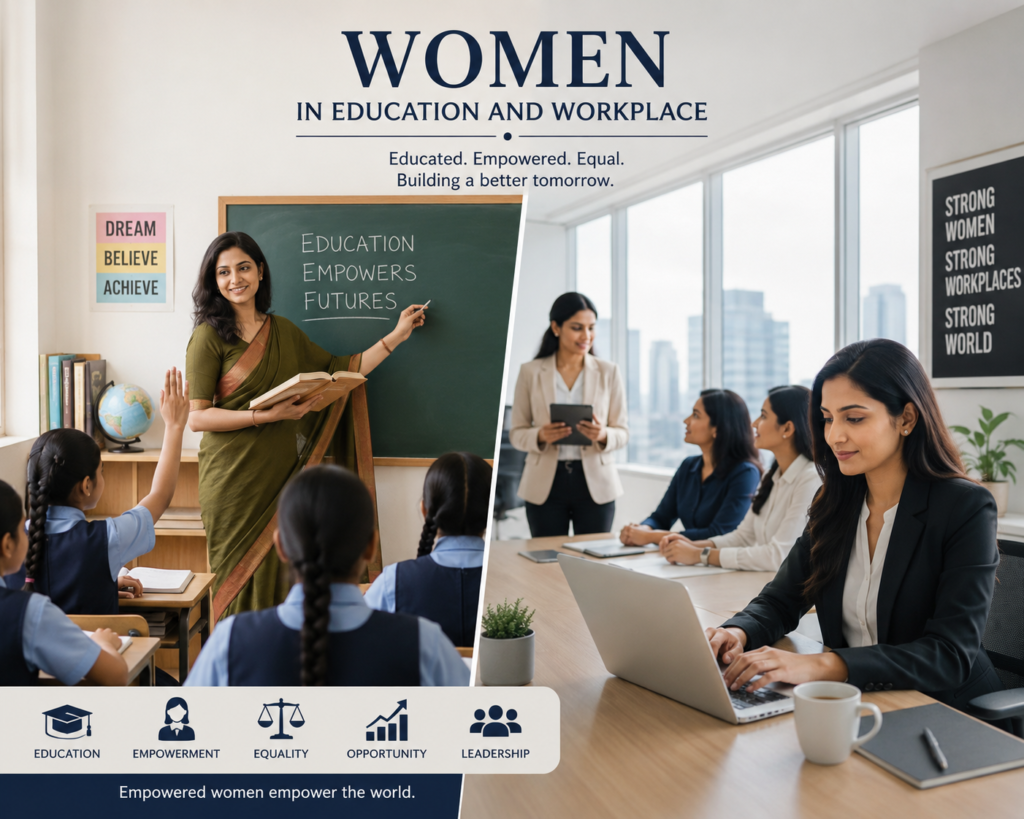
The role of women in education and the workplace has transformed significantly over the past decades. From being restricted to traditional roles, women today are leaders, innovators, and changemakers across industries. Their participation in education and professional spaces is not only vital for gender equality but also for economic and social progress.
Importance of Women in Education
- Access to education empowers women to achieve independence.
- Skill development enhances career opportunities.
- Social empowerment promotes equality and inclusivity.
- Leadership opportunities prepare women for influential roles.
Women in the Workplace
- Corporate leadership: Women CEOs and managers are reshaping industries.
- Entrepreneurship: Female‑led startups are thriving in technology, fashion, and education.
- Healthcare: Women doctors, nurses, and researchers drive innovation.
- Education sector: Teachers and professors inspire future generations.
- STEM fields: Engineers, coders, and scientists lead digital transformation.
Challenges Faced by Women
- Workplace bias
- Work-life balance
- Pay gap
- Limited mentorship
- Cultural barriers
Strategies for Empowering Women
- Skill development programs
- Networking opportunities
- Mentorship initiatives
- Flexible work policies
- Equal pay campaigns
Comparison Table
| Aspect | Current Situation | Future Strategy |
|---|---|---|
| Representation | Growing but uneven | Promote inclusivity |
| Pay gap | Still significant | Equal pay policies |
| Leadership | Limited presence | Encourage women leaders |
| Work-life balance | Challenging | Flexible policies |
| Mentorship | Scarce | Structured programs |
Success Stories
- Indra Nooyi – Former CEO of PepsiCo, global role model.
- Kiran Mazumdar-Shaw – Founder of Biocon, pioneer in biotech.
- Falguni Nayar – Founder of Nykaa, e‑commerce leader.

